 Bellingham Siding
 The Damage You Don't See Is the Damage That Costs the Most
By the time siding looks bad from the curb — cupping, staining, soft spots, paint that won't hold — the real problem has usually been building for years behind it. Siding is the visible layer. Underneath it sits a system of house wrap, flashing, sheathing, and framing that's supposed to manage the water that inevitably gets past the surface. When that system fails quietly, the siding can look fine right up until it doesn't.
In Bellingham and across Whatcom County, that quiet failure has a lot of help. We sit in a marine climate with driving rain off the Strait of Georgia and Bellingham Bay, salt-laden air along the waterfront and Chuckanut corridor, and a moss season that stretches from fall through spring. None of those things cause rot by themselves. What they do is keep wood-based materials wet for longer stretches than almost anywhere else in the country, and time-under-moisture is the single biggest variable in how fast a wall assembly breaks down.
How Water Actually Gets Behind Siding
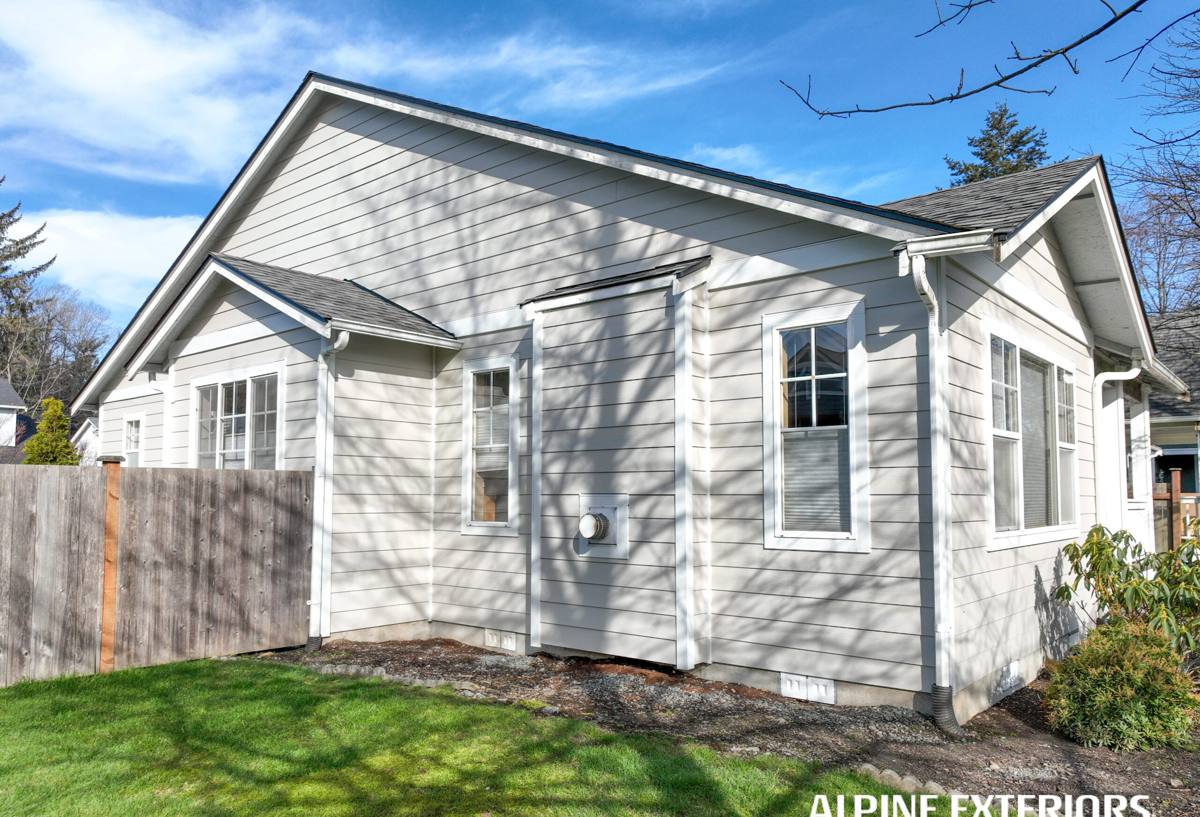
Very little siding is 100% watertight, and it isn't supposed to be. Every manufacturer assumes some moisture will get past the outer layer — through nail holes, seams, butt joints, and places where the siding meets trim, windows, or the roofline. The siding's job is to shed most of the water; the drainage plane behind it (house wrap, flashing, and ideally an air gap) is supposed to handle the rest and let it drain or dry out.
Common entry points we find on Whatcom County homes:
- Butt joints and seams where boards meet, especially on south and west-facing walls that catch the worst driving rain
- Nail penetrations, particularly where the wrong fastener or spacing was used
- Missing or poorly lapped flashing above windows, doors, and horizontal trim
- Caulk that was never a substitute for proper flashing in the first place, now cracked and doing nothing
- Roof-to-wall intersections where step flashing was skipped or installed backward
- Siding installed tight to the wrap with no drainage gap, so water has nowhere to go but sideways into the wall
None of these are exotic problems. They're the same handful of details that get rushed or skipped on almost every job where the crew is moving fast and nobody's checking the work.
What's Actually Happening Behind the Wall
Sheathing Saturation
Most homes in this region are sheathed with OSB or plywood. Both will tolerate occasional wetting if they get a chance to dry out between events. The problem in Bellingham is that between events isn't very long — our wet season runs long and humid, and shaded north walls under evergreens or house eaves may never fully dry between rains. Sheathing that stays damp for weeks at a time starts to lose structural integrity and becomes a food source for wood-decay fungi.
Framing Rot
Once sheathing is compromised, moisture reaches the studs, sill plates, and sometimes the subfloor. This is where a siding problem turns into a structural problem. Rotted framing isn't a cosmetic fix — it means cutting open the wall, removing damaged lumber, and rebuilding before any new siding goes on.
Mold and Air Quality
Wet wall cavities are ideal mold habitat, and that mold doesn't stay contained to the stud bay. Depending on how the wall is built, spores and musty air can migrate into living space through outlets, baseboards, and framing gaps — a problem homeowners often notice as a smell before they ever see a stain.
Insulation Failure
Wet insulation loses most of its R-value and stays wet far longer than the wood around it, which keeps the whole assembly from drying and can accelerate rot even after the original leak source is fixed.
Why Bellingham's Climate Is Specifically Hard on Siding
A few local factors make this county tougher on exterior walls than a drier inland region would be:
- Driving rain: Wind-driven rain off the Strait pushes water horizontally into seams and joints that would stay dry in a calmer climate, which is exactly the kind of exposure that finds weak flashing details.
- Salt air: Homes near Bellingham Bay, Chuckanut Drive, and the county's shoreline neighborhoods deal with airborne salt that accelerates corrosion of fasteners and metal flashing — and corroded flashing stops doing its job long before it looks obviously broken.
- Moss season: Moss and algae thrive in our shaded, damp conditions and hold moisture directly against siding surfaces for months at a time, especially on north-facing walls and under roof overhangs.
- Short drying windows: Overcast, humid stretches mean fewer days where a wet wall assembly gets real airflow and sun to dry out between rain events.
Not All Siding Materials Handle This the Same Way
Some materials are far more forgiving of the occasional moisture that gets behind them. Others depend heavily on perfect installation and ongoing maintenance to avoid problems. Here's how the common options compare on moisture behavior specifically — not price, not looks, just how each one holds up when water reaches it.
| Material | Behavior When Wet | Maintenance Sensitivity |
|---|---|---|
| Cedar / primed spruce | Wood-based; absorbs moisture directly and can cup, split, or rot without diligent repainting and sealing | High — repaint/reseal every few years |
| LP SmartSide (OSB-based) | Engineered wood strand product; performs well when installed and maintained correctly, but any breach in the factory coating or caulking exposes the wood substrate to swelling and edge rot | High — caulked joints and coating integrity must be kept up |
| Vinyl siding | Doesn't absorb water itself, but doesn't stop water either — it relies entirely on what's behind it, and can trap moisture against the wrap in poorly detailed installs | Low material upkeep, but hides problems behind it |
| James Hardie fiber cement | Cement-based composition doesn't swell, rot, or feed fungal growth; still requires correct flashing and installation to manage bulk water, but the material itself isn't the weak link | Low — factory ColorPlus finish, no repainting cycle |
The point isn't that wood-based or engineered-wood products are unusable — plenty perform fine for years when installed to spec and kept up with. It's that they put the burden of long-term moisture resistance on maintenance and installation precision, in a climate that doesn't give you much margin for either to slip.
Warning Signs Worth Walking Your House For
Most hidden rot gets caught by paying attention to a handful of visible clues before they turn into an interior problem. Walk your exterior — especially north walls, areas under gutters, and anywhere trim meets siding — and look for:
- Soft or spongy spots when you press on siding or trim near the bottom of walls
- Paint that's bubbling, peeling, or won't hold no matter how often it's redone
- Dark staining or streaking running down from seams, window heads, or trim joints
- Visible cupping, warping, or separation at board edges and butt joints
- Persistent moss or black algae growth on siding, especially shaded sections
- A musty smell near exterior walls, baseboards, or outlets on the interior side
- Siding that feels noticeably heavier or swollen compared to unaffected sections
Any one of these on its own isn't necessarily an emergency. Several together, or any sign near a known problem spot like a window head or roof-wall intersection, is worth a closer look before the next wet season.
Catching It Early vs. Catching It Late
What a repair costs depends almost entirely on how far the moisture got before anyone addressed it. Roughly, the escalation looks like this:
| Stage Caught | What's Typically Involved |
|---|---|
| Surface signs only (staining, moss, minor paint failure) | Cleaning, spot repair, re-caulking or re-flashing a specific detail |
| Sheathing wet but framing intact | Remove affected siding and sheathing section, dry and inspect framing, replace sheathing and wrap, reinstall siding |
| Framing rot present | Structural carpentry to sister or replace studs/sill plate, full wall assembly rebuild before any new siding |
| Widespread, multi-wall rot | Extensive reframing, possible engineering review, full re-siding of affected elevations |
The jump from the first row to the third row isn't gradual — it can happen over one or two wet seasons once sheathing saturation reaches the framing. That's the real argument for an inspection at the first sign of trouble rather than waiting until siding is visibly failing everywhere.
What Correct Installation Looks Like
Whatever siding material ends up on a home, the details that actually keep water out of the wall are largely the same:
- Properly lapped house wrap installed shingle-style, sealed at every penetration
- Metal or high-quality flashing above every window, door, and horizontal trim piece — never caulk used as a substitute
- Step flashing at every roof-to-wall intersection
- A drainage gap or rainscreen behind the siding so any water that gets in can actually get back out
- Correct fastener type, length, and spacing for the specific siding product
- Manufacturer-specified clearances at grade, decks, and patios so siding isn't sitting in standing water or constant splash-back
This is why we standardized on James Hardie fiber cement for every job we install. It's not that other products can't be made to work — it's that Hardie's HZ5 product line is engineered specifically for climates like ours, the material itself doesn't feed rot or swell when it takes on incidental moisture, and it carries a strong transferable warranty backed by a manufacturer that's staked its reputation on performance in wet regions. Combined with correct flashing and a drainage gap, it gives a wall assembly the best chance of staying dry — and if it doesn't, of not being the thing that fails.
If You're Not Sure What's Behind Your Siding
Most homeowners can't tell from the outside whether they're looking at a cosmetic issue or the early stage of a rot problem — and honestly, neither can we without a closer look. If you're seeing any of the warning signs above, or you just want a straight answer on the condition of your siding before it becomes a bigger job, we're happy to take a look. We offer free, no-pressure estimates for homes throughout Bellingham and Whatcom County, and we'll tell you plainly what we find, whether that's a small repair or a full re-side.