 Bellingham Siding
 Whatcom County homes take a beating that most of the country never has to deal with. Between the Puget Sound salt air, the driving rain that comes sideways off the water in winter storms, and a moss season that can stretch from October clear through May, Bellingham siding works harder than siding almost anywhere else in the state. The problem is that siding failure rarely announces itself. It creeps in behind a fascia board, under a window trim, or at a butt joint nobody's looked at closely in a decade. By the time it's visible from the sidewalk, there's usually been moisture doing damage for a while.
This page walks through what to actually look for, why these signs show up here specifically, and what they mean for the material choice underneath your existing siding — because in this climate, the siding itself matters almost as much as catching problems early.
Why Bellingham Siding Ages Differently Than Siding Inland
Three things stack up against exterior cladding in this part of Washington, and they compound each other rather than acting alone.
Salt Air From the Sound
Homes near Bellingham Bay, Fairhaven, and the waterfront neighborhoods deal with airborne salt that accelerates corrosion on fasteners, flashing, and any exposed metal trim. Salt-laden moisture also tends to sit on surfaces longer than plain rainwater, which matters for materials that absorb water rather than shed it.
Driving, Wind-Driven Rain
Bellingham doesn't just get a lot of rain — a good share of it arrives horizontally during winter systems. That means water gets pushed up under laps, into seams, and behind trim in ways that gentle, straight-down rain never would. Siding systems and installation details that work fine in a drier, calmer climate can fail here simply because the water is hitting the wall at an angle it wasn't designed for.
A Long, Serious Moss Season
Shaded lots, mature tree cover, and persistent damp mean moss and algae get a real foothold on north-facing walls and anywhere airflow is restricted. Moss holds moisture against the surface for months at a time, which is a very different exposure than an occasional wet week.
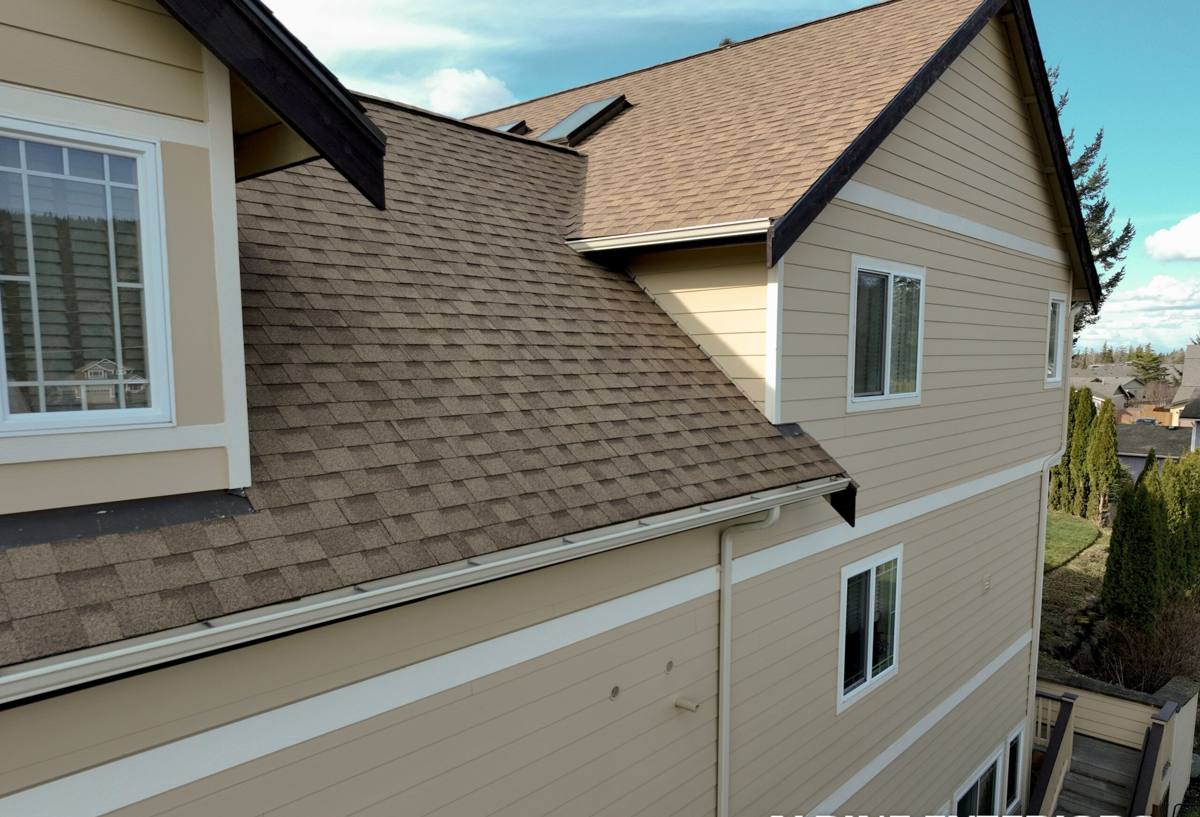
The Early Warning Signs Worth Walking Your House For
Most of these can be checked from the ground with a flashlight and a screwdriver. None require climbing on a roof.
Soft or Spongy Spots
Press gently on siding near the bottom courses, under windows, and around any penetration (hose bibs, dryer vents, light fixtures). If it gives like wet cardboard, moisture has already gotten into the material — this is common on wood-based products and shows up earlier at ground level and roof lines, where splashback and gutter overflow concentrate water.
Bubbling, Peeling, or Chalky Paint
Paint failure on siding is rarely just a cosmetic issue. Bubbling usually means moisture is trying to escape from underneath the paint film. Chalking (a powdery residue that rubs off on your hand) is normal aging on painted surfaces, but bubbling and peeling within a few years of a paint job point to a moisture or adhesion problem worth investigating before repainting again.
Visible Moss or Black Streaking
A little surface algae on a shaded wall is cosmetic. Thick moss growth, especially where it's built up along a lap edge or in a corner, is a sign that the area rarely fully dries out — which is exactly the condition that leads to rot underneath.
Gaps, Warping, or Buckling Panels
Siding that has visibly warped, cupped, or pulled away from the wall has already absorbed and released moisture repeatedly. This cycle — wet, swell, dry, shrink — is what eventually opens gaps at seams and fastener points.
Cracking Along Butt Joints and Corners
Butt joints (where two pieces of siding meet end to end) and outside corners are the highest-stress, highest-exposure points on any wall. Cracking here is often the first visible sign of a product or installation reaching its limit.
Fastener Staining or Popped Nails
Rust streaks running down from a nail head mean either the wrong fastener was used, or moisture is reaching fasteners that should stay dry. Nails that have backed out or popped through the surface usually mean the siding underneath has swelled and shrunk enough to work them loose.
Interior Signs
Don't limit the inspection to the outside. Musty odors in exterior-wall closets, water stains on interior drywall near windows, or unexplained increases in heating bills can all trace back to siding that's no longer keeping water out.
- Press-test siding near the ground, under windows, and around penetrations for softness
- Check painted surfaces for bubbling or peeling versus normal chalking
- Look at north-facing and shaded walls for moss buildup along seams
- Scan for warped, cupped, or buckled panels
- Inspect butt joints and outside corners for cracking
- Look for rust streaking or popped/backed-out fasteners
- Check interior walls near exterior siding issues for stains or odors
- Walk the house after a heavy wind-driven rainstorm, when problems are easiest to spot
Why the Material Underneath Determines How Fast These Signs Show Up
Warning signs aren't just about maintenance neglect — they're often about a mismatch between the siding material and this specific climate. Different materials fail in different ways and on different timelines.
Wood-Based and Engineered Wood Products
Primed spruce and engineered wood siding are wood at their core, which means they're dimensionally reactive to moisture — they swell when wet and shrink when they dry out. In a climate with a genuine multi-month moss season and frequent wind-driven rain, that cycle repeats often enough that edge swelling, delamination at cut ends, and fastener issues tend to show up earlier than in drier regions. These products can perform reasonably well when the caulking, paint, and field-cut edge treatment are kept up on a strict schedule — the trade-off is that the maintenance burden is real and ongoing, not a one-time task.
Vinyl Siding
Vinyl doesn't rot or absorb water the way wood products do, but it has its own weak points here. It's a thin material that can crack in cold snaps, warp under direct sun exposure on south and west walls, and — critically for this region — it doesn't stop wind-driven rain as well as a rigid panel system, since it relies heavily on overlapping laps rather than a sealed, monolithic surface. Moss and algae also show up readily on vinyl's textured surface, and pressure washing to remove it can drive water behind panels if not done carefully.
Fiber Cement (the Category, Broadly)
Fiber cement as a category holds up well against moisture, doesn't feed rot, and resists moss adhesion better than wood-based products because it's not an organic material moss can root into as readily. Within fiber cement, though, there's real variation between manufacturers in formulation consistency, factory-finish quality, and how the product is engineered for a specific climate zone — which is why we standardized on one line rather than treating fiber cement as a single interchangeable commodity.
| Material | How It Fails Here | Typical Early Sign |
|---|---|---|
| Primed spruce / engineered wood | Moisture cycling, edge swelling, seam failure | Soft spots, peeling paint, cupped panels |
| Vinyl | Cold cracking, UV warping, water intrusion at laps | Cracked panels, gapping, moss in textured grain |
| Cedar | Checking, splitting, moisture absorption at end grain | Graying, splitting, soft cut ends |
| Standard fiber cement | Coating wear, edge moisture if unsealed at install | Chalking finish, staining at cut edges |
| James Hardie fiber cement (HZ5 for this region) | Slow, predictable weathering when installed to spec | Minimal — factory finish resists moss and fading |
Why We Install Only James Hardie
We made the decision years ago to install exclusively James Hardie fiber cement siding, and the reasoning comes directly from what we see on homes in this climate. Hardie's HZ5 product line is engineered specifically for regions with heavier moisture exposure like the Pacific Northwest, which matters given the wind-driven rain and prolonged damp that define a Bellingham winter. The material is non-combustible, doesn't feed rot or moss the way organic siding does, and holds its factory-applied ColorPlus finish without the recurring repaint cycle that wood and some other sidings require.
None of this means Hardie is maintenance-free — no exterior product is. But the maintenance is lighter and more predictable, the warranty coverage is stronger and transferable if you sell the home, and the failure modes we see on Hardie installs are almost always tied to installation shortcuts (bad flashing details, wrong fastener spacing, poor caulking at penetrations) rather than the material itself giving out. That's why correct installation — not just the product on the truck — is the other half of getting long-term performance out of any siding in this climate.
What to Do If You Spot Warning Signs
Finding one or two of the signs above doesn't necessarily mean full replacement. Isolated soft spots, a cracked panel, or moss buildup on one wall can often be addressed as a repair. The signs that point toward a bigger conversation are:
- Softness or staining showing up in multiple, unrelated areas of the house
- Siding that's original to a home built before better moisture-management details were standard practice
- Interior moisture signs (odors, stains, mold) tracing back to an exterior wall
- A pattern of recurring paint failure despite regular upkeep
In those cases, an honest assessment of what's underneath the surface siding — sheathing, house wrap, flashing — matters more than the cosmetic condition of the siding itself.
Seasonal Timing for Inspections in Whatcom County
Late fall, right before the heavy winter rains set in, is the best time to catch issues while they're still small. Spring, after moss has had all winter to establish itself, is the best time to assess moss-related buildup and plan any cleaning or repair before summer sun bakes damaged areas further. Waiting until a problem is visible from the street usually means the damage has been progressing, unseen, for at least one full wet season already.
If you're noticing any of these signs on your Bellingham home, or you'd simply like an honest, no-pressure look at where your siding stands, we're glad to come take a look. There's no cost and no obligation — just a straightforward assessment from a crew that works on homes in this exact climate every week.