 Bellingham Siding
 A Neighborhood Shaped by Trees and Water
Sudden Valley sits along the south shore of Lake Whatcom, tucked into a wooded, hilly landscape that gives the community its character — and gives homeowners here a specific set of exterior maintenance headaches. Mature conifers shade large sections of nearly every lot for much of the day. That's part of why people love living there. It's also why siding, roofing, and trim in Sudden Valley tend to show moisture wear years before the same materials would on a more open, sun-exposed lot in town.
We work throughout Bellingham and Whatcom County, and Sudden Valley is one of the areas where we see the clearest pattern: houses in full sun on one side and deep shade on the other, with moss, mildew, and soft trim concentrated almost entirely on the shaded, north- or east-facing walls. Understanding that pattern is the starting point for any siding decision here.
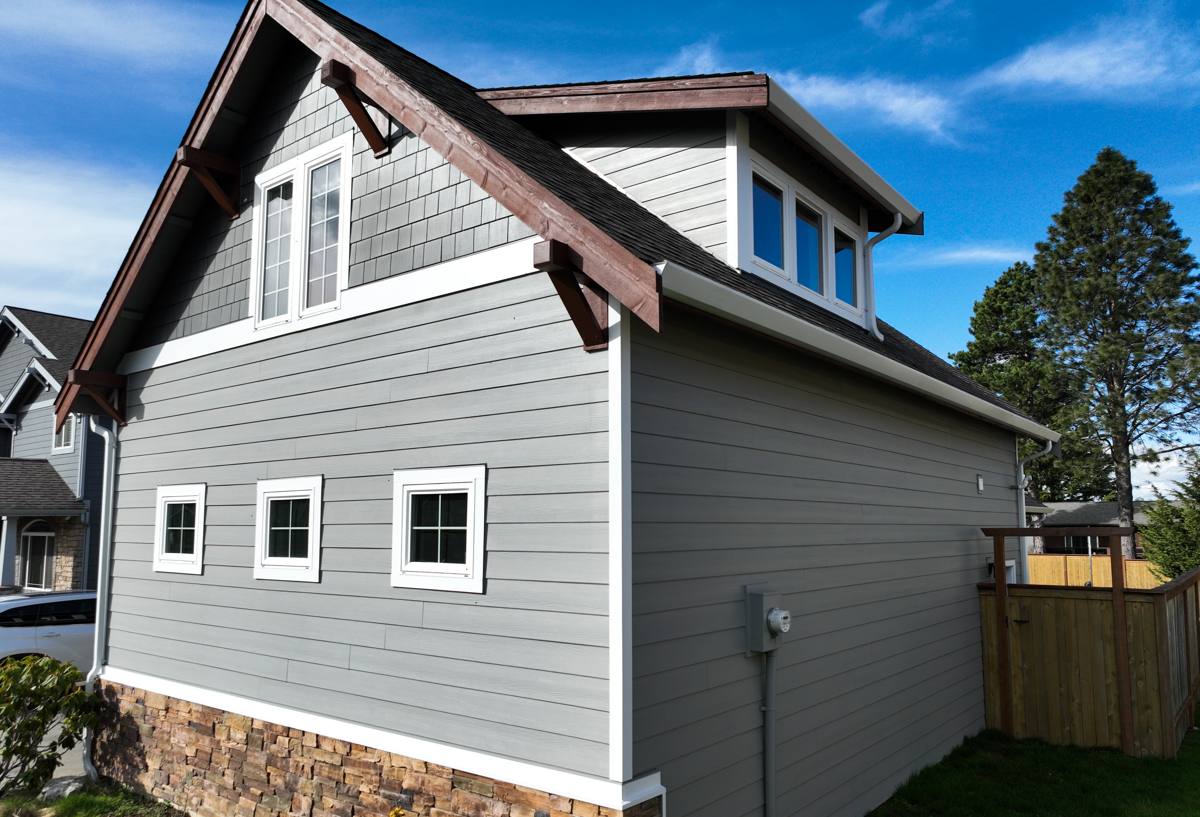
What Bellingham's Climate Actually Does to a House
Whatcom County's marine climate brings a long wet season, driving rain off Puget Sound and Bellingham Bay, and air that carries enough moisture and salt influence to matter for exterior materials even well inland. Add Sudden Valley's tree canopy on top of that regional pattern and you get a few specific effects:
- Shaded walls stay damp far longer after a storm than sun-exposed walls, sometimes by days rather than hours
- Moss and algae get a head start in fall and don't fully die back until late spring — a genuinely long moss season
- Needles, leaf litter, and pollen collect in siding laps, trim ledges, and roof valleys, holding moisture against the material
- Reduced airflow under a dense canopy slows drying even on days without rain
None of this is unique to Sudden Valley — it's the same physics that affects any shaded, tree-heavy lot in a wet climate. But the density of tree cover in this particular neighborhood makes the effect more pronounced than it is on a typical in-town Bellingham lot.
Why This Matters More Than People Expect
Most siding failures we see aren't dramatic. They're slow: a corner board that stays soft to the touch, a paint film that's chalking and peeling on the shaded side only, moss creeping up from the bottom courses where splash-back and shade overlap. By the time it's visible from the driveway, moisture has usually been working on the material underneath for a season or two already.
Why Shade and Moisture Are the Real Enemy of Siding
Wood and Wood-Based Products
Cedar, primed spruce, and engineered wood products all depend on paint film and sealed edges to keep water out. In full sun, that film cures hard and sheds water well. In deep, damp shade, the film stays softer longer, UV curing is slower, and cut edges and butt joints are more likely to wick moisture before they're properly sealed. Over years, that shows up as swelling, delamination at the edges, and soft spots — especially low on the wall and around window trim where water lingers.
Vinyl Siding
Vinyl doesn't rot, but it isn't immune to a shaded, damp environment either. It traps moisture and organic debris behind the panels rather than absorbing it, which means mold and mildew can develop in the gap between the vinyl and the wall assembly without being visible from outside. Vinyl also becomes brittle in cold snaps and can crack under falling branches or storm debris — a real consideration on a heavily treed lot.
Fiber Cement, Installed Correctly
Fiber cement doesn't feed mold the way wood-based products can, and it doesn't rely on a paint film to keep its shape or structural integrity the way vinyl does. That doesn't make it maintenance-free — moss will still grow on any siding surface that stays damp and shaded long enough — but it removes the rot and delamination failure modes that make shaded siding such a long-term liability.
Why We Install Only James Hardie Fiber Cement
We made a decision a while back to stop installing LP SmartSide, vinyl, Cemplank, Allura, primed spruce, and cedar siding — not because those products can't perform anywhere, but because we wanted to stand behind one system we trust in this specific climate, and be honest with homeowners about the trade-offs of the rest. James Hardie is what we put on houses instead, for a few concrete reasons:
- Non-combustible core — fiber cement doesn't contribute fuel to a fire, which matters on wooded lots with limited defensible space
- Engineered for the Pacific Northwest — Hardie's HZ5 product line is formulated for wetter, more variable climates like ours, not a one-size-fits-all national spec
- ColorPlus factory finish — baked-on, UV-cured color that doesn't depend on job-site paint film curing correctly in shade or damp weather
- Dimensionally stable — fiber cement doesn't swell, cup, or telegraph fastener movement the way wood-based sheet products can
- Strong transferable warranty — backed by Hardie directly, which matters if you sell the house before the siding's service life is up
Moss and mildew can still form on the surface of Hardie board in a shaded spot — no siding material is immune to that when it sits under a dense canopy — but it washes off a hard, factory-finished fiber cement surface without damaging the substrate, which isn't something you can say about every product on the market.
What Correct Installation Looks Like on a Shaded, Wooded Lot
Product choice only gets you halfway. On Sudden Valley lots specifically, installation details matter more than average because the siding has less help from sun and airflow to recover from small mistakes:
Drainage and Clearance
Proper installation includes a drainage plane behind the siding, correct flashing at every window and door, and clearance gaps at the bottom of the wall, at roof lines, and at decks and grade. On a shaded wall, any water that gets trapped behind the siding takes longer to dry out, so getting that drainage path right the first time carries more weight than it would on a sun-drenched wall.
Caulking and Joints
Hardie's own installation guidance is specific about which joints get caulked and which get flashed instead of caulked. Over-caulking a shaded wall can trap moisture rather than shed it — a mistake we see on re-sides where a previous installer treated every seam the same way regardless of exposure.
Trim Selection
We pair Hardie board with fiber cement or properly detailed trim rather than wood trim wherever a wall sees regular shade and moisture — mixing a durable field material with a trim material that rots defeats the purpose.
Beyond Siding: Roofing, Windows, and Decks
Siding rarely fails in isolation on a shaded lot — it's usually one piece of a whole exterior that's dealing with the same shade and moisture load. We handle roofing, windows, and decks as well, which matters in a neighborhood like Sudden Valley for a few reasons:
- Roofing — north-facing roof planes under tree cover grow moss fastest and hold granule-damaging moisture longest; roof condition and siding condition usually need to be looked at together
- Windows — failed window seals and worn flashing are a common hidden source of the water damage that shows up as soft siding or trim nearby
- Decks — shaded decks and the ledger boards that attach them to the house are a frequent point where wood rot starts and spreads into adjacent siding
Looking at the whole exterior at once, rather than treating siding as an isolated project, is usually how we catch the real source of a moisture problem instead of just replacing the symptom.
Cost Factors for a Sudden Valley Siding Project
| Factor | Why It Matters Here |
|---|---|
| Wall exposure (sun vs. shade) | Shaded walls may need more attention to drainage detailing and trim material during installation |
| Existing damage extent | Rot or delamination hidden behind old siding adds sheathing repair before new siding goes on |
| Access and lot terrain | Sloped, wooded lots common in Sudden Valley can affect scaffolding and material staging |
| Trim and detail work | Homes with more window trim, corner boards, and architectural detail take more labor per square foot |
| Tear-off vs. overlay | Full tear-off costs more up front but lets us correct drainage and flashing issues an overlay would hide |
Choosing a Local Contractor for a Wooded Lot
A crew that only works flat, sun-exposed subdivisions doesn't necessarily bring the right instincts to a shaded, treed lot near the lake. When you're vetting a contractor for a Sudden Valley home, it's worth asking directly:
- Do they inspect for hidden moisture and rot before quoting, not just after tear-off begins?
- Can they explain their flashing and drainage plane approach in plain language, not just brand names?
- Are they familiar with Hardie's manufacturer installation instructions, not just "fiber cement in general"?
- Will they document sheathing condition with photos if they find damage during tear-off?
- Do they carry proper licensing and insurance for work in Whatcom County?
- Will they give you a written, itemized estimate rather than a single lump number?
A local crew that regularly works in shaded, wooded neighborhoods around Bellingham and Lake Whatcom has usually already seen the failure patterns specific to that environment — which means fewer surprises once the old siding comes off.
If you're noticing moss buildup, soft trim, or peeling paint on a shaded wall of your Sudden Valley home, we're happy to take a look and walk you through what we're seeing — no pressure, no obligation. Reach out below for a free estimate.