 Bellingham Siding
 Siding in Sehome: A Neighborhood With Its Own Climate Demands
Sehome sits close to Bellingham Bay and wraps around Western Washington University, which means the homes here see a mix of conditions that don't always show up the same way across the rest of Whatcom County. Elevation changes through the neighborhood, mature tree cover on many streets, and proximity to the water all combine to put steady moisture pressure on exterior surfaces. Add in the marine air drifting up from the bay and you've got a recipe that wears down the wrong siding material faster than most homeowners expect.
We've worked on homes throughout Bellingham long enough to know that Sehome isn't a one-size-fits-all neighborhood. Older homes near the university core often still have original wood siding or aging vinyl, while newer builds on the neighborhood's edges may have gone with cheaper composite products during a remodel. Whatever the starting point, the climate here doesn't discriminate — salt air, driving rain, and a long moss season all take their toll, and the siding on your house is the first line of defense against all three.
What Sehome Homes Actually Face
Salt Air and Metal Fatigue
Bellingham Bay is close enough that airborne salt reaches homes throughout Sehome, especially on days with wind off the water. Salt air accelerates corrosion on exposed fasteners, flashing, and any metal trim that isn't properly coated or protected. Over years, this can lead to rust streaking, failed fastener heads, and small point failures in siding systems that weren't designed with coastal exposure in mind.
Driving Rain and Wind-Driven Moisture
Whatcom County gets a lot of rain, but it's not always straight-down rain. Storms off the Strait of Georgia and the Sound frequently push moisture sideways into exterior walls, which stresses joints, seams, and butt ends far more than a gentle vertical rain would. Siding that isn't installed with the right gaps, flashing details, and water-management planning will eventually let that wind-driven moisture find its way behind the cladding.
Moss, Algae, and Prolonged Dampness
Sehome's tree canopy and the region's long gray season keep exterior surfaces damp for extended stretches, particularly on north-facing walls and anywhere shaded by mature trees. That prolonged dampness is exactly what moss and algae need to take hold. On porous or fibrous materials, sustained moss growth can trap moisture against the surface and accelerate deterioration; on the wrong siding product, it can also mean repeated pressure washing and treatment just to keep the exterior looking presentable.
Why We Only Install James Hardie Fiber Cement
Bellingham Siding Installer made a deliberate decision years ago to stop installing vinyl, LP SmartSide, and other engineered wood or composite products, and to standardize on James Hardie fiber cement siding exclusively. That's not a marketing angle — it's a response to what we've seen happen to lower-tier siding products in exactly the kind of climate Sehome sits in.
What We Stopped Installing, and Why
- Vinyl siding: lightweight and inexpensive, but it expands and contracts with temperature swings, can warp or crack in wind-driven storms, and doesn't hold up well against sustained UV and moisture cycling over decades.
- LP SmartSide and other engineered wood products: these use wood strand technology with resin treatments, and while the manufacturing has improved over the years, any wood-based product remains vulnerable at cut edges, seams, and fastener penetrations if moisture gets in and isn't caught early.
- Primed spruce and traditional cedar: beautiful materials with real character, but both require an ongoing maintenance commitment — repainting, caulking, and moisture monitoring — that most homeowners underestimate when they choose it.
None of these are "bad" products in every setting. They just carry trade-offs — maintenance burden, moisture sensitivity, installation tolerances — that we're not comfortable asking a Sehome homeowner to manage against this specific climate, year after year.
What James Hardie Gets Right
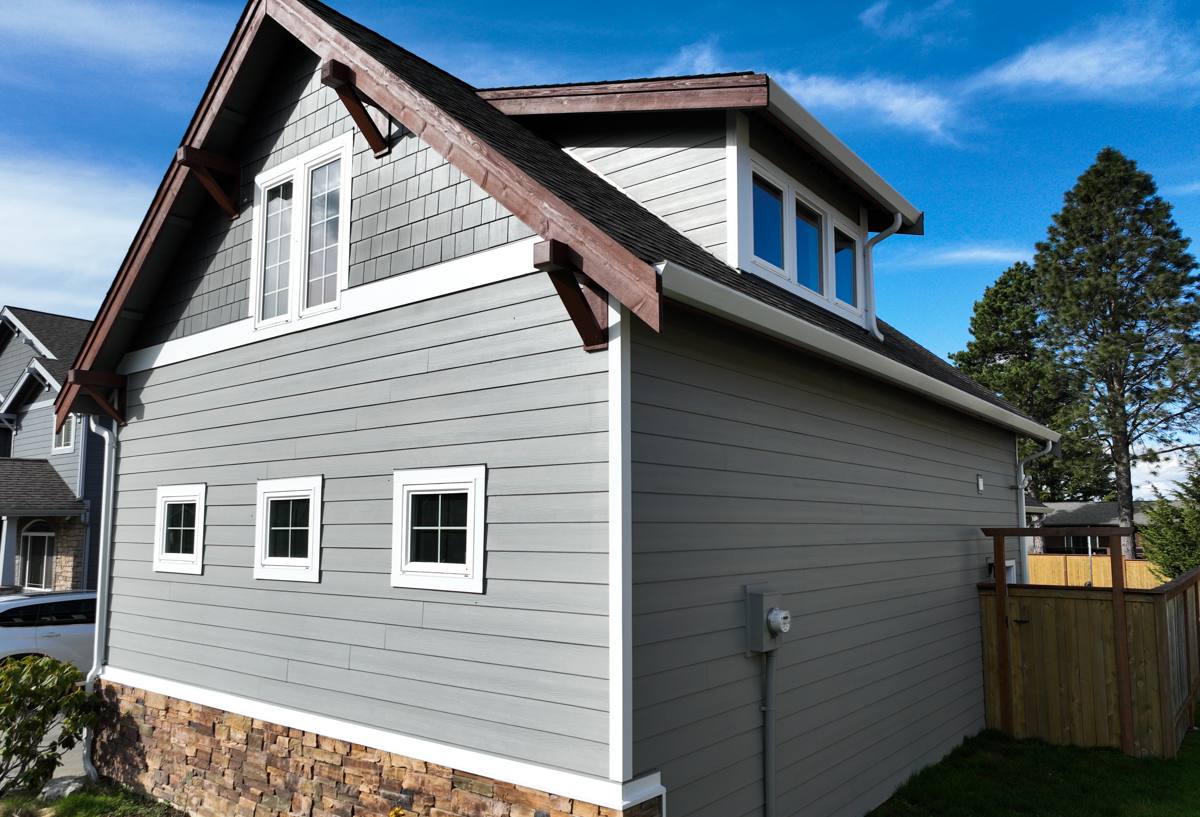
James Hardie fiber cement is non-combustible, dimensionally stable, and manufactured with a factory-applied ColorPlus finish that resists fading and chipping far better than field-applied paint. Hardie's HZ5 product line is engineered specifically for climates with significant moisture exposure, which lines up directly with what Sehome and the rest of Whatcom County deal with. It doesn't warp with humidity swings, it holds paint and color consistently, and it carries a strong transferable warranty when installed to Hardie's specifications — which matters if you ever sell the home.
Beyond Siding: Roofing, Windows, and Decks
Siding rarely fails in isolation. A roof that's shedding water incorrectly, windows with failed flashing, or a deck ledger board trapping moisture against the house can all undermine even the best siding installation. That's why we handle roofing, windows, and decks alongside siding — not because we're trying to upsell every job, but because these systems are physically connected, and treating them as one envelope produces a better long-term result than patching siding in isolation while ignoring a roofing detail that's dumping water straight onto the wall below it.
How the Systems Interact in a Neighborhood Like Sehome
| System | Common Issue Locally | Why It Matters for Siding |
|---|---|---|
| Roofing | Worn flashing, clogged gutters under tree cover | Overflow and backsplash saturate siding at the roofline |
| Windows | Failed caulking or old flashing tape | Water intrusion at openings rots sheathing behind siding |
| Decks | Ledger boards against damp siding | Trapped moisture accelerates rot at the connection point |
What a Siding Project Looks Like for a Sehome Home
Assessment First
We start by walking the exterior with you, looking at drainage patterns, tree shade exposure, existing moisture damage, and how the current siding has held up. Older Sehome homes sometimes have layers of siding history — a original material with a later re-side over the top — and we want to understand what's actually there before pricing anything.
Removal and Sheathing Check
Once old siding comes off, we check the sheathing and house wrap underneath for hidden rot or moisture damage. This step is non-negotiable: installing new siding over compromised sheathing just hides a problem that will resurface, often in a worse spot.
Water Management Details
Given the wind-driven rain this area sees, flashing at windows, doors, and horizontal transitions gets particular attention. This is where a lot of siding failures actually originate — not from the siding material itself, but from shortcuts at these detail points.
Hardie Installation to Spec
James Hardie's warranty depends on installation matching their published specifications — proper fastener spacing, clearance from grade and roof lines, and correct caulking at joints. We install to that standard as a baseline, not an upsell.
Cost Factors for Sehome Siding Projects
| Factor | Why It Affects Cost |
|---|---|
| Home size and wall complexity | More corners, dormers, and transitions mean more labor and trim detail |
| Extent of sheathing repair needed | Hidden moisture damage found during tear-off adds material and labor |
| Existing siding removal difficulty | Layered or multiple past re-sides take longer to strip |
| Access and site conditions | Mature trees, tight lot lines, or sloped yards affect staging and scaffolding |
| Trim and color selection | ColorPlus factory finishes and trim profiles vary in material cost |
We don't quote a number until we've actually looked at your home — anything else is a guess dressed up as a price.
Why a Local Crew Matters Here
A crew that only knows how to install siding in a dry, low-wind climate will make different assumptions than one that works in Whatcom County every week. We know what wind-driven rain does to a poorly flashed window in a Sehome storm, and we know which north-facing walls are going to fight moss no matter what material goes up. That local, repeated experience shapes how we detail every job — it's not something you can get from a crew that's just passing through the area for one project.
Being local also means we're accountable after the job is done. If a question comes up two years down the road, we're still in Bellingham, not a phone number that's disconnected.
A Practical Checklist for Sehome Homeowners
- Check north-facing and tree-shaded walls for moss buildup or discoloration at least once a year.
- Look at caulking around windows and doors for cracking or gaps, especially after a hard winter.
- Watch for paint that's chalking, peeling, or bubbling — a sign moisture may be getting behind the siding.
- Clear gutters before the fall rains hit so overflow doesn't run down and saturate siding at the roofline.
- If you have a deck attached to the house, inspect the ledger board connection for signs of trapped moisture.
- Ask any contractor bidding your siding project which specific product line and installation spec they're using — not just the brand name.
Getting Started
If you're noticing moss buildup, peeling paint, or soft spots on your home's exterior in Sehome, it's worth having someone take a real look before those issues spread further into the wall assembly. We're happy to walk your property, explain what we're seeing, and put together a clear, honest estimate — no pressure, no obligation. Use the form below to request a free estimate and we'll get in touch to schedule a time that works for you.