 Bellingham Siding
 Birchwood's Exterior Climate, Explained
Birchwood sits close enough to Bellingham Bay and the broader Whatcom County shoreline that salt-laden air is a real factor in how exterior materials age here, not just a talking point. Add in the region's long, low-intensity rainy season — months of steady, wind-driven drizzle rather than short violent storms — and you get a climate that's less about extreme events and more about relentless, cumulative exposure. Wood, metal, and even some engineered products break down faster under that kind of sustained moisture and salt than they would in a drier inland climate.
Then there's moss. Whatcom County's combination of shade, moisture, and mild temperatures gives moss and algae a long growing season on north-facing walls, under eaves, and anywhere airflow is limited. It's not just cosmetic — moss holds moisture against a surface for extended periods, and over years that matters for whatever is underneath it, whether that's paint, caulking, or the substrate itself.
What This Looks Like on an Actual House
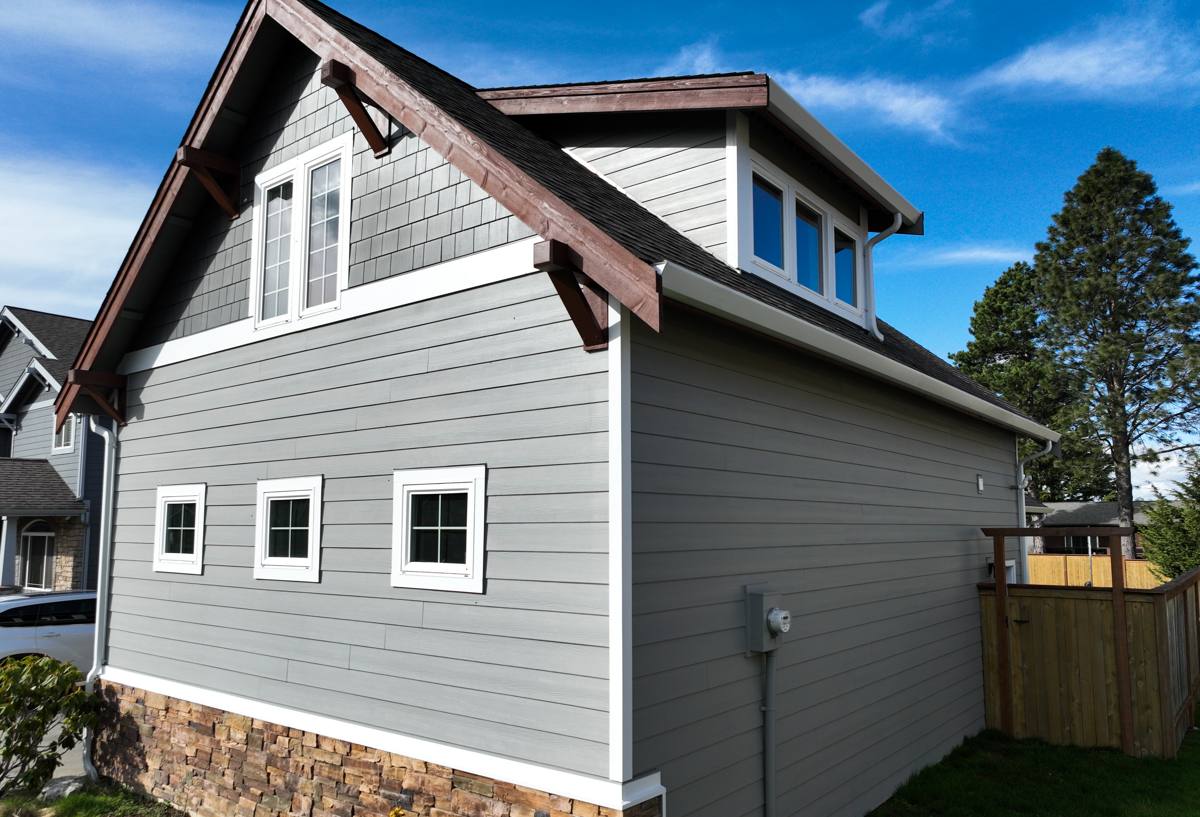
On homes in and around Birchwood, we typically see the same pattern: siding and trim on the north and west exposures wear faster than the south and east sides. Corners, butt joints, and anywhere caulking has failed are where moisture actually gets in. Homes closer to the water tend to show more paint chalking and hardware corrosion. None of this is unusual for the area — it's just what a Pacific Northwest coastal climate does to a house over a couple of decades, and it's the reason material choice and installation quality matter more here than in milder climates.
Why Siding Material Choice Matters More in This Climate
In a dry climate, a mediocre siding installation can survive for decades on luck alone. In Birchwood's climate, mistakes get found out — usually within a few years, not a few decades. That's true of the material itself and of the workmanship behind it.
We install James Hardie fiber cement siding exclusively. We don't install vinyl, LP SmartSide, Cemplank, Allura, primed spruce, or cedar. That's a deliberate standard, not a sales pitch, and it's worth explaining honestly rather than just asserting.
What We're Not Installing, and Why
- Vinyl siding handles rain fine, but it expands and contracts significantly with temperature swings and can warp or crack in windborne debris. It's also not repairable in the way fiber cement is — a damaged panel typically means a full replacement of that section, and matching faded vinyl years later is difficult.
- LP SmartSide and similar engineered wood products perform reasonably when installation is flawless and maintenance is consistent, but they're wood-based, and wood-based products are more sensitive to the kind of sustained moisture exposure Birchwood sees. Edge sealing and caulk maintenance become non-negotiable, not optional.
- Cedar and primed spruce are beautiful and traditional, but real wood siding in a wet coastal climate requires an ongoing maintenance commitment — refinishing, caulking, moisture monitoring — that most homeowners underestimate when they choose it.
- Cemplank and Allura are also fiber cement products and share some of Hardie's core strengths, but we've standardized on one manufacturer so we can guarantee consistent installation specs, warranty terms, and color-match availability across every job we do.
None of these are "bad" products in the abstract. They're products with trade-offs that show up faster in a climate like this one, and we'd rather be upfront about that than install something we know will need premature attention.
Why James Hardie
Fiber cement is dimensionally stable — it doesn't expand and contract the way vinyl or wood does, which matters for caulked joints and paint adhesion over time. It's non-combustible, which is a real consideration given the wildfire smoke seasons the region has seen in recent years. Hardie's ColorPlus factory finish is baked on under controlled conditions, which holds color better than field-applied paint and resists the chalking we see on older painted siding around Birchwood. And Hardie's HZ5 product line is engineered specifically for regions with the freeze-thaw and moisture cycling the Pacific Northwest gets, not a generic national spec.
Installation Details That Actually Matter Here
Fiber cement siding is only as good as the flashing, gapping, and caulking behind it. In a low-moisture climate, a sloppy installation might not show problems for years. In Birchwood, water finds the mistakes fast.
| Detail | Why It Matters in This Climate |
|---|---|
| Proper weather-resistive barrier and rainscreen gap | Lets any moisture that gets behind the siding drain and dry instead of sitting against the wall sheathing |
| Correct nailing pattern and fastener spacing | Manufacturer-spec fastening prevents panel movement that opens gaps for wind-driven rain |
| Flashing at windows, doors, and butt joints | These are the highest-risk points for water intrusion in driving rain |
| Bottom clearance from grade, decks, and roof lines | Keeps siding out of standing water and splash-back zones, which is where premature failure usually starts |
| Quality sealant at joints, matched to Hardie's spec | Cheap or mis-applied caulk is one of the most common causes of early moisture problems we see on re-inspections |
We follow James Hardie's published installation instructions to the letter because doing so is also what keeps the manufacturer's warranty valid — a shortcut that saves an hour on install day can void coverage that's supposed to last decades.
Beyond Siding: The Rest of the Exterior Envelope
Siding doesn't work in isolation. In a climate like Whatcom County's, roofing, windows, and siding all have to function together to keep water out, which is why we handle all three plus decks rather than just one piece of the house.
Roofing
A roof that's shedding water properly protects the siding below it — poor roof drainage or failed flashing at a roofline is a common hidden cause of siding damage that looks, at first glance, like a siding problem. Moss on roofing is also worth addressing proactively in this climate, for the same reasons it matters on walls.
Windows
Window flashing integration is one of the most common failure points on older Bellingham-area homes. When we install or replace siding around existing windows, we check that flashing ties in correctly rather than just cutting siding to fit around whatever is already there.
Decks
Decks attached to the house create a siding intersection that needs careful flashing and clearance, especially where a deck ledger meets the wall. It's a detail that's easy to get wrong and expensive to fix later once rot has set in behind the siding.
Cost Factors for a Birchwood Siding Project
Every home is different, but a few things consistently move the price on siding work in this area:
| Factor | Impact |
|---|---|
| Full tear-off vs. re-side over existing sheathing | Tear-off costs more upfront but lets us verify and repair the wall assembly underneath — important if there's hidden moisture damage |
| Home size and wall complexity | More corners, gables, and trim details mean more labor and material cutting |
| Existing moisture damage found during removal | Rotted sheathing or framing needs repair before new siding goes on — this is common on older coastal-exposed homes |
| Siding profile and trim package chosen | Lap width, trim style, and accent details affect material cost |
| Access and site conditions | Steep lots, mature landscaping, or limited access can add labor time |
Maintaining Hardie Siding in Birchwood's Climate
Fiber cement is low-maintenance compared to wood or vinyl, but "low-maintenance" doesn't mean "no-maintenance," especially with the moss pressure this area sees.
- Rinse siding annually, focusing on north-facing and shaded walls where moss and algae take hold first
- Keep gutters clear so overflow doesn't run down and saturate siding repeatedly in the same spot
- Trim back vegetation and tree limbs that keep siding shaded and damp longer than necessary
- Inspect caulking at joints and trim every couple of years and re-caulk before gaps open up
- Address any moss or algae growth promptly rather than letting it establish and hold moisture
- Watch for paint or finish changes near ground level, downspouts, and deck ledgers — early signs of a moisture issue
Why a Local Crew Matters
A contractor working across Whatcom County day in and day out knows which walls in Birchwood take the worst of the weather, how local building departments handle permitting, and what actually goes wrong on homes in this specific climate versus a generic install manual. That's different from a crew that installs siding as one of several regions across a much larger, drier territory. Local experience shows up in the small decisions — where to add extra flashing, which details to double-check on an older Bellingham-area home, how to sequence work around the wet season — that don't show up in a bid sheet but do show up in how the siding performs ten years later.
Get a Straight Answer for Your Home
Every home in Birchwood carries its own mix of sun exposure, wind direction, and existing wear, so the right approach depends on an actual look at your walls, not a generic estimate. If you're weighing a siding, roofing, window, or deck project, we're happy to come take a look and give you a straightforward, no-pressure estimate — including an honest answer if your existing siding has more life left in it than you think.