 Bellingham Siding
 Exterior Work for a Bayfront Bellingham Neighborhood
Silver Beach sits close enough to Bellingham Bay that the water shapes daily life on the exterior of every home in the neighborhood, whether the owner thinks about it or not. Salt-laden air drifts up from the shoreline, wind off the water pushes rain sideways against north and west walls, and the tree cover common to this part of Whatcom County keeps siding and roofing damp long after a storm has passed. None of that is unusual for Bellingham, but it is more pronounced here than it is a few miles inland, and it changes what "durable siding" actually means for a Silver Beach home.
We work on homes throughout Bellingham and Whatcom County, and Silver Beach is one of the areas where we see, up close, what marine exposure does to exterior materials over ten, twenty, and thirty years. That experience is the reason we install one siding product — James Hardie fiber cement — and it's also why our roofing, window, and deck work is built around the same climate realities rather than a one-size-fits-all approach.
What Salt Air Actually Does to a House
Salt air isn't just a coastal talking point — it's a chemical reality that accelerates the aging of exterior materials in specific, measurable ways:
- Fasteners, flashing, and hardware corrode faster when exposed to airborne salt, especially on the bay-facing sides of a structure.
- Paint and factory finishes break down more quickly under salt exposure combined with UV, leading to earlier chalking, fading, and peeling.
- Wood-based siding products absorb moisture more readily in salt-humid air, which speeds up swelling, softening, and rot at joints and butt seams.
- Metal components on lower-quality trim and flashing systems can pit and streak, staining the siding beneath them.
None of this means a house near the bay is doomed — it means the materials and installation details matter more here than they would on a home fifteen miles inland in the Nooksack Valley. A siding product that performs adequately in a dry, low-wind location can fall well short of expectations a few blocks from Bellingham Bay.
Driving Rain and Wind-Driven Moisture
Bellingham's weather pattern brings a lot of rain, but the rain itself is only part of the story for a neighborhood like Silver Beach. Wind off the open water turns ordinary rainfall into driving rain that hits walls at an angle instead of running straight down, which puts far more stress on seams, laps, and penetrations than vertical rainfall does. Water finds its way behind poorly lapped siding, under-caulked trim, and undersized flashing, and once it's behind the cladding, the framing and sheathing underneath start absorbing moisture that has nowhere to evaporate quickly in our humid climate.
This is why installation detail matters as much as the siding material itself. Correct lap sequencing, properly flashed window and door openings, rainscreen gaps where appropriate, and sealed penetrations for vents and fixtures are what actually keep wind-driven rain out of the wall assembly. We install every project — siding, windows, and roofing alike — with those details treated as non-negotiable, not optional upgrades.
Moss Season and What It Means for Siding and Roofing
Whatcom County's moss season runs long, and shaded, damp-prone areas near mature trees and close-set lots — common in older Silver Beach streets — give moss and algae exactly the conditions they need to take hold on siding, trim, and roofing. Moss retains moisture against the surface it's growing on, which is a problem for any material that isn't fully sealed and non-absorbent. Left unaddressed, moss and algae growth can hold dampness against siding for weeks at a time, feeding the same rot and finish-breakdown issues that salt air and driving rain contribute to independently.
A factory-cured, non-combustible fiber cement surface with a baked-on finish resists moss staining and doesn't provide the organic food source that some wood-based products do, which is one of several reasons it holds up better in this specific microclimate.
Why We Only Install James Hardie Fiber Cement
We don't install vinyl siding, LP SmartSide, cedar, primed spruce, or fiber cement alternatives like Cemplank or Allura. That's a deliberate standard, not a lack of options. Each of those products has legitimate strengths, but each also carries a real-world trade-off — moisture sensitivity, finish maintenance, impact resistance, or long-term warranty structure — that we've decided isn't worth building a Silver Beach installation around, given what this specific climate does to exterior materials over time.
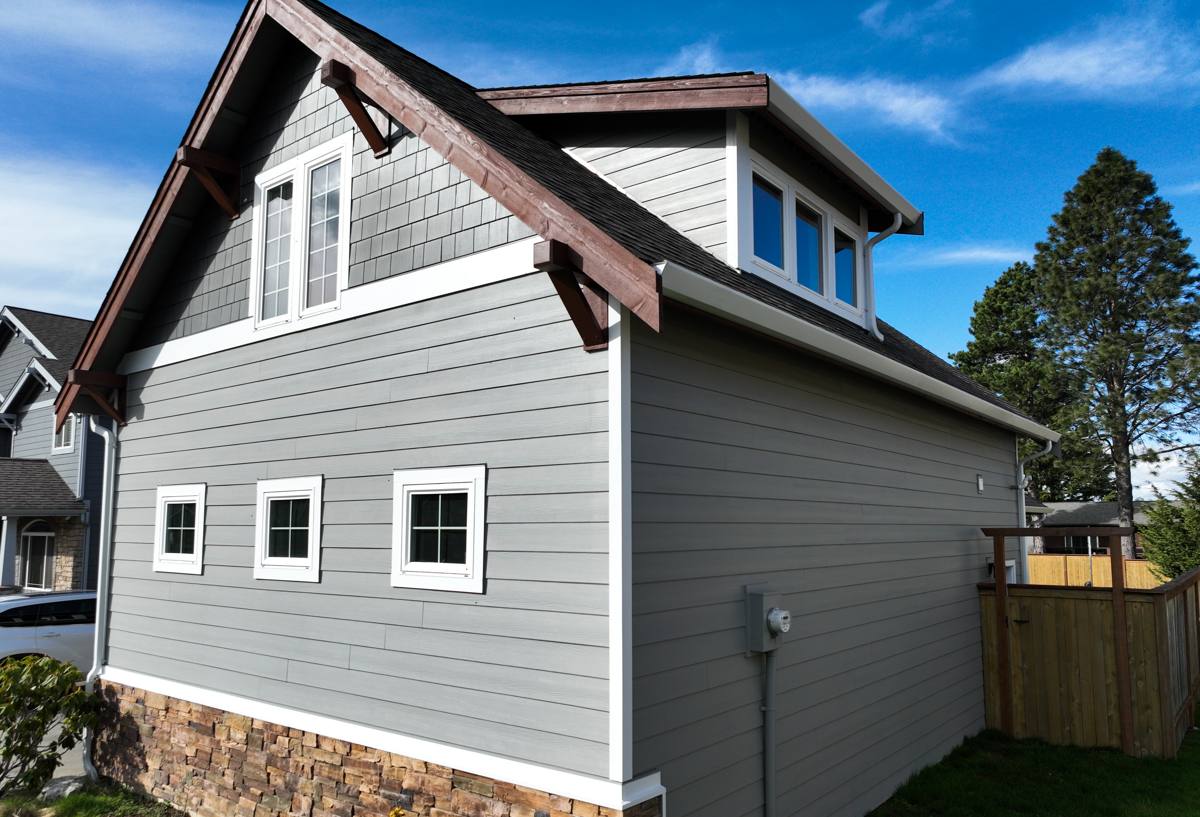
James Hardie fiber cement is non-combustible, engineered specifically for regional moisture and temperature conditions through its HZ5 product line, and finished at the factory with ColorPlus technology rather than field-painted, which removes one of the biggest points of failure in coastal siding: an inconsistent, thin field-applied coat that starts breaking down within a few years near salt air. It also carries a strong transferable warranty, which matters to homeowners who may sell within the life of the siding.
Comparing Siding Materials for a Bayfront Climate
| Material | Moisture Behavior Near the Bay | Finish Durability | Typical Maintenance |
|---|---|---|---|
| Vinyl siding | Doesn't rot, but can warp or crack in wind and temperature swings; seams can allow water intrusion behind panels | Color molded in, but fades and becomes brittle with UV/salt exposure over time | Periodic cleaning; panel replacement if cracked or warped |
| LP SmartSide / engineered wood | Treated to resist moisture, but any breach in the finish exposes wood-based substrate to rot risk in humid, salt-air conditions | Field or factory-primed finish requires repainting on a maintenance cycle | Regular caulk and paint inspection, especially at seams and edges |
| Cedar / primed spruce | Natural wood absorbs moisture readily; performs best with diligent, frequent upkeep | Finish (stain or paint) breaks down faster under UV and salt exposure | Frequent refinishing; highest ongoing maintenance of the group |
| James Hardie fiber cement | Non-combustible, engineered for regional moisture; does not swell, rot, or support pest damage | Factory-applied ColorPlus finish holds color and resists chalking longer than field-applied coatings | Occasional washing; no repainting on a fixed cycle for most homeowners |
How a Siding Replacement Works on a Silver Beach Home
Assessment and Wall Inspection
Every project starts with a look at what's happening behind the existing siding, not just the surface. On homes near the bay, we pay particular attention to the bay-facing and west-facing walls, since those typically take the brunt of wind-driven rain and salt exposure. We check for soft sheathing, failed flashing, and signs of moisture intrusion around windows, doors, and penetrations before any material decisions are finalized.
Moisture Management Details
Depending on the wall assembly and the home's exposure, this can include a properly integrated weather-resistive barrier, correctly lapped and taped seams, rainscreen furring where it makes sense for the wall, and flashing at every window, door, and penetration. These details are what actually determine how the siding performs in driving rain over the next twenty years — the cladding material is only one part of the system.
Installation to Manufacturer Spec
James Hardie siding is engineered to perform when installed to specific fastening, clearance, and caulking standards, and shortcuts at this stage are where most premature siding failures — on any brand — actually originate. We install to those specifications as standard practice, not as an upsell.
Final Trim, Caulking, and Cleanup
Trim, corner details, and caulking are finished with the same coastal-exposure standard in mind, and the site is cleaned up before we consider the job done.
Roofing, Windows, and Decks in the Same Climate
Siding is rarely the only exterior system under stress in a neighborhood like Silver Beach. Roofing takes the most direct hit from driving rain and moss, and a roof with failing flashing or moss-compromised shingles will eventually send moisture problems down into the wall assembly below it. Windows near the bay deal with the same wind-driven rain that pressures siding seams, and older single-pane or poorly flashed units are a common source of hidden water intrusion around the frame. Decks facing the water take on both UV and moisture exposure at once, which shortens the life of untreated or poorly fastened decking and framing.
Because we handle siding, roofing, windows, and decks as one contractor, we look at a Silver Beach home's exterior as a connected system rather than four separate projects. A siding replacement is a natural point to flag a roofing or window issue that's actually driving moisture problems, rather than treating the symptoms one at a time over several years.
What to Look for in a Contractor for This Neighborhood
Coastal and near-coastal exposure punishes shortcuts faster than an inland job does, which makes contractor selection more consequential in Silver Beach than it might be elsewhere in Whatcom County.
- Ask whether the crew is factory-certified for the specific siding product they're installing, not just generally experienced with siding.
- Ask how they handle flashing and weather barrier detailing at windows, doors, and penetrations — this is where most water intrusion problems actually start.
- Ask about their experience with wind-exposed or bay-facing homes specifically, since the failure points differ from a sheltered inland lot.
- Confirm licensing, bonding, and insurance, and ask for a written scope that specifies materials, fastening method, and warranty terms.
- Ask what the manufacturer's warranty actually requires for the installation to remain valid — this varies by product and matters more than most homeowners realize.
Maintaining Exterior Materials Near the Bay
Whatever siding, roofing, or windows a Silver Beach home ends up with, a little seasonal attention goes a long way in this climate:
- Rinse siding periodically to remove salt residue and organic buildup, especially on bay-facing walls.
- Keep gutters and downspouts clear so wind-driven rain has a clear path away from the wall assembly.
- Trim back vegetation and tree cover that keeps siding and roofing shaded and damp for extended periods, which encourages moss.
- Have caulking and flashing at windows, doors, and trim checked periodically, since these are the first points of failure for wind-driven moisture.
- Address roof moss early, since it holds moisture against the roofing material and can migrate to fascia and siding over time.
Ready to Talk About Your Home
If you're weighing a siding, roofing, window, or deck project on a Silver Beach home, we're happy to take a look and talk through what your specific exposure — bay-facing wall, tree cover, sun and wind pattern — actually calls for. There's a free, no-pressure estimate form below whenever you're ready to start that conversation.