 Bellingham Siding
 Roof Repair in Puget: Built for What This Location Actually Faces
Homes in the Puget area near Bellingham sit close enough to the water that the roof takes on a different kind of wear than a roof further inland. Salt-laden air moves off the Sound and settles on metal flashing, fasteners, and vent components. Rain doesn't just fall — wind pushes it sideways under shingle edges and into valleys that a dry-climate roof was never detailed to handle. And because Whatcom County stays mild and damp for most of the year, moss and algae get a growing season that stretches far longer than it would in a drier part of the state. None of that is unusual for this part of Washington, but it does mean a roof here needs specific attention at specific points, and a repair that ignores those points tends to fail again within a season or two.
We work roofs, siding, windows, and decks across Whatcom County, and roof repair calls in Puget are a regular part of that work. The goal on every one of them is the same: figure out what's actually causing the problem — not just patch the symptom — and fix it in a way that holds up through the next several wet seasons, not just the next dry week.
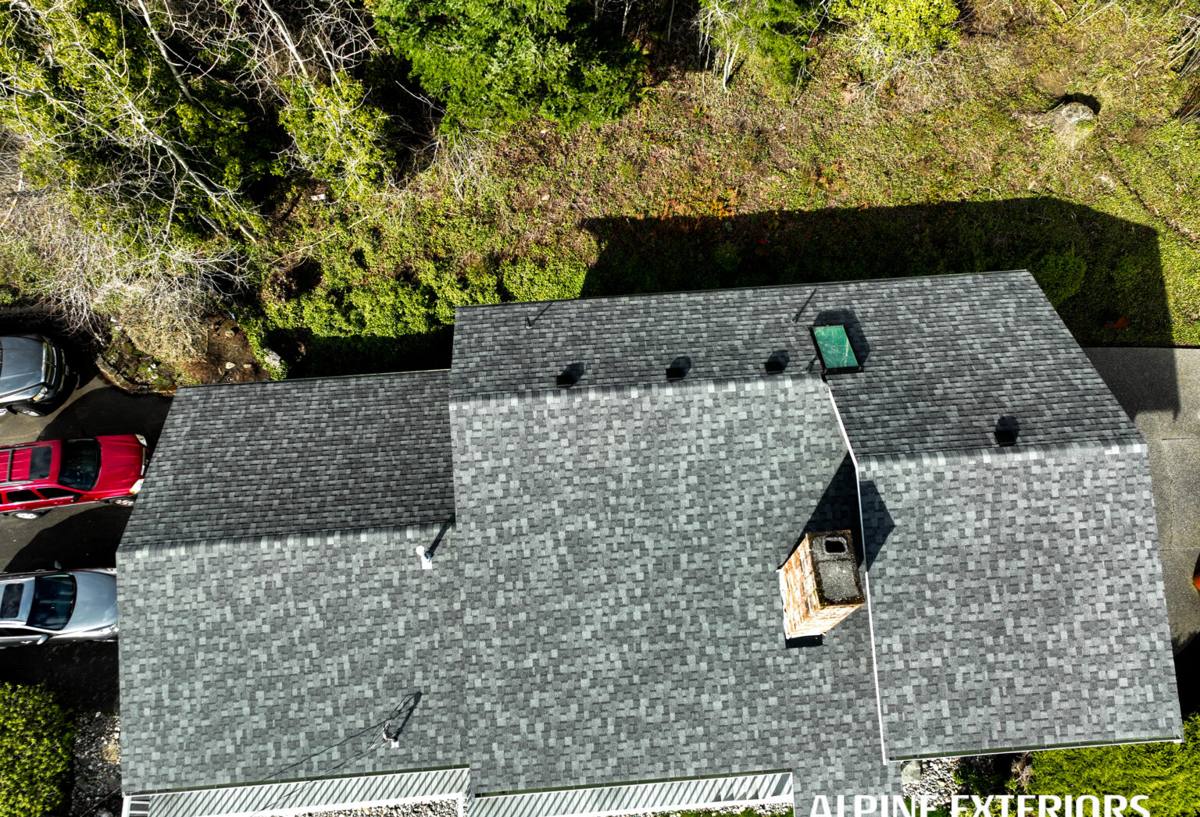
What Salt Air, Rain, and Moss Actually Do to a Puget Roof
Corrosion Near the Water
Metal components — flashing, drip edge, roofing nails, vent boots with metal collars — corrode faster in a salt-air environment than they do even a few miles inland. Corroded flashing loses its seal at valleys, chimneys, and roof-to-wall transitions long before the shingles around it show any wear, which is why a leak in a Puget-area home often traces back to a flashing detail rather than the roofing material itself.
Wind-Driven Rain
Proximity to open water means more exposure to wind, and wind-driven rain behaves differently than rain that falls straight down. It gets pushed under shingle tabs, around pipe boots, and into any gap in a valley or transition that wasn't sealed with that kind of exposure in mind. A roof that would perform fine in a sheltered inland yard can leak here if the underlayment and flashing weren't specified for wind-driven moisture.
Moss and Algae
Shaded slopes, north-facing sections, and roofs near mature trees hold moisture longer, and Whatcom County's mild temperatures mean moss keeps growing through most of the year instead of dying back in a hard freeze. Moss holds water against the roofing surface, works its way under shingle edges as it spreads, and can lift or loosen roofing material over time if it isn't kept in check.
How We Diagnose a Puget Roof Problem
A roof repair estimate starts with a real inspection, not a guess from the ground. That means getting on the roof (weather permitting) or using a close visual and, where needed, interior attic inspection to trace a leak back to its actual source. Water that shows up on a ceiling doesn't always originate directly above the stain — it can travel along a rafter or sheathing seam from a flashing failure several feet away. We look at:
- Flashing condition at every valley, chimney, skylight, and roof-to-wall transition
- Shingle condition — curling, cupping, granule loss, cracked or missing tabs
- Pipe boot and vent seal condition, since rubber boots degrade faster near the water and in constant damp
- Moss and algae coverage, and whether it's actively lifting roofing material
- Underlayment condition where accessible, and signs of moisture reaching the roof deck
- Attic ventilation and any signs of trapped moisture or deck staining from inside
- Gutter and downspout function, since backed-up water at the eaves causes damage that looks like a roofing problem but starts as a drainage problem
We'll walk you through exactly what we find, in plain terms, before recommending a scope of work. If it's a straightforward repair, we'll say so. If we find something bigger, we'll explain why and what the options actually are.
What a Correct Repair Involves
A roof repair that holds up in a salt-air, high-moisture climate isn't just about swapping a few shingles. The details underneath matter more than the shingles themselves:
- Removing and replacing damaged shingles or roofing material back to sound decking, not just patching over the visible damage
- Re-flashing valleys, chimneys, and wall transitions with corrosion-resistant materials rather than reusing pitted or thinning flashing
- Properly lapping new flashing and underlayment so water sheds outward at every layer, not just at the surface
- Replacing degraded pipe boots and vent seals rather than caulking over a cracked one
- Checking and correcting attic ventilation if trapped moisture is contributing to deck or shingle deterioration
- Matching shingle color and profile as closely as possible when only a section is being replaced
Skipping any of these to save time on a repair usually means the same leak, or one nearby, resurfaces within a year or two. We build repairs to the same standard we'd want on a roof we were replacing outright.
Repair vs. Replacement: An Honest Read
Not every roof problem in Puget calls for a full replacement, and we don't default to recommending one. The decision comes down to a few practical factors:
| Situation | Usually Points To |
|---|---|
| Single leak, isolated flashing failure, roof otherwise sound | Targeted repair |
| Roof under 15 years old with scattered wind or storm damage | Repair, sometimes a partial re-roof of the affected slope |
| Widespread moss damage across multiple slopes with lifted shingles | Depends on deck condition — often still a repair if caught early, replacement if delayed |
| Multiple past repairs, roof nearing or past its rated lifespan | Replacement usually more cost-effective long-term |
| Soft or spongy decking found during inspection | Replacement of the affected section at minimum |
We'll give you the real trade-offs — including when a repair is genuinely the smarter financial move — rather than steering toward whichever option is more profitable for us.
Signs a Puget-Area Roof Needs a Repair Call
- Water staining on interior ceilings or walls, especially near exterior walls or chimneys
- Moss buildup that keeps returning quickly after cleaning
- Granules collecting heavily in gutters or at the base of downspouts
- Curling, cupping, or missing shingles, particularly after a windstorm off the water
- Rust streaking below flashing or vent boots
- Daylight visible through the roof deck from inside the attic
- Soft spots underfoot when a roof is walked, or visible sagging along the roofline
Any one of these is worth a call before the next round of heavy weather. Most are a straightforward repair when addressed early; left through another wet season, several of them turn into a much bigger job.
What Roof Repair Typically Costs, and What Drives the Range
Repair costs vary a lot depending on scope, and we're not going to quote a number without seeing the roof — but the factors that move the price are consistent:
| Factor | How It Affects Cost |
|---|---|
| Size and location of the damaged area | Small, accessible sections cost less than large or multi-slope repairs |
| Roof pitch and access | Steep or hard-to-access roofs take longer and require more safety setup |
| Extent of flashing replacement needed | Full re-flashing of a valley or chimney adds labor and material cost beyond a simple shingle swap |
| Underlying deck condition | Rotted or soft decking found during the repair adds material and labor to replace it before reroofing that section |
| Shingle availability and matching | Older or discontinued shingle profiles can be harder to match, sometimes affecting material sourcing time |
A minor, isolated repair is often a modest cost measured in a few hundred dollars; a repair involving significant re-flashing, deck replacement, or a large damaged area climbs from there. We'll break down the actual scope and cost during the estimate so there's no surprise once work starts.
Why a Crew That Already Works Puget Matters
A contractor who works roofs across this specific stretch of Whatcom County, close to the water, sees how salt air, wind-driven rain, and moss actually behave on real houses over years — not just how a product performs on a spec sheet. That translates into practical decisions on a repair: knowing which flashing metals hold up against salt exposure here, how much attention a shaded north slope needs compared to one that gets full sun, and which corners simply can't be cut without the repair failing again within a couple of winters. It also means showing up with the right materials the first time, instead of a second trip once the wrong fix reveals itself.
Beyond the Roof: Siding, Windows, and Decks
Roof repair is a big part of what we do in Puget, but the same salt air and moisture that stresses a roof stresses the rest of a home's exterior too. We also handle siding repair and replacement, window installation, and deck work, and we install James Hardie fiber cement siding as our standard, chosen for how it holds up against sustained moisture compared to lower-cost alternatives. If a roof repair turns up moisture damage at a wall-to-roof transition, or aging trim and siding nearby, we can address it as part of the same visit instead of sending you to track down a second contractor.
Get a Free, No-Pressure Estimate
If your Puget-area roof has a leak, storm damage, or moss buildup you'd like a second opinion on, we're glad to take a look and give you a straightforward, honest read on what it actually needs. Reach out using the form below to schedule a free estimate — no pressure, no upsell script.