 Bellingham Siding
 Building a Deck That Actually Holds Up in Sunnyland
Sunnyland is one of Bellingham's older, more established neighborhoods, with mature tree canopy, a mix of home ages, and lots that run from flat to noticeably sloped. That combination is great for shade in August and terrible for a deck that isn't built with the right details. Between Whatcom County's long wet season, the driving rain that comes off Bellingham Bay and the Salish Sea during fall and winter storms, and the moss that finds a home on anything that stays damp for more than a few days, a deck here needs to be built differently than one going up in a dry climate. We're not talking about anything exotic — just the right materials, the right flashing, and fastener choices that won't let salt-laden air eat through hardware in a few years.
This page walks through what actually matters for a custom deck built for a Sunnyland home: what the climate does to decks over time, how we frame and flash them to keep water out of the house, which decking materials make sense for this area, and what our process looks like from first conversation to final walkthrough.
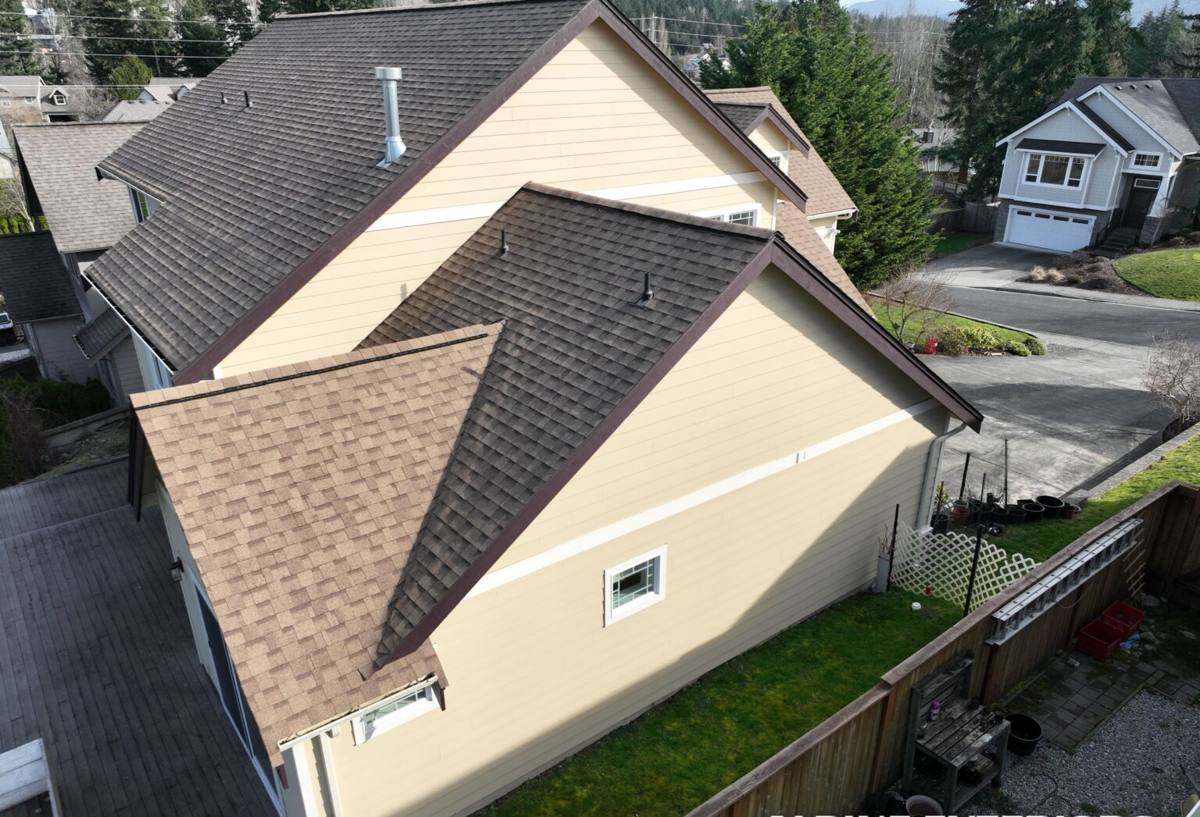
What Bellingham's Climate Does to a Deck Over Time
None of this is dramatic on its own — it's the accumulation that causes problems. A deck built without these details in mind doesn't fail in year one. It fails quietly, over five to ten years, in ways that are expensive to fix because they're hidden.
Driving rain and the ledger board
The single most important connection on almost every deck is the ledger board — the framing member bolted to the house that carries a large share of the deck's structural load. In a climate with frequent wind-driven rain, this is also the most common place for water to find its way behind siding and into the rim joist. Without proper flashing at this joint, moisture gets trapped between the ledger and the house, and rot sets in where you can't see it until the deck starts to feel spongy or pull away from the structure.
Moss, algae, and slip risk
Whatcom County's moss season runs long — realistically, several months of the year where shaded, north-facing, or tree-covered surfaces stay damp enough for moss and algae to take hold. On a deck, that's not just a cosmetic issue. Moss and algae film make wood and even some composite surfaces genuinely slippery, and it's worse in a neighborhood like Sunnyland where established trees keep parts of a yard shaded and slow to dry out.
Salt air and hardware corrosion
Bellingham's proximity to Bellingham Bay and the Salish Sea means the air here carries more salt than an inland location would. Salt accelerates corrosion in fasteners, brackets, and structural hardware — the kind of galvanic and rust damage that shows up as rust streaks on decking, loose railing brackets, or fastener heads that snap off when you try to remove them years later. Standard interior-grade hardware simply isn't built for this environment.
Decking Material Options for Sunnyland Homes
There's no single "best" decking material — the right choice depends on budget, how much upkeep you want to do, and how shaded your lot is. Here's how the common options actually compare once you factor in this climate.
| Material | Moisture & Moss Behavior | Maintenance | Typical Lifespan Here |
|---|---|---|---|
| Pressure-treated fir/pine | Absorbs water, prone to moss in shaded areas, can cup or check as it dries out between rains | Needs re-sealing every 1-2 years to perform well | 10-15 years with upkeep |
| Cedar | Naturally rot-resistant but still needs sealing; moss still grows on the surface in shade | Sealing/staining every 2-3 years | 15-20 years with upkeep |
| Composite decking | Doesn't rot or absorb water like wood, but algae and mildew can still form a film on the surface in shaded, damp spots | Periodic washing; no staining or sealing required | 25+ years, varies by product warranty |
| PVC decking | Fully moisture-resistant core; least susceptible to moss taking hold | Occasional washing | 25+ years, varies by product warranty |
Composite lines from manufacturers like Trex or TimberTech are popular choices for exactly this reason — homeowners here are often more interested in not having to re-stain a deck every other year than in shaving costs on material. That said, real wood still has a place, especially for homeowners who want a specific look or a lower upfront cost and are willing to keep up with sealing on a schedule.
What we won't do, and why
We don't install decking or hardware that's undersized or under-rated for outdoor, high-moisture use just to hit a lower price point. That includes skipping flashing at the ledger to save labor time, using interior-rated fasteners, or spacing joists wider than the decking manufacturer specifies. These shortcuts don't show up in year one — they show up as callbacks and structural repairs down the road, and they're the kind of thing that's far cheaper to do right the first time than to fix later.
Framing and Structure: Where Most Deck Problems Start
The decking boards are what you see and walk on, but the framing underneath is what determines whether the deck is safe and long-lasting. This is where experience with local conditions matters most.
- Ledger flashing: Self-adhering flashing membrane and proper step flashing at the house connection, integrated with the siding — not just caulked and hoped for.
- Footings: Sized and set to the depth required by local code, which accounts for frost depth and soil bearing in this area. On sloped Sunnyland lots, footing placement often needs to be adjusted for grade changes across the yard.
- Joist spacing and material: Matched to the decking product's span rating — composite and PVC boards often require tighter joist spacing than solid wood.
- Fasteners and connectors: Stainless steel or hot-dip galvanized hardware throughout, not just at visible connections.
- Drainage under the deck: Grading and, where needed, a drainage system underneath so water doesn't pool against footings or posts.
On a shaded, tree-lined lot, we also pay attention to airflow underneath and around the deck. A deck built tight against grade with no ventilation underneath will stay damp longer after every rain, which is exactly what moss and mildew need to establish themselves.
Railings, Stairs, and Hardware Built for This Climate
Railings and stairs take a lot of abuse — they're touched constantly, they're the first thing to show corrosion, and they're a safety item, not just an aesthetic one. We spec stainless steel or properly coated hardware for railing posts, baluster connectors, and stair stringers specifically because standard zinc-plated hardware corrodes faster in this air. For lots with more shade, we also think about railing and baluster style — solid panel railings can trap moisture and debris against a deck's edge, where open baluster designs let air and water move through instead of pooling.
Our Custom Deck Process
Every deck we build starts with a conversation about how you actually plan to use the space, then moves through design, permitting, and construction in a sequence that avoids surprises.
- On-site consultation: We look at your lot's grade, sun exposure, tree cover, and how the deck will attach to the house before recommending anything.
- Design and material selection: We go over decking material, railing style, and layout options, with honest trade-offs on cost and maintenance for each.
- Permitting: We handle the permit application and drawings required by the local jurisdiction.
- Framing and structural work: Footings, posts, beams, and joists are built to span and load requirements, with flashing installed at every point water can reach the house.
- Decking, railing, and stairs: Installed per manufacturer spacing and fastening specs, not generic guesswork.
- Final walkthrough: We go over the finished deck with you, including basic care and what to watch for over the first year.
Permits and Code Basics for Bellingham-Area Decks
Most decks attached to a house, and many freestanding decks above a certain height, require a building permit in Bellingham and unincorporated Whatcom County. The permit process reviews footing depth and structural design against local soil and frost conditions, which is exactly why footing depth on a Sunnyland lot needs to be confirmed against current code rather than copied from a neighbor's project or an online guide. Guardrails are generally required once a deck surface is more than 30 inches above grade, with a minimum guardrail height and maximum baluster spacing set by the adopted building code — we confirm the current requirements for your specific project rather than relying on rules of thumb, since code details can change and vary by exact deck height and configuration.
Skipping the permit step might feel like it saves time, but it can create real problems at resale, with insurance, or if there's ever a structural question down the line. We pull permits as a standard part of the process, not an upsell.
Keeping Moss and Mildew Off Your New Deck
Even the best-built deck needs some seasonal attention in this climate. None of it is complicated, but skipping it is how moss gets a foothold.
- Sweep leaves and debris off the deck surface regularly in fall, especially under tree cover — trapped organic matter holds moisture and feeds moss growth.
- Rinse or wash the deck surface a couple of times a year, more often in shaded areas, to remove the algae film before it becomes visible moss.
- Keep gutters and downspouts near the deck clear so runoff isn't dumping extra water directly onto or under the deck.
- Check railing and structural hardware annually for early rust or looseness — catching corrosion early is a five-minute fix instead of a hardware replacement.
- For wood decking, stay on your sealing/staining schedule — a lapsed seal coat is when moisture starts getting into the wood fibers.
- Trim back overhanging branches where practical to improve sun exposure and airflow across the deck surface.
Why Hire a Crew That Already Works in Sunnyland
A deck built to a generic national spec sheet isn't necessarily built for this specific neighborhood's conditions. We already know which parts of Sunnyland tend to hold shade longest through the day, how sloped lots in the area typically need footing adjustments, and which flashing and hardware choices actually hold up against the region's rain and salt air rather than just meeting minimum code. That local familiarity shows up in fewer surprises during construction and a deck that's still solid a decade later, not just at the final walkthrough.
If you're planning a new deck or replacing one that's showing its age, we'd be glad to take a look at your property and talk through options. Reach out for a free, no-pressure estimate — use the form below to get started.