 Bellingham Siding
 Decking Built for Birch Bay's Coastline, Not Just Any Backyard
Birch Bay sits right on the water, and that changes what a deck has to deal with day in and day out. Salt-laden air off the bay accelerates corrosion on fasteners and hardware. Driving rain off Georgia Strait finds its way into every joint and seam that isn't detailed correctly. And the long, damp moss season that defines this part of Whatcom County means anything horizontal — decking boards, rail caps, stair treads — is going to collect organic growth if it can't shed water and dry out between storms. A deck built to a generic spec sheet doesn't hold up here the way one built for these specific conditions does.
We install composite decking throughout Bellingham and the surrounding communities, and Birch Bay jobs get their own set of considerations from the framing up. This page covers what that actually looks like: the material choices, the build details, and the reasons a crew that already works this shoreline gets a better result than a one-size-fits-all installation.
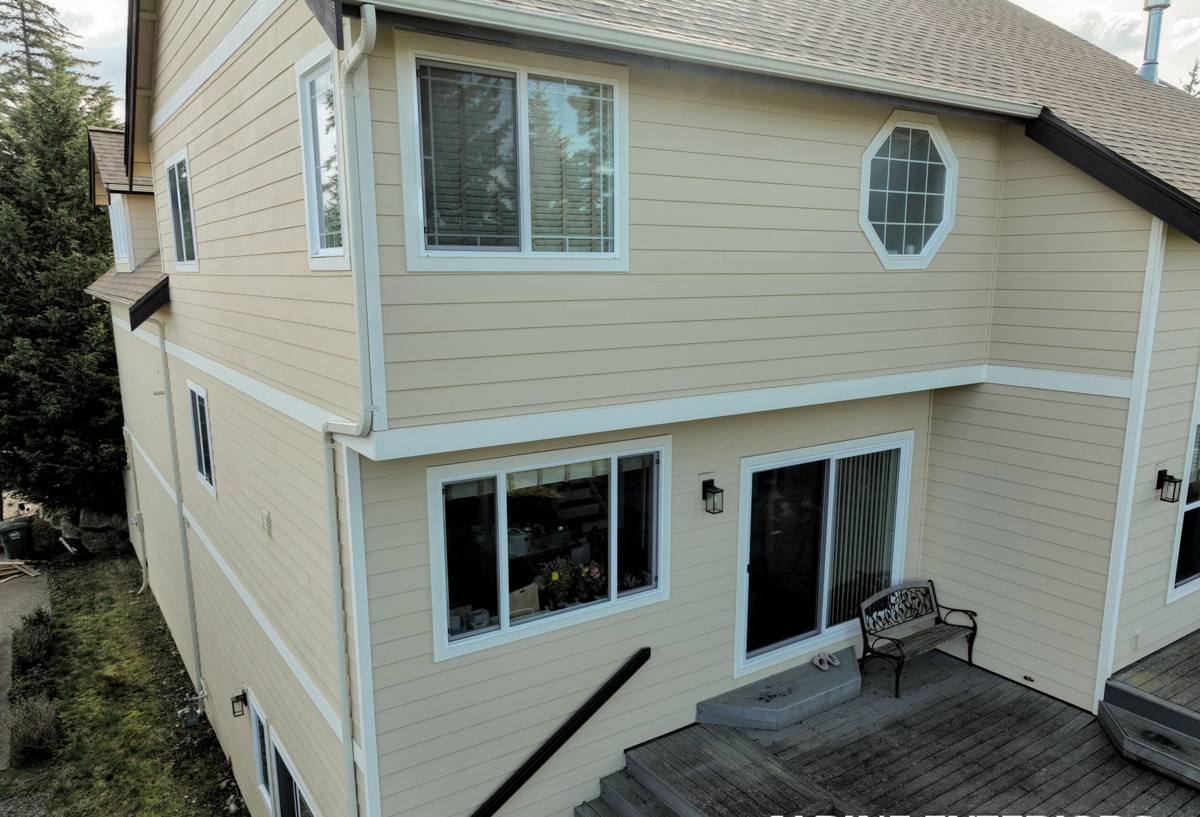
Why Composite Makes Sense for a Coastal Property
Wood decking isn't a bad product, but it asks a lot of a homeowner in a salt-air, high-moisture environment — annual sealing, more frequent board replacement as rot sets in, and a constant fight against moss and mildew staining. Composite decking, when installed correctly, removes most of that maintenance burden. It doesn't absorb moisture the way wood does, it won't splinter or cup from repeated wet-dry cycles, and it resists the mold and algae growth that thrives in Birch Bay's shaded, damp yards.
That said, composite isn't maintenance-free, and we tell homeowners that upfront. It still needs to be kept clear of standing debris, and the surface can develop a film of algae in shaded, low-airflow areas if it's never cleaned. The difference is that a rinse and occasional scrub handles it — there's no re-staining, no sanding, no board swaps every few years.
What Correct Installation Actually Involves
Composite decking fails prematurely almost always because of installation shortcuts, not the material itself. In a coastal environment like Birch Bay, the details that matter most are:
- Stainless steel or coated fasteners rated for coastal/marine exposure — standard galvanized hardware corrodes faster in salt air and can streak or stain the decking
- Proper board spacing for drainage and expansion, adjusted for our wet winters and the material's thermal movement
- Joist tape or a comparable moisture barrier on the framing to protect the substructure, since the decking itself may resist water but the frame underneath still needs protection
- Ventilation underneath the deck so airflow can dry out the structure between rain events instead of trapping moisture
- Ledger board flashing done correctly where the deck attaches to the house — this is one of the most common failure points on any deck, coastal or not
- Grading and drainage at ground level so water moves away from posts and footings instead of pooling around them
Skip any of these and you end up with a deck that looks fine for a year or two before hardware rust stains show up, boards start to feel spongy at the edges, or the framing underneath rots out from behind a composite surface that looks perfect on top.
The Moss and Algae Problem, Specifically
Whatcom County's moss season runs long — realistically most of the fall through spring — and Birch Bay's proximity to the water and tree cover in a lot of yards makes it worse than in drier inland spots. Moss and algae need three things to take hold: moisture, shade, and a surface they can grip. A poorly drained deck with boards laid too tight and no airflow underneath gives them all three.
We address this at the design stage, not after the fact. Board spacing, deck orientation relative to sun exposure where the layout allows it, and underside ventilation all factor into cutting down how much moss pressure a deck sees. Composite surfaces with a textured, capped finish also resist moss adhesion better than smooth or uncapped boards, which matters more here than it would in a drier climate.
Choosing the Right Composite Product
Not all composite decking is built the same, and for a Birch Bay property we lean toward capped composite products — boards with a protective polymer shell around a wood-composite core — over uncapped composite, which absorbs more moisture over time and is more prone to staining and mold in a wet climate. The table below is a general comparison to help frame the decision; exact pricing depends on the product line, board profile, and the size and complexity of your deck.
| Factor | Capped Composite | Uncapped Composite | Pressure-Treated Wood |
|---|---|---|---|
| Moisture resistance | High — sealed shell | Moderate — core can absorb water | Low without ongoing sealing |
| Moss/algae resistance | Good, especially textured finishes | Fair | Poor unless treated regularly |
| Coastal hardware needs | Stainless/coated fasteners | Stainless/coated fasteners | Stainless/coated fasteners |
| Ongoing maintenance | Occasional rinse/clean | Periodic cleaning, some risk of staining | Annual sealing/staining |
| Relative upfront cost | Higher | Mid-range | Lowest |
| Typical service life (properly installed) | Long, backed by manufacturer warranty | Moderate to long | Shorter without diligent upkeep |
For most Birch Bay homeowners, the capped composite's higher upfront cost pencils out against years of not having to sand, stain, or replace boards damaged by rot — especially on a deck that's exposed to bay winds and salt spray for most of the year.
Framing and Substructure — What's Underneath Matters as Much as the Boards
A composite deck is only as good as what it's built on. We see this most often on older Birch Bay properties where a deck was re-surfaced with composite boards over an aging or under-protected wood frame. The new decking looks great, but the joists and posts underneath were never upgraded to handle the same moisture exposure, and problems show up a few years later from the frame out.
For new builds and full replacements, we use pressure-treated or coated framing appropriate for high-moisture exposure, protect the ledger connection with proper flashing, and set posts on footings sized and placed for the site's drainage. On resurfacing jobs, we inspect the existing frame before doing anything else — if the substructure isn't sound, no amount of quality decking on top will fix that.
Our Process for a Birch Bay Deck Project
- On-site assessment — we look at sun/shade exposure, prevailing wind and rain direction, existing drainage, and the condition of any structure being replaced
- Material and layout selection — matched to the site's moisture and moss exposure, not just aesthetics
- Framing and structural work — new or reinforced substructure, moisture barrier, proper ledger flashing
- Decking installation — coastal-rated fasteners, correct spacing, attention to drainage at every edge and seam
- Railing, stairs, and trim — detailed the same way as the deck field so water doesn't find a weak point at transitions
- Final walkthrough — we go over basic care so the deck performs the way it's supposed to for the long haul
Why a Local Crew Matters for This Job
A deck built by a contractor who doesn't regularly work waterfront and near-waterfront properties in Whatcom County is guessing at how much hardware corrosion, moisture intrusion, and moss pressure to design for. We work Birch Bay and the broader Bellingham area routinely, which means we're not learning the local conditions on your project — we already know what driving rain off the bay does to an under-flashed ledger board, and we already know which fastening and spacing choices hold up through a Whatcom County winter instead of failing after one or two seasons.
That local track record also shows up in smaller decisions: where to route drainage on a sloped Birch Bay lot, how much ventilation a shaded, tree-covered yard actually needs versus an open one, and which board finishes hold their color and grip best under year-round coastal humidity.
Simple Maintenance Checklist for Composite Decking in This Climate
- Rinse the deck surface periodically to clear salt residue and organic debris, especially after storms
- Sweep leaves and needles out of corners and against the house before they trap moisture
- Check fastener heads and railing hardware for any early signs of corrosion or staining
- Keep gutters and downspouts near the deck clear so runoff isn't dumping directly onto the structure
- Trim back overhanging branches or shrubs that keep sections of the deck shaded and damp
- Address any soft spots, movement, or drainage pooling promptly rather than waiting
What This Costs, Honestly
Composite decking projects vary a lot based on square footage, board selection, railing style, stairs, and how much of the substructure needs to be rebuilt versus reused. Capped composite generally costs more upfront than pressure-treated wood or uncapped composite, but for a Birch Bay property exposed to salt air and near-constant moisture, that upfront difference is usually offset by years of avoided maintenance and repair. We'll give you real numbers for your specific project rather than a rough estimate that doesn't account for your site's exposure and drainage situation.
If you're planning a new deck or replacing an aging one in Birch Bay, we're happy to come take a look and walk you through what your property specifically needs. Use the form below to request a free, no-pressure estimate.