 Bellingham Siding
 Birch Bay's Climate: Salt Air, Driving Rain, and a Long Moss Season
Birch Bay sits right on the water, and that changes what siding has to deal with compared to a home a few miles inland in Bellingham. Wind off the bay carries salt spray onto exterior walls, especially on homes with a direct or partial view of the water. Salt air is corrosive to metal fasteners and trim, and it accelerates the breakdown of finishes that weren't built to handle it. Over years, that exposure shows up as pitting, fastener bleed, and premature fading on siding products that weren't engineered for a marine environment. On the water-facing elevations, corner boards, trim edges, and the lowest courses nearest grade tend to show wear first, since they take the brunt of both salt spray and splash-back from rain.
Driving rain is the second factor. Storms moving in off the water don't just fall straight down — wind pushes rain sideways into wall assemblies, working it into laps, seams, and any gap in the water-resistive barrier. A siding system that isn't installed with the right clearances, flashing, and drainage plane will eventually let that moisture in, even if the siding material itself is sound.
Then there's moss. Whatcom County's mild, wet winters and shaded, humid microclimates near the water give moss and algae a long growing season — often nine months or more in shaded, north-facing, or tree-sheltered areas. Organic and wood-based siding products are especially vulnerable because moss and algae can take hold in the material itself, not just sit on the surface. Fiber cement doesn't feed that growth the way wood-based products can, which matters a lot on a property that stays damp and shaded for much of the year.
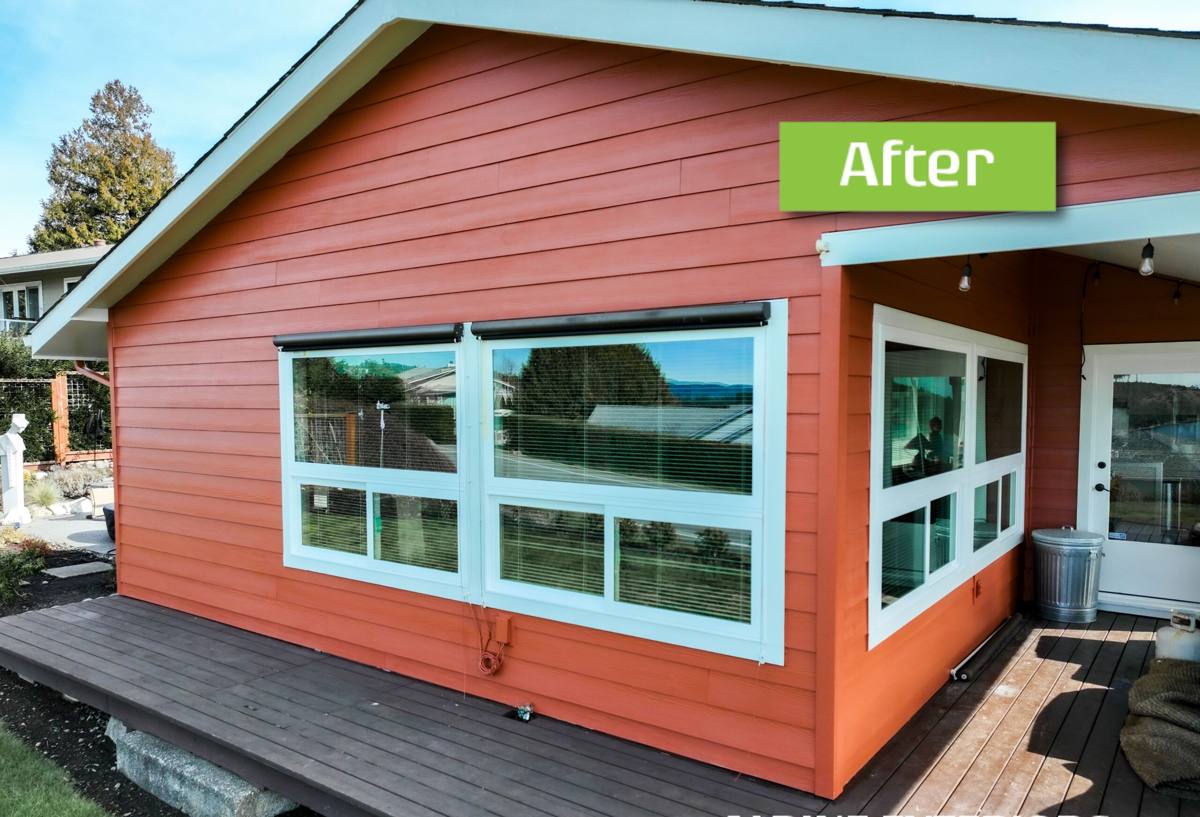
Why We Install Only James Hardie Fiber Cement
We don't install LP SmartSide, vinyl, Cemplank, Allura, primed spruce, or cedar. That's not a marketing angle — it's a standard we hold because of what we've seen happen to those products in exactly this kind of climate. Wood-based engineered siding needs its paint film and edge seals kept intact to resist moisture; once a seam opens near the water, swelling and rot can follow faster than it would inland. Vinyl handles moisture fine but softens, warps, and fades under UV and heat cycling, and it can't be painted to refresh it once the color goes chalky. Other fiber cement brands may look similar to Hardie on a spec sheet, but we've standardized on James Hardie specifically for its factory-applied ColorPlus finish, its climate-engineered HZ product lines, and a warranty structure that's transferable and backed by decades of the same company standing behind it.
Salt air is also hard on trim details specifically, since narrow profiles and exposed fastener heads have less material to absorb corrosion before it becomes visible. For a waterfront-adjacent property like a Birch Bay home, our product standard isn't optional — it's the difference between siding that still looks right at year fifteen and siding that needs attention by year seven or eight.
Choosing the Right Hardie Product Line for a Waterfront Property
James Hardie makes siding in different formulations for different climate zones, and the Pacific Northwest falls into Hardie's HZ5 zone, engineered for wet, temperate climates with freeze-thaw cycles and sustained moisture exposure. For Birch Bay specifically, we typically look at:
- HardiePlank lap siding — the most common choice for full re-sides, available in several exposure widths and textures (smooth, cedarmill)
- HardiePanel vertical siding — often used for accent sections, gables, or a board-and-batten look
- HardieTrim boards — matched trim that resists the same moisture and moss pressure as the field siding, instead of leaving a wood trim weak point
- HardieSoffit panels — worth considering on homes with exposed eaves facing prevailing wind and rain
The right combination depends on the home's exposure — how directly it faces the water, how much roof overhang protects the walls, and how shaded or sheltered different elevations are. A wall that takes direct wind-driven rain off the bay gets treated differently than a sheltered side yard, even on the same house.
Texture choice matters too. Smooth panels show salt residue and water spotting more readily than a cedarmill texture, so we talk through which look fits both the home's style and how much upkeep an owner wants to take on.
What a Correct Install Looks Like in Birch Bay
Fiber cement siding is only as good as the assembly behind it. On a coastal property, a handful of details matter more than they would on a sheltered inland lot:
Drainage and moisture management
We install a proper water-resistive barrier and, where the wall assembly calls for it, a drainage gap that lets any moisture that gets behind the siding drain and dry out instead of sitting against the sheathing. This matters more on walls that take direct wind-driven rain.
Flashing and fastening
Every window, door, and roof-to-wall transition gets flashed to shed water outward, not into the wall. Fasteners are corrosion-resistant and placed according to Hardie's fastening schedule — not just close to the edge, but at the spacing and depth the manufacturer specifies, since a fastener driven wrong is a future leak point.
Clearances
Hardie specifies minimum clearance from grade, roof lines, and decks — usually a few inches — so the bottom edge of the siding isn't sitting in standing water or snow. On a property near the bay where ground moisture and drainage can already be a factor, we don't shortcut these clearances.
Caulking and joints
Butt joints and trim intersections are sealed with a quality, paintable sealant rated for exterior use, not just whatever's cheapest. In a salt-air environment, joint failure is often where problems start.
ColorPlus Finish: Built for Sun, Salt, and Moisture
James Hardie's ColorPlus finish is baked on at the factory in multiple coats, which gives it better fade and chip resistance than field-applied paint. That matters directly in Birch Bay: salt air and UV exposure are two of the fastest ways to break down a painted surface, and a factory finish holds its color and integrity longer than most site-applied paint jobs can. It also means touch-up, when it's ever needed, uses matched ColorPlus touch-up product instead of a mismatched can from the hardware store.
ColorPlus doesn't need repainting on the schedule that job-site-painted wood or fiber cement does. That's a meaningful difference on a property where salt exposure would otherwise push a repaint cycle sooner than an inland home would need.
Cost Factors for a Birch Bay Siding Project
Every project is different, and we won't quote a number without seeing the house, but these are the factors that typically move the price on a coastal re-side:
| Factor | Why It Matters |
|---|---|
| Tear-off vs. install over existing siding | Full tear-off costs more but lets us inspect and repair sheathing and framing underneath — important if there's been past moisture intrusion |
| Exposure and facing direction | Walls facing the bay and prevailing wind may need extra flashing detail and drainage measures the sheltered sides don't |
| Trim and detail complexity | Gables, dormers, and multiple roof lines mean more flashing, cuts, and trim work |
| Product line and profile | Plank width, texture, and accent panel choices affect material cost |
| Existing damage | Rot or moisture damage found during tear-off adds repair scope before new siding goes on |
Our Installation Process
We walk every project the same way, adjusted for what a given Birch Bay property actually needs:
- On-site assessment — we look at exposure, existing siding condition, trim, and any signs of past moisture problems
- Written estimate — scope, product selection, and pricing before any work starts
- Tear-off and inspection — removing existing siding and checking sheathing and framing for hidden rot or moisture damage before anything new goes up
- Weather barrier and flashing — installing or repairing the water-resistive barrier and flashing every penetration and transition
- Hardie installation — siding, trim, and any accent panels installed to Hardie's fastening and clearance specifications
- Final walkthrough — checking joints, caulking, and finish before we call the job done
Keeping Coastal Siding Looking Right
James Hardie siding is low-maintenance, not zero-maintenance — especially in a moss-prone, salt-air setting like Birch Bay. A little routine attention keeps it performing the way it's built to:
- Rinse the exterior with a garden hose once or twice a year to clear salt residue and light grime — skip the pressure washer, which can force water behind joints
- Keep gutters clear so overflow isn't running down the siding face
- Trim back vegetation and tree cover where it's keeping walls shaded and damp longer than necessary
- Watch shaded, north-facing sections for early moss or algae growth and address it before it spreads
- Check caulking at joints and trim every year or two and recaulk if it's cracked or pulling away
- Repaint only if needed at the trim level — ColorPlus field siding typically doesn't need it on the same cycle
Why Local Experience in Birch Bay Matters
A crew that already works this stretch of Whatcom County knows which elevations on a Birch Bay home take the worst of the weather before they ever pull a tape measure. That's not something you get from a general contractor who does one coastal job a year. We know how the bay's wind and rain patterns behave against a wall assembly, what clearance and flashing details actually hold up here, and how to sequence a tear-off so a home isn't sitting exposed if weather moves in.
Waterfront and shoreline-adjacent properties in Whatcom County sometimes carry additional permitting or setback considerations beyond what an inland re-side needs, and we account for that in scheduling and scope from the start rather than discovering it mid-project. We also handle permitting and inspection requirements the same way for every property we work on, so there's no guesswork on that end either.
If you're weighing a re-side in Birch Bay, we're happy to take a look at the house, walk you through what we'd recommend and why, and put together a free, no-pressure estimate — no obligation either way.