 Bellingham Siding
 Why Puget-Area Decks Wear Out Faster Than You'd Expect
Homes in the Puget area sit close enough to the water that salt air is a daily fact of life, not an occasional nuisance. Combine that with the driving rain that rolls in off Bellingham Bay through fall and winter, plus a moss season that can stretch from October well into spring under the region's tree cover, and you've got three separate forces working against every deck in the neighborhood at once. None of them are dramatic on their own. Together, over five or ten years, they're why decks that look fine from the porch often have real problems underneath.
Salt air is the one people underestimate most. It doesn't just sit on the surface — it works into the threads of screws and bolts, into the galvanized coating on joist hangers, and into any exposed metal fastener that wasn't rated for coastal exposure. Once that coating breaks down, rust follows, and rusted hardware loses grip strength long before it looks obviously bad. Driving rain adds a second problem: in Whatcom County, wind-driven rain doesn't just fall straight down, it gets pushed sideways into ledger boards, under flashing laps, and into any gap where two deck boards meet a house wall. And moss, once established on a shaded or north-facing deck, holds moisture against the wood surface for weeks at a stretch, which is exactly the condition wood rot needs to take hold.
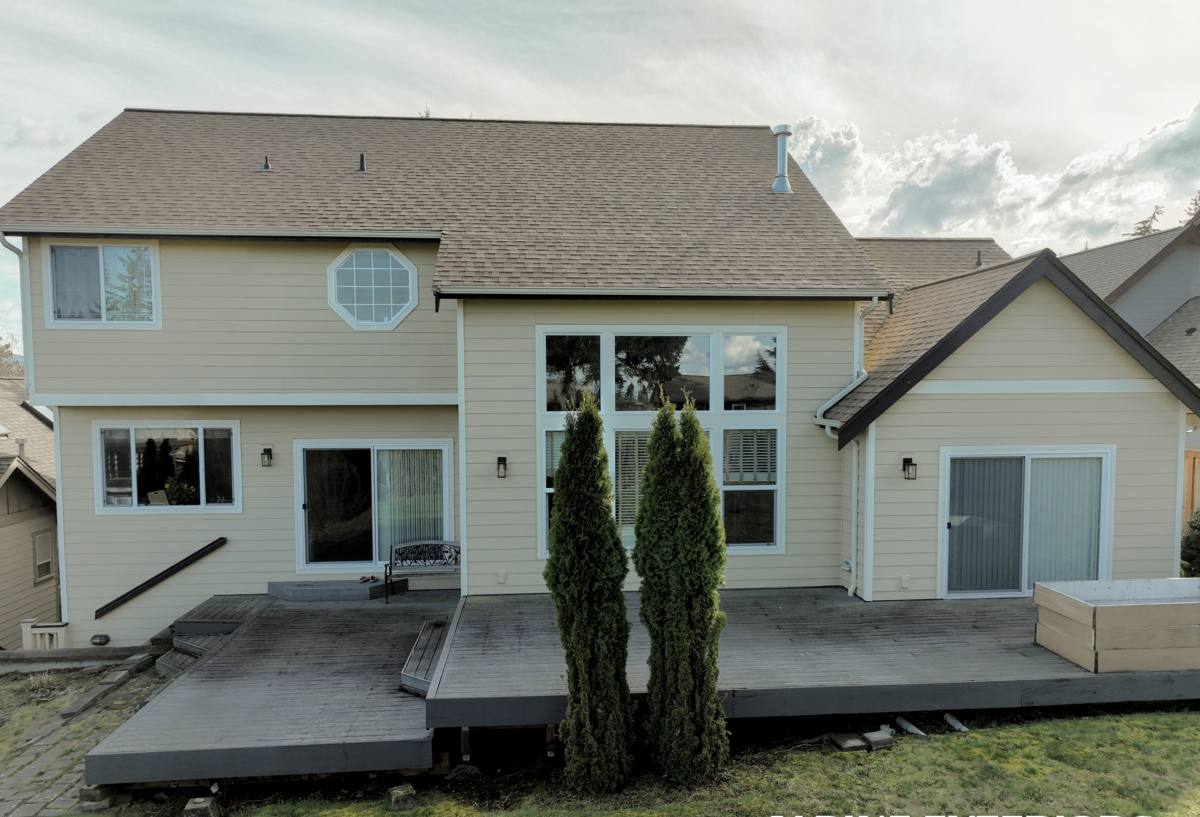
Early Warning Signs Worth Calling About
Most deck failures we get called out for didn't happen overnight. They were visible — or feelable underfoot — for months before anyone made the call. Catching these early is almost always the difference between a repair bill and a rebuild bill.
- Boards that feel spongy, bouncy, or slightly springy when you walk across them
- A visible gap or dark staining where the deck meets the house (the ledger board connection)
- Rust streaks running down from screw heads, joist hangers, or post bases
- Green or black moss buildup that stays damp for days after rain stops
- Handrails or stair stringers that feel loose or wiggle side to side
- A musty or mildew smell coming from underneath the deck
- Cracked, split, or cupped boards, especially near board ends
Any one of these on its own might be minor. Two or three together usually means moisture has been getting into the structure for a while.
What's Usually Failing Underneath
The decking boards you walk on are the least of it. Most of the repair work — and most of the risk if it's ignored — is in the framing underneath, which you can't fully evaluate without getting under the deck or pulling a few boards.
Ledger Board and Flashing
The ledger board is the piece that bolts the deck to the house, and it's the single most common point of failure we find on older decks in wet coastal climates. If the flashing above it was installed wrong, sized wrong, or has simply failed after years of driving rain, water tracks behind it and rots the ledger, the rim joist behind it, and sometimes the house sheathing. This is structural — it's what holds the deck to your home — and it's rarely visible until the wood is already soft.
Support Posts and Footings
Posts that sit directly on or near grade, without proper post bases keeping wood off standing water, tend to rot from the bottom up. In our climate, ground moisture rarely dries out fully between storms, so a post base that's cracked, corroded, or missing entirely lets that moisture wick straight into the post end grain.
Joists and Beams
Rusted joist hangers, split beam ends, and joists that have been sitting under a slow leak from a failed board or flashing point are the structural issues most likely to get missed on a surface-level look. This is also where moss and standing debris on top of the deck cause the most hidden damage — water pools, seeps between boards, and drips onto the framing below for years without anyone noticing.
Repair or Rebuild? How We Make That Call
Not every deck with problems needs to come down. The honest answer depends on how much of the structure is still sound versus how much has been compromised, and how much of the damage is isolated versus spread across the whole frame.
| Factor | Repair usually makes sense | Rebuild usually makes more sense |
|---|---|---|
| Ledger board condition | Solid wood, isolated flashing failure | Soft or rotted ledger, or rim joist behind it |
| Extent of rot | Limited to a few boards or one section | Found in multiple joists, beams, or posts |
| Age of structure | Under 15 years, built to a reasonable standard | Original construction predates current code, or footings undersized |
| Fastener condition | Isolated rust, hardware still functional | Widespread corrosion on hangers and structural screws |
| Footings and posts | Stable, minimal movement | Heaving, rotted, or improperly set posts |
We'll always tell you plainly which category your deck falls into, and why — including when a repair is the right call even though a rebuild would be more profitable for us. A deck that just needs new boards, a proper ledger flashing detail, and a handful of hangers replaced doesn't need to be torn out.
What a Correct Repair Actually Involves
A repair that only replaces what's visibly broken tends to fail again in the same spot within a few years, especially in this climate. A repair done right addresses the moisture path that caused the damage in the first place, not just the symptom.
Fasteners and Hardware
Given the salt exposure common to Puget-area properties, we use stainless steel or high-grade coated fasteners and hardware rated for coastal and treated-lumber contact, not standard hardware that will start corroding again within a couple of seasons. This matters more here than it would inland — hardware that's fine forty miles east of here can fail early this close to the water.
Flashing and Water Management
Any ledger repair gets proper flashing integrated with the house's water-resistive barrier, not just caulked over. Caulk is a maintenance item, not a repair — it fails, and when it does, it traps water against the wood instead of shedding it. Correct flashing works whether or not anyone ever recaulks it.
Decking Material Choices for Repairs
When boards need replacing, homeowners usually choose between pressure-treated wood, cedar, and composite decking. Each has honest trade-offs worth understanding before you decide:
- Pressure-treated lumber — lowest upfront cost, but needs regular sealing or staining to hold up against our rain and moss cycle, and it will eventually need refinishing to prevent graying and surface checking
- Cedar — naturally resists rot and looks good against a Northwest home, but is softer, costs more, and still needs periodic finish maintenance to keep moisture from working into the grain
- Composite decking — highest upfront cost, no staining or sealing required, and much better resistance to the moss and mildew staining that's common on shaded coastal decks, though it needs correct fastening and gapping since it expands and contracts differently than wood
There's no universally "right" choice — it depends on your budget, how much upkeep you want to do, and how shaded or exposed your specific deck is. We'll walk through what makes sense for your situation rather than pushing whatever's easiest for us to install.
Our Deck Repair Process
- On-site inspection — we get underneath the deck, not just walk across the top, checking ledger, posts, joists, and hardware condition directly
- Honest scope and estimate — a written breakdown of what's failing, what's still sound, and what repair (or rebuild) actually requires
- Demolition of only the affected sections — we don't tear out more than necessary, but we also don't patch over hidden rot to save a day of labor
- Structural correction — replacing joists, hangers, posts, or ledger material and flashing as needed, brought up to current fastening and moisture-management standards
- Decking and hardware installation — using the material you've chosen, with coastal-rated fasteners throughout
- Final walkthrough — checking for level, secure railings, proper drainage off the deck surface, and no soft spots anywhere in the finished repair
Why a Crew That Already Works in Puget Matters
A deck repair crew that mostly works drier inland areas will sometimes underbuild for what this climate actually demands — standard hardware where coastal-rated hardware belongs, caulk where real flashing belongs, or a repair scope that doesn't account for how far moisture has already traveled through the framing. Working regularly in Bellingham and across Whatcom County's coastal neighborhoods means we're not guessing at how salt air, wind-driven rain, and long wet winters affect deck framing — we're seeing the same failure patterns repeatedly and building repairs that are meant to hold up against them, not just pass a quick look.
It also means we're realistic about timing. Deck repair work in this region is weather-dependent, and a crew unfamiliar with the area's rain patterns can end up starting projects that get repeatedly delayed. We plan around the seasons we actually work in.
Keeping a Repaired Deck in Good Shape
A correct repair buys you years, but a little seasonal attention buys you more. This is the same list we'd give a homeowner right after we finish a repair:
- Sweep leaves and debris off the deck surface before fall rains set in — trapped debris is what starts most moss growth
- Rinse or lightly scrub visible moss and algae off boards a couple of times a year rather than letting it build up
- Check that gaps between boards stay clear so water can drain through instead of pooling
- Reseal or restain wood decking on the manufacturer's recommended schedule, not just when it starts looking gray
- Glance underneath once a year for new rust streaks, soft spots, or gaps at the ledger board
- Keep gutters and downspouts near the deck clear so runoff isn't draining directly onto or under it
If you're noticing any of the warning signs above, or just want an honest read on how much life is left in your Puget-area deck, we're happy to take a look. The estimate is free, there's no pressure to book anything on the spot, and you'll get a straight answer about whether you're looking at a repair or something bigger — use the form below to get started.