 Bellingham Siding
 South Hill's Exposure: What the Local Climate Does to Siding
South Hill sits up on a slope above Bellingham Bay, and that elevation is a mixed blessing for the homes up there. The views are a big part of why people live on the hill, but that same exposure means the wind coming off the water carries salt-laden air onto exterior walls, trim, and fasteners year-round. Add in Whatcom County's long, wet fall-through-spring stretch of driving rain, and you have a climate that is genuinely hard on cladding — not in a dramatic way, but in the slow, cumulative way that shows up as failed caulk joints, swollen trim, and streaked paint five or ten years down the road.
The tree cover and shaded lots common on the hill add another factor: north- and east-facing walls that don't get much direct sun stay damp longer after a storm, which is exactly the condition moss and algae need to take hold. On a lot of South Hill homes you can see the difference in growth between the sun-exposed side of the house and the shaded side within a few feet of each other. Siding material and installation detail both matter here — a product that handles rain fine on a dry, sunny lot can struggle on a shaded, salt-exposed hillside lot a few blocks away.
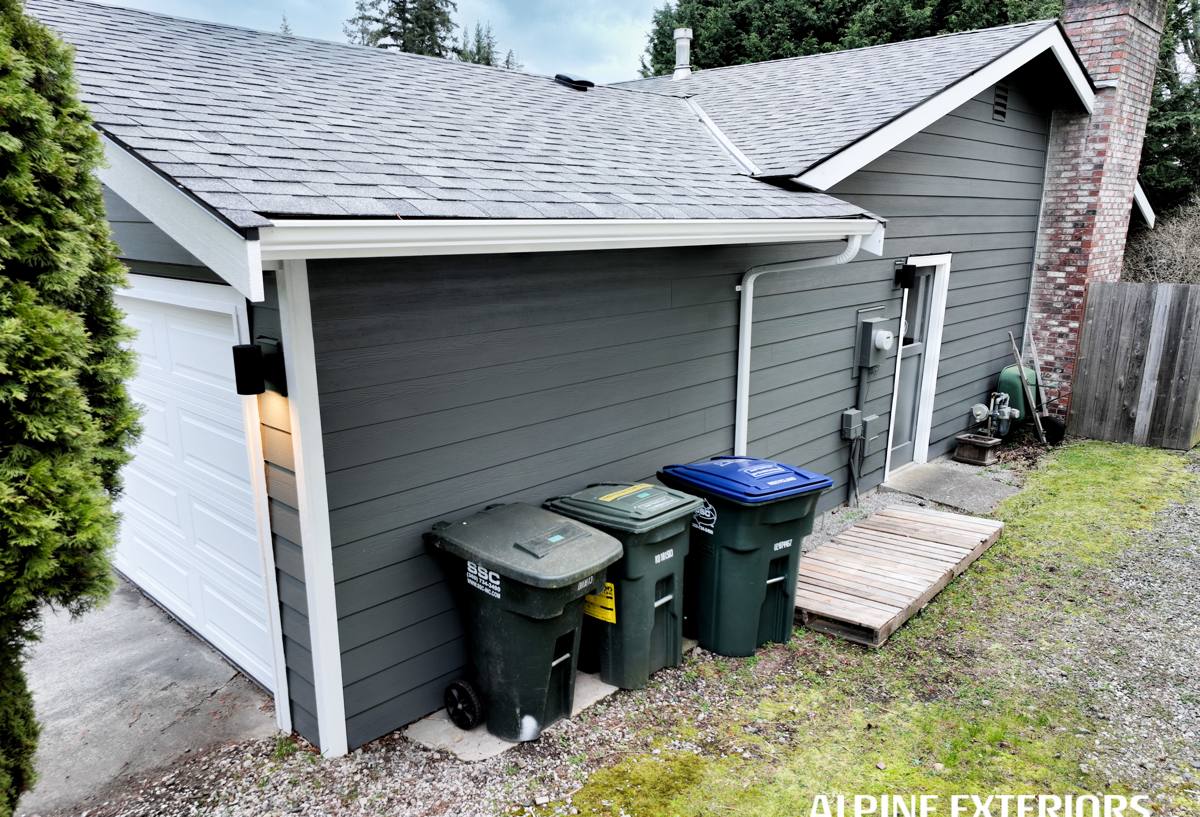
Why Fiber Cement Is the Right Match for This Neighborhood
Older Homes, Mixed Architecture
South Hill has a real mix of housing stock — older homes with traditional lap profiles sitting next to newer builds and remodels. Fiber cement handles that variety well because it's manufactured in lap, shingle, and panel profiles, so a period-appropriate look isn't a trade-off against durability the way it can be with some synthetic alternatives.
Hillside Wind and Salt Exposure
Wind-driven rain doesn't fall straight down on a hillside lot — it hits siding at an angle, works into laps and seams, and dries slower in shaded pockets. Fiber cement is dimensionally stable; it doesn't swell, cup, or rot the way wood-based products can when they take on repeated moisture. That stability is what protects the paint or factory finish sitting on top of it, which is ultimately what keeps a wall looking good for decades instead of needing attention every few years.
The James Hardie System We Install
We install James Hardie fiber cement exclusively — not as a brand preference, but because it's the product line engineered specifically for climates like this one. Hardie's HZ5 formulation is built for the wetter, harsher weather zones of the Pacific Northwest, as opposed to the standard HZ10 formulation sold in milder, drier regions. That distinction matters more on an exposed hillside lot than it does on a sheltered inland site.
The system includes lap siding for traditional horizontal profiles, shingle-style panels where a home calls for that look, and trim boards that keep corners, window returns, and fascia consistent with the field siding. Most of what we install carries Hardie's ColorPlus factory finish — a baked-on finish applied under controlled conditions, which holds up better against UV and moisture than a field-applied paint job and comes with its own finish warranty on top of the product warranty.
What Correct Installation Actually Involves
Moisture Management Behind the Cladding
Siding is only as good as what's behind it. A correct install starts with a weather-resistive barrier over sound sheathing, properly lapped and taped at seams, with flashing at every window, door, and roof-to-wall transition. On a hillside lot that takes wind-driven rain, we pay particular attention to kick-out flashing at roof lines and to head flashing over trim — these are the details that, when skipped, cause hidden rot years before anyone notices a problem on the surface.
Fastening, Clearances, and Joints
Hardie's installation manual specifies fastener type, spacing, and penetration depth, and following it isn't optional if you want the warranty to hold. We keep the minimum ground clearance the product requires, maintain proper gaps at butt joints for expansion, and use sealants rated for the exposure rather than whatever caulk happens to be in the truck. Corner and trim joints get backer rod and sealant where the manual calls for it, not just a bead run down the seam.
Field-Cut Edges
Every field cut exposes raw fiber cement that needs to be sealed before the piece goes up, especially on butt joints and around penetrations. Skipping this step is one of the more common shortcuts that leads to premature moisture wicking at the cut edge — it doesn't fail immediately, but it fails early.
Our Process for a South Hill Project
A siding job on a hillside lot has logistics that a flat, easy-access lot doesn't. Here's how we typically run a South Hill project:
- Site walk and assessment — we look at the existing siding, sheathing condition, drainage around the foundation, and note which walls take the worst weather exposure.
- Access and staging plan — hillside lots often have limited driveway or yard space, so we plan material staging and scaffolding before the crew shows up, not on the fly.
- Tear-off and sheathing check — old siding comes off and we inspect the sheathing underneath for rot or soft spots before anything new goes on. Hidden damage gets repaired, not covered up.
- Weather barrier and flashing — house wrap, flashing, and any rainscreen detailing goes in before a single piece of Hardie siding is installed.
- Siding, trim, and sealant install — installed to Hardie's published specifications, with attention to the joints and penetrations most likely to see water on an exposed lot.
- Final walkthrough — we go over the finished work with the homeowner and address anything on the punch list before calling the job done.
Comparing Siding Materials for This Climate
Homeowners on the hill often ask how fiber cement stacks up against the other materials they've seen quoted. Here's an honest comparison based on how each performs in a wet, salt-exposed, moss-prone climate like South Hill's:
| Material | Moisture Behavior | Maintenance | Typical Lifespan |
|---|---|---|---|
| James Hardie fiber cement | Dimensionally stable; doesn't swell or rot from repeated wetting | Occasional wash; ColorPlus finish resists fading longer than field paint | 30+ years with proper install |
| Vinyl siding | Doesn't rot, but can warp or crack in temperature swings and impact | Low, but color fades and can't be repainted easily | 20–30 years, shorter in harsh exposure |
| Wood / cedar | Absorbs moisture readily; needs consistent sealing to prevent rot | Frequent painting or staining, especially on shaded walls | Highly variable, often 10–20 years without diligent upkeep |
| Engineered wood (e.g. LP SmartSide) | Resin-treated but still wood-based; edge and joint sealing is critical | Regular inspection of seams and cut edges | Manufacturer-rated, but moisture-sensitive if details are missed |
This isn't to say every other product is a bad choice everywhere — it's that on an exposed, shaded, salt-air hillside lot, the margin for installation error is smaller, and fiber cement gives homeowners the most forgiving material for that margin.
Living With Fiber Cement in a Marine, Moss-Prone Climate
Fiber cement is low-maintenance, not no-maintenance. On South Hill lots with heavy shade or tree cover, we recommend an annual rinse-down of north- and east-facing walls to keep moss and algae from taking hold, along with a look at gutters and downspouts to make sure water isn't sheeting down the siding face. ColorPlus-finished siding generally goes far longer between repaints than field-painted wood, but it's still worth a visual check each year for any caulk joints that have shrunk or pulled away, since those are the first thing to fail and the easiest to fix before they become a bigger problem.
Why Hire a Crew That Already Works South Hill
Installation quality is what determines whether fiber cement performs the way it's supposed to for thirty-plus years, and a crew that's already worked this neighborhood knows things a first-time visitor doesn't: which walls on a hillside lot take the worst wind-driven rain, how to stage material and scaffolding on a sloped or tight lot, and how Bellingham's permitting process works for exterior work. We also know not to install over wet sheathing during a soggy stretch of Whatcom County weather — a detail that matters more here than in a drier climate, and one that's easy for an out-of-area or inexperienced crew to rush past.
Signs Your South Hill Home May Need New Siding
- Paint that's peeling, bubbling, or chalking faster on shaded or north-facing walls than the rest of the house
- Soft spots, visible warping, or delamination in wood or engineered wood siding
- Moss or algae staining that comes back within weeks of being cleaned off
- Caulk joints that have shrunk, cracked, or pulled away from trim and corners
- Visible gaps at butt joints or around window and door trim
- Rising energy bills that may point to compromised insulation or air sealing behind the siding
- Siding installed more than 20–25 years ago, especially wood or older composite products
Getting Started
If you're seeing any of these signs on a South Hill home, or you're just planning ahead for a hillside lot that takes more weather than most, we're happy to take a look and walk you through what correct fiber cement installation involves for your specific exposure. Reach out for a free, no-pressure estimate — someone will walk the property with you, answer questions honestly, and give you a straightforward assessment before any work is proposed.