 Bellingham Siding
 Fiber Cement Siding Built for York's Stretch of Bellingham
York is one of Bellingham's established residential neighborhoods, and like the rest of Whatcom County, it sits inside a climate that is genuinely hard on exterior materials. Salt-tinged marine air off the bay, rain that comes in sideways as often as it falls straight down, and a moss season that can run most of the year on shaded walls all work on a house continuously, not just during the occasional big storm. When we talk with York homeowners about siding, we're not selling a generic upgrade — we're talking about the one exterior material that actually has to survive this specific combination of conditions for the next few decades.
We install James Hardie fiber cement siding, and only James Hardie fiber cement siding, on the homes we work on in York and across Bellingham. This page is about that one product, in this one neighborhood, because the two are connected: York's mix of older and newer homes needs a siding system engineered for sustained coastal moisture, not just one that looks good on install day.
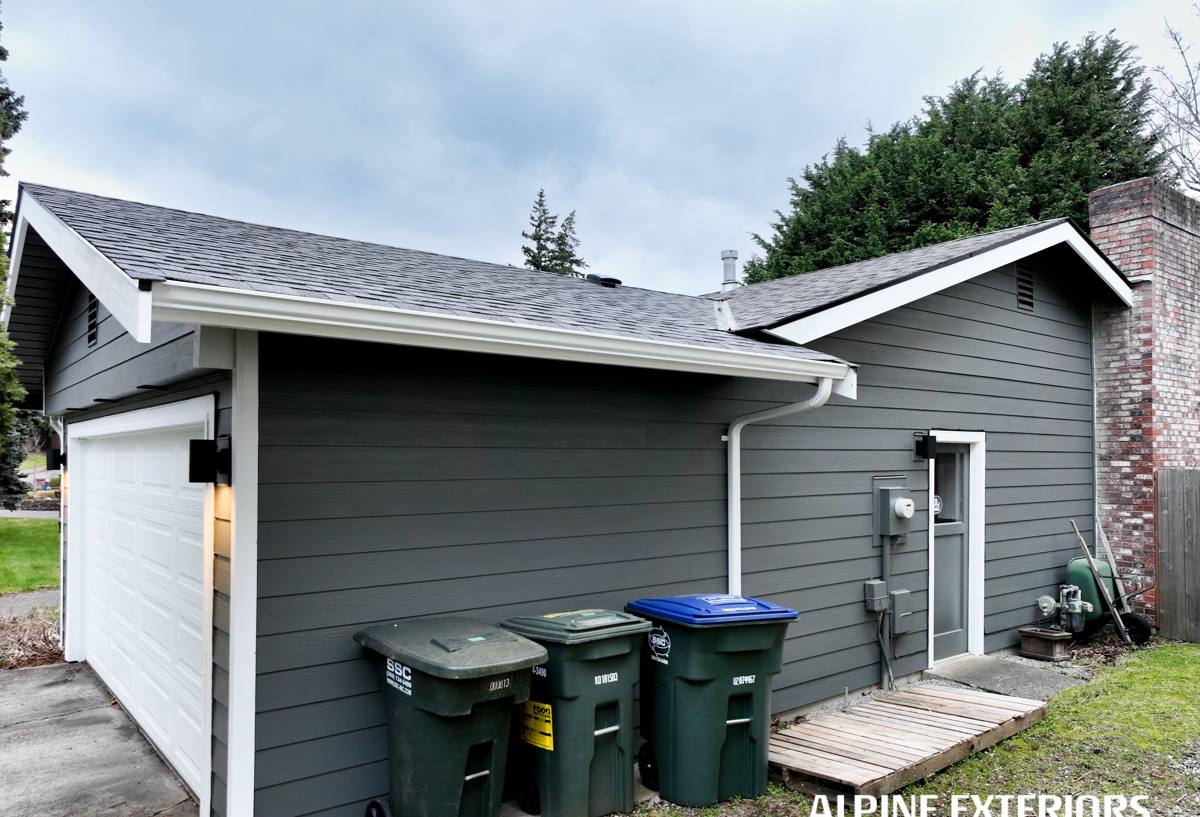
What York's Climate Actually Does to a House
Salt Air and Sustained Marine Moisture
Bellingham's proximity to the bay means a steady drift of moisture-laden, slightly salt-tinged air moving through neighborhoods like York, day in and day out, not only when a storm rolls through. That kind of exposure is slow and cumulative. It works on fasteners, on flashing, and on lower-grade finishes in a way that often isn't visible until years into a siding system's life, which is exactly the kind of damage that's expensive to catch late and cheap to prevent up front with the right material and the right install detail.
Wind-Driven Rain at Every Joint
Rain in this part of Whatcom County doesn't fall straight down as often as people assume. Wind pushes it sideways, which means it's driven into lap joints, trim seams, and wall penetrations from angles a simple vertical-rainfall assumption never accounts for. A siding system, house wrap, and flashing detail that would hold up fine in a drier, calmer climate can still leak here, specifically because of that wind-driven angle of attack.
A Moss Season That Barely Breaks
Mild temperatures, tree cover, and near-constant dampness add up to an extended moss and mildew season on north-facing and shaded walls throughout York and the rest of Bellingham. Any siding material with even mild porosity, or one that traps moisture against the substrate instead of shedding it, becomes a growth surface over time. It tends to show up first in the places nobody checks often — behind shrubs, under eaves, on the shaded side of the house.
Why We Install Only James Hardie Fiber Cement
We don't offer a lineup of siding brands and let price decide the winner. We install James Hardie fiber cement, full stop, because of what we've consistently seen on tear-offs and repair calls in this exact climate.
- Non-combustible core: fiber cement doesn't feed a fire the way wood-based siding products can, which matters for household safety.
- Factory-applied ColorPlus finish: the color coat is cured under controlled factory conditions instead of brushed on at the jobsite, so it resists fading and moisture intrusion far longer than field-applied paint.
- Climate-engineered HZ formulation: Hardie's HZ5 product line is built for regions with heavy sustained moisture and freeze-thaw cycling, which is a better match for coastal Whatcom County than a generic national spec.
- Dimensional stability: fiber cement doesn't swell, cup, or warp the way engineered wood products can after repeated wet-season moisture cycles.
- A strong transferable warranty: Hardie backs its products with one of the more substantial warranty structures in the industry, provided the installation follows spec.
What We Don't Install, and Why
We don't install LP SmartSide, vinyl siding, Cemplank, Allura, primed spruce, or cedar. Those are legitimate products, and other contractors install them well. Our decision not to is a professional standard, not a knock on the products themselves. LP SmartSide is an engineered wood product that performs reasonably in drier climates, but in a marine environment with this much sustained rain, engineered wood is more sensitive to moisture at cut edges and fastener penetrations than fiber cement is. Vinyl is affordable and low-maintenance in a general sense, but it can warp under sun exposure, crack in a cold snap, and trap moisture behind the panel if house wrap and flashing aren't handled with real care — an easy detail to get wrong and a hard one to catch from the curb. Cedar and primed spruce are genuinely attractive natural materials, but they need ongoing painting or sealing to keep moisture out, and in a climate this wet, that maintenance schedule tends to slip in a way that shortens the material's real-world lifespan. We'd rather stand fully behind one system than sell a cheaper option that quietly shifts maintenance risk onto the homeowner a few years down the road.
What a Correct Installation Actually Requires
Fastening, Clearance, and Flashing
Buying the right material is only half the job. A James Hardie installation that performs the way it's engineered to needs correct fastening patterns, proper clearance from grade and rooflines, joints that are lapped and sealed to spec, and house wrap and flashing that function as one integrated system rather than separate steps done in isolation. Rushed or corner-cut installation is one of the most common reasons a good product develops a bad reputation on a given street, which is why we treat install detail with the same seriousness as the material decision itself.
Picking the Right Product Line for the House
Hardie makes several distinct product lines — lap siding, panel siding, shingle-style siding, and trim — and the right choice depends on the home's existing architecture, its exposure on the lot, and the look the homeowner actually wants. A shaded, moisture-heavy elevation and a sun-exposed street-facing wall on the same York property can reasonably call for different detailing, even when the material family is the same.
Our Process for a York Siding Project
- Walkthrough and assessment: we look at the whole exterior, not just the siding that's visibly failing, and check for the moisture sources — roofing, windows, decks — that often cause siding damage in the first place.
- Honest scope and quote: we tell you plainly whether you're looking at a repair, a partial re-side, or a full tear-off, and why, before we hand over a number.
- Material selection: we match the Hardie product line, profile, and ColorPlus color to the home and its exposure, not off a single default spec.
- Tear-off and installation: old siding and any compromised sheathing come off, house wrap and flashing go in as one system, and the new Hardie siding is fastened and sealed to spec.
- Final walkthrough: we go over the finished work with you before we consider the job done, not just before we invoice it.
Repair or Full Replacement?
Not every siding problem in York means a full tear-off. Isolated impact damage, a section that failed around a window, or trim that's come loose can often be repaired and matched into existing Hardie siding without redoing the whole house. But when moisture has been tracking behind the wall assembly for a while, or the existing siding is an older product that's simply reached the end of its service life, a patch job usually just postpones a bigger expense. We'll tell you plainly which situation you're actually in rather than defaulting to whichever answer is easier to sell.
Fiber Cement Siding Cost Factors in York
| Factor | What It Affects | Why It Matters in York |
|---|---|---|
| Home size and wall complexity | Total material and labor | Older homes in this part of Bellingham often carry more trim, dormers, and roof intersections where wind-driven rain can work its way in |
| Tear-off vs. overlay | Labor scope and substrate access | A full tear-off exposes hidden moisture damage that's common under decades-old siding in this climate |
| Substrate condition | Repair costs before new siding goes on | Years of trapped moisture behind failing siding can rot sheathing and framing before it's ever visible from the street |
| Product line and profile | Material cost | Lap, panel, and shingle-style Hardie products carry different material and labor costs depending on the home's architecture |
| Trim and color selection | Material cost and finish longevity | ColorPlus factory finishes outlast field-applied paint against salt air and UV exposure |
| Site access and lot terrain | Labor time and equipment needs | Mature trees and tighter lot setbacks common in older neighborhoods can add staging and setup time |
Real numbers depend on the specific house, which is why we walk the property before quoting instead of pricing off square footage alone.
Signs Your York Home's Siding Needs Attention
- Moss or dark staining that comes back quickly after cleaning, especially on shaded or north-facing walls
- Soft or spongy siding, particularly near the base of the wall or around window and door trim
- Peeling paint, bubbling, or visible warping on siding boards
- Cracked, chipped, or missing sections after storms or wind events
- Visible gaps at seams, corners, or trim joints where water can track in
- Rising heating bills that may point to a wall assembly that's no longer sealing properly
Why a Crew That Already Works in York Matters
A crew that regularly works this part of Bellingham has seen how salt air, driving rain, and moss actually behave on real houses over a full year, not just how a product performs on a spec sheet. That shows up in practical decisions on install day — where extra flashing attention actually pays off, which wall orientations stay wet longest, and which details are worth the extra time so you're not dealing with a callback two winters later. York's mix of home ages means no two properties get exactly the same treatment, and a crew with hands-on experience across the neighborhood accounts for that instead of applying one generic approach to every job.
If your York home needs new fiber cement siding, a repair, or just an honest second opinion on what's really going on behind an aging wall, we're glad to take a look. Reach out using the form below to schedule a free, no-pressure estimate.