 Bellingham Siding
 Why Happy Valley Siding Wears Differently Than You'd Expect
Happy Valley is one of Bellingham's established residential neighborhoods, with a mix of home ages, mature tree cover, and the kind of hillside variation you find throughout Whatcom County. That combination creates a specific set of stresses on exterior siding. The neighborhood sits close enough to Bellingham Bay that salt-laden air still reaches homes here even when they're not waterfront, and that salt exposure accelerates corrosion on fasteners, trim, and any siding material that isn't built to resist it. Add in the driving rain that comes sideways off Pacific storms most winters, and siding has to shed water horizontally, not just vertically, or it starts failing at seams and laps long before its expected lifespan is up.
Then there's shade. Mature trees are common throughout Happy Valley, and wherever tree canopy keeps a wall in shadow for most of the day, that section of siding stays damp longer after every rain. In Whatcom County, that translates into a moss and algae season that can run eight months or more on north- and east-facing walls. Moss doesn't just look bad — it holds moisture against the substrate, and over years that moisture finds every gap in caulking, flashing, or fastening and starts rotting what's underneath.
None of this means Happy Valley is a uniquely hostile place to own a home. It means siding replacement here has to be planned around three specific loads — salt, wind-driven rain, and sustained moisture from shade and moss — rather than treated as a generic exterior upgrade.
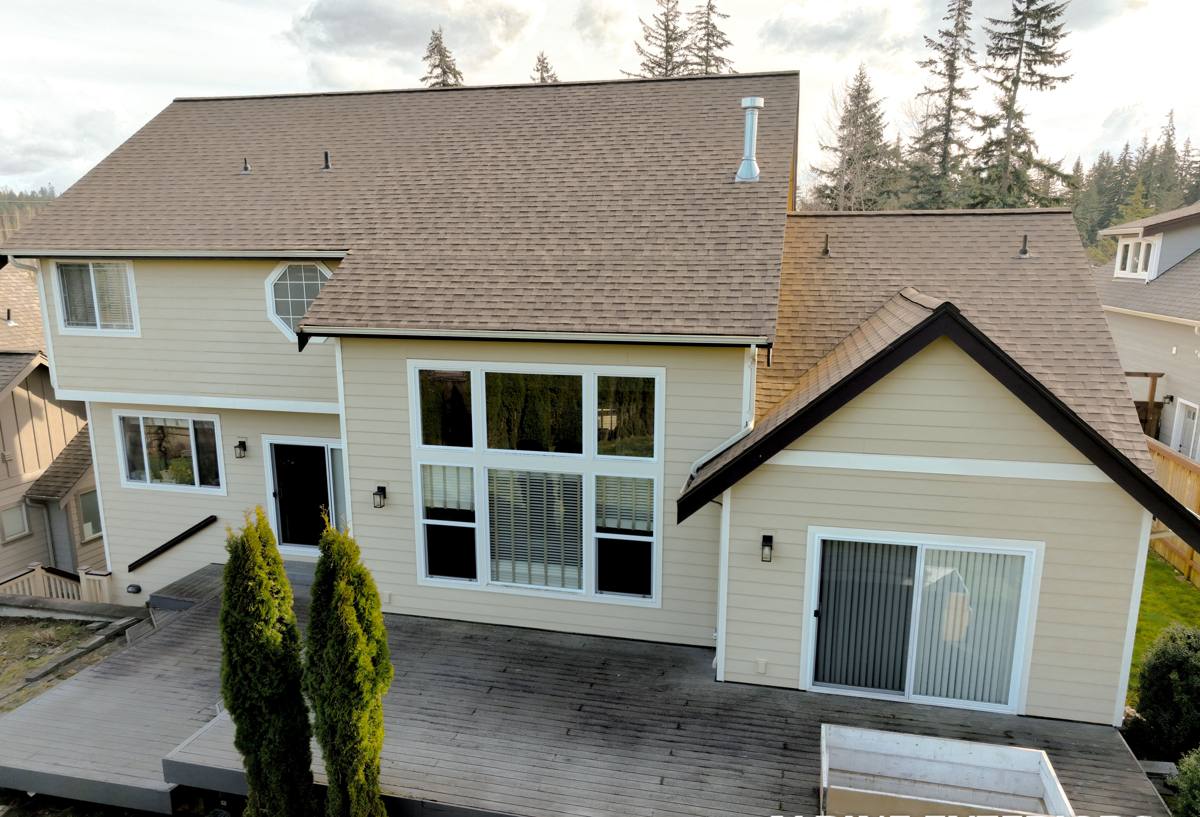
Signs a Happy Valley Home Needs Siding Replacement, Not Just Repair
Repair makes sense when damage is isolated and the rest of the siding is sound. Replacement makes sense when the problems are spread across the wall system or point to something happening behind the siding, not just on its surface. Walk your exterior and look for these signs before deciding which path is right for your home:
- Soft or spongy spots when you press on siding, especially near the bottom courses and around window and door trim
- Persistent moss or dark streaking that comes back within weeks of cleaning, particularly on shaded walls
- Visible cupping, warping, or separation at the laps, which usually means moisture has already gotten behind the board
- Paint that's failing in patches rather than uniformly — often a sign of moisture pushing out from underneath, not just UV wear
- Rust streaking below nail heads or fastener lines, a common symptom of salt-air corrosion on older fastening systems
- Rot or discoloration at inside corners, butt joints, or anywhere trim meets siding, where water tends to collect
- Rising energy bills or noticeably drafty rooms, which can point to a compromised weather barrier behind failing siding
If you're seeing two or three of these across different parts of the house, that's usually a sign the underlying water-resistive barrier and flashing system have been compromised, not just the visible siding. At that point, patch repairs tend to be a short-term fix that costs more in the long run than a properly sequenced replacement.
What a Correct Siding Replacement Actually Involves
It Starts Underneath the Siding, Not With It
The siding itself is the last layer installed, not the first thing that matters. A correct replacement starts with removing the old material down to the sheathing, inspecting for rot or soft spots, and repairing or replacing any damaged framing and sheathing before anything new goes up. Skipping this step is the single most common reason a "new" siding job fails early — new siding over compromised sheathing just hides the problem for a few more years.
The Water-Resistive Barrier and Drainage Plane
Next comes a new weather-resistive barrier, properly lapped and sealed, with flashing integrated at every window, door, and penetration so water is directed out and down rather than trapped. In a climate like Whatcom County's, we install with a drainage gap behind the siding wherever the wall assembly calls for it, so any moisture that does get past the cladding has somewhere to go instead of sitting against the sheathing. This is especially important on the shaded, moss-prone walls common throughout Happy Valley, where wet-dry cycling happens slower and moisture has more time to do damage.
Fastening and Clearances
Fastener choice matters more here than in drier climates — corrosion-resistant fasteners rated for the exposure are non-negotiable given the salt air reaching the neighborhood. We also hold correct clearances between the bottom of the siding and grade, decks, and roof lines, because tight clearances are one of the most common causes of premature rot, and they're just as common on older Happy Valley homes as they are on new construction.
Why We Install Only James Hardie Fiber Cement
We standardized on James Hardie fiber cement siding for every home we work on, including replacements throughout Happy Valley, and we don't install vinyl, LP SmartSide, primed spruce, cedar, or other fiber cement brands. That's a deliberate choice based on how those materials perform under exactly the conditions this neighborhood deals with:
- Non-combustible material — fiber cement doesn't burn, melt, or warp from heat the way vinyl and some engineered wood products can
- Built for moisture, not just painted against it — Hardie's HZ5 product formulation is engineered for the Pacific Northwest's wet climate zone specifically, not a one-size-fits-all national product
- Factory-applied ColorPlus finish — baked-on color that resists fading and chipping far better than field-applied paint, which matters when a wall stays damp and shaded for months at a time
- Dimensionally stable — it doesn't expand, contract, or cup the way wood-based products can when they take on and release moisture repeatedly through a long wet season
- Backed by a strong, transferable warranty — meaningful protection on a product this many homeowners are trusting with their home's largest exterior investment
We're not going to tell you vinyl or engineered wood siding is worthless — both have legitimate uses and plenty of homes carry them without issue. But for a climate that combines salt air, sustained wind-driven rain, and a moss season that can run most of the year, we've found fiber cement gives homeowners the best combination of durability, low maintenance, and long-term value, and we'd rather install one product exceptionally well than several products adequately.
Our Process for Happy Valley Siding Replacement Jobs
- On-site assessment — we walk the exterior, check for moisture damage, evaluate tree cover and shade patterns, and note any access or terrain considerations specific to your lot
- Scope and product selection — we recommend the Hardie product line, profile, and color that fits your home and the exposure it deals with, and walk you through what's included
- Written estimate — a clear, itemized quote before any work begins, no surprise change orders for anything we could have identified during the assessment
- Removal and inspection — old siding comes off, sheathing and framing get inspected, and any rot or damage is addressed before new material goes up
- Weather barrier and flashing — new water-resistive barrier, properly lapped flashing, and drainage detailing installed to spec
- Hardie installation — siding installed to manufacturer specifications for fastening, clearances, and joint treatment
- Final walkthrough — we review the finished job with you, point out care basics, and make sure everything meets what was quoted
Because tree cover and hillside lots are common in this part of Bellingham, we plan access and staging for each property individually rather than assuming a standard setup — that's part of why local experience matters, which we'll get to below.
What Drives Siding Replacement Cost
Every home is different, and we won't quote a number without seeing the house, but these are the main factors that move the price up or down on a typical Happy Valley project:
| Factor | Why It Matters |
|---|---|
| Home size and wall complexity | More square footage and more corners, gables, and trim details mean more labor and material |
| Condition of existing sheathing | Rot discovered during tear-off adds repair scope that can't always be predicted beforehand |
| Story height and access | Two- and three-story walls, steep lots, and limited staging areas increase scaffolding and safety requirements |
| Current siding material | Removing multiple layers or old wood/vinyl siding takes longer than a single-layer tear-off |
| Product line and profile | Hardie offers several lap widths, panel styles, and shingle profiles at different price points |
| Trim and detail work | Corner boards, window trim, and custom detailing add labor beyond the flat wall area |
| Tree cover and moisture damage | Heavily shaded walls with a history of moss are more likely to need sheathing repair |
The most reliable way to get an accurate number is a walkthrough, since two homes of the same square footage can have very different costs depending on condition and access.
Why Local Experience in Happy Valley Actually Matters
A siding crew that's worked this specific part of Bellingham knows things a general contractor from outside the area won't. They know which wall orientations in this neighborhood tend to hold moss the longest and need extra attention to drainage detailing. They know how to stage equipment and materials on the hillside lots and mature-tree properties common here without damaging landscaping. They're familiar with Whatcom County permitting and inspection requirements, so paperwork doesn't stall your project. And they've seen, over repeated jobs in the same conditions, exactly which failure points show up first on homes exposed to this combination of salt air and sustained rain — which means they build the fix for that problem into the installation from day one instead of learning it the hard way on your house.
That local pattern recognition is hard to replicate with a one-off crew, no matter how skilled they are in general. It's the difference between a technically correct installation and one that's actually tuned to how homes fail in this specific climate.
Protecting Your Investment After Replacement
New Hardie siding is low-maintenance compared to wood or older vinyl, but "low-maintenance" isn't "no-maintenance," especially in a moss-prone climate. A few habits go a long way toward protecting the investment:
- Rinse shaded, moss-prone walls once or twice a year with a garden hose and soft brush — avoid pressure washers, which can force water behind laps and joints
- Keep gutters clear so overflow doesn't run down the wall face and stay wet longer than the siding is designed to handle
- Trim back tree branches and shrubs that keep a wall in constant shade or hold moisture against it
- Have caulking and trim joints checked every few years, since sealant is the first thing to age even when the siding underneath is fine
- Address any new soft spots or discoloration quickly — small repairs are far cheaper than another full replacement down the road
If you're seeing signs of trouble on your current siding, or you just want an honest read on whether repair or replacement makes more sense for your Happy Valley home, we're happy to walk the property with you. There's no pressure and no obligation — just a straight assessment and a written estimate you can take your time with.