 Bellingham Siding
 Happy Valley's Siding Problem Isn't Like Everywhere Else
Happy Valley sits on Bellingham's south side, close enough to the bay to catch salt-laden air off the water and wooded enough that many lots stay shaded and damp well into the afternoon. That combination is harder on exterior siding than either factor would be on its own. Salt air accelerates corrosion on fasteners and trim metal. Tree cover slows drying time after every rain, which in Whatcom County means siding can stay damp for days at a stretch during the wet months. Add Bellingham's long moss season — typically running from early fall through late spring — and you have a neighborhood where siding is under near-constant low-grade moisture pressure, even in years without a single hard storm.
None of that is unique to Happy Valley in a dramatic way. It's the same story across a lot of Whatcom County. But the tree canopy here is denser than in newer, more open subdivisions, and that shade is exactly what keeps north- and west-facing walls from ever fully drying out between weather systems. Siding that would be fine in a sunnier, more exposed part of Bellingham can struggle here if it isn't built and installed for sustained moisture exposure.
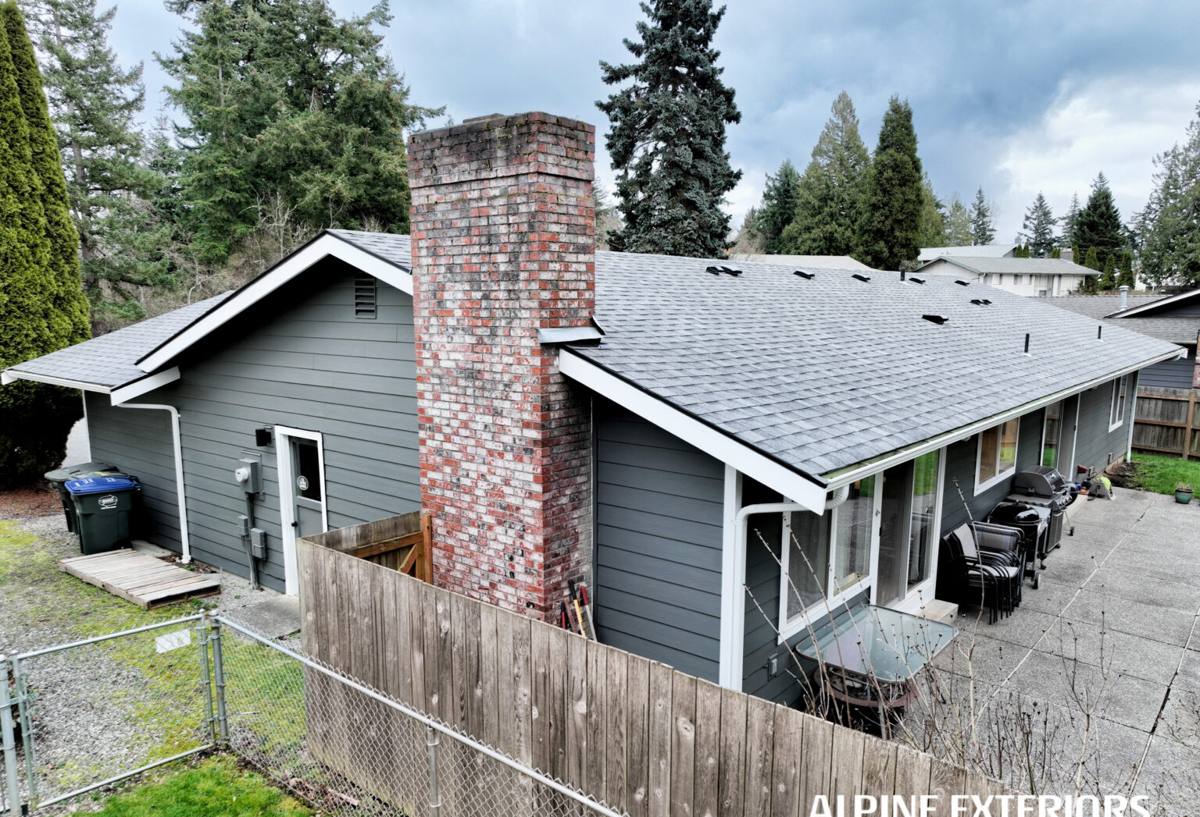
What Driving Rain and Salt Air Actually Do to a Wall
Wind-driven rain off Bellingham Bay doesn't just wet the surface of a wall — it pushes moisture sideways into laps, joints, and fastener penetrations. Over time, that's where failures start: swelling at cut edges, soft spots around poorly flashed penetrations, and paint that lifts because water got behind it instead of running off it. Salt air adds a second mechanism. It's mildly corrosive to exposed steel, so fasteners, flashing, and trim hardware that aren't rated for coastal exposure corrode faster than they would inland, which eventually shows up as rust staining or loosened fastening.
Moss compounds both problems. It doesn't attack siding directly the way rot does, but it holds moisture against the surface, blocks airflow and sun exposure that would otherwise help a wall dry, and — on wood-based products — creates a food source for the organisms that do cause decay. A wall that's shaded, damp, and mossy for half the year needs a siding material and an installation detail set built for exactly that, not a product that performs well in a lab test under ideal drying conditions.
Why We Standardized on James Hardie for Homes Like This
We install James Hardie fiber cement exclusively — not vinyl, not LP SmartSide, not other fiber cement brands like Allura or Cemplank. That's a deliberate call, not a default. Fiber cement as a category resists moisture, insects, and fire in ways vinyl and wood-based sidings can't match, but not all fiber cement is engineered or backed the same way. James Hardie builds its HZ5 product line specifically for the wetter, harsher climate zones on the West Coast, with a moisture and freeze-thaw profile suited to places like Whatcom County. The factory-applied ColorPlus finish is baked on and warranted against fading and flaking in a way field-applied paint simply isn't, which matters a lot on a wall that's going to spend months at a time under damp shade.
We're not going to tell you a competing product is junk — most fiber cement brands are reasonable materials in the right application. Our decision comes down to consistency: HZ5-rated Hardie boards, Hardie's engineering data for this climate zone, and a transferable warranty structure we're comfortable standing behind on every job. Standardizing on one system also means our crews know its installation details cold, instead of switching methods between product lines.
James Hardie Product Lines We Use Locally
- HardiePlank HZ5 lap siding — the standard horizontal siding for most Happy Valley homes, engineered for high-moisture, freeze-thaw climates
- HardiePanel — vertical panel siding, often used for accent walls, gables, or a board-and-batten look
- HardieTrim — fascia, corner boards, and window/door trim built to match the siding's moisture resistance so trim doesn't become the weak point
- HardieSoffit — vented and non-vented options for eaves, which matters where roof overhangs are already fighting moss and moisture
What a Correct Installation Involves
James Hardie siding performs the way it's engineered to only when it's installed to spec — the manufacturer's own data shows a meaningful share of siding complaints trace back to installation error, not the material. In a climate like this one, a few details matter more than usual:
- A drainage plane behind the siding. A properly lapped weather-resistive barrier — and, on many walls, a rain screen gap — gives any moisture that gets past the siding a path to drain and dry instead of sitting against the sheathing.
- Correct fastener type and placement. Fasteners need to be corrosion-resistant given the salt air, driven at the right depth and spacing per Hardie's fastening schedule — not just "close enough."
- Proper clearance from grade, roofing, and decks. Siding installed too close to soil, roof lines, or hardscape traps moisture at exactly the joints most exposed to splash-back and standing water.
- Flashing at every penetration. Windows, doors, hose bibs, light fixtures, vents — every penetration is a place water can get behind the siding if it isn't flashed and integrated with the drainage plane correctly.
- Factory-cut edges sealed, field cuts primed. ColorPlus boards are protected at the factory edges; any field cut needs to be sealed per Hardie's instructions or that edge becomes a moisture entry point.
Skip any one of these and you can end up with a wall that looks right for a couple of years and then starts failing from the inside out — which is a much more expensive fix than doing it right the first time.
Cost Factors Specific to a Job Like This
| Factor | Why It Matters in Happy Valley | Effect on the Job |
|---|---|---|
| Existing siding removal | Older homes may have layered siding history or hidden moisture damage under existing cladding | Full tear-off with sheathing inspection is often needed rather than a straight overclad |
| Tree-covered, sloped lots | Limited access, staging space, and equipment setup on wooded or hilly parcels | Can add labor time and affect scheduling around access |
| Trim and detail complexity | Multiple gables, dormers, or accent walls common in the neighborhood's older housing stock | More HardieTrim and flashing work per square foot of siding |
| Rain screen / drainage upgrade | Sustained shade and moisture make a drainage gap worth the added cost on many walls | Modest material and labor add, offset by long-term moisture protection |
| Color and finish selection | ColorPlus factory finish vs. primed boards for field paint | ColorPlus costs more upfront but removes a repaint cycle for years |
Our Process for a Happy Valley Home
We walk the property first, not just the walls. That means checking roofline drainage, gutter and downspout condition, grade slope away from the foundation, and how much shade and moss pressure each elevation actually gets — a south-facing wall and a north-facing wall on the same house can need different attention. From there we inspect the existing siding and sheathing for hidden moisture damage before quoting anything, because that inspection determines whether a wall needs a full tear-off or can be prepped and reclad.
Once we're into the install, the sequence is consistent: remove old siding and inspect sheathing, repair or replace any damaged sheathing, install and properly lap the weather-resistive barrier, add a rain screen gap where the wall calls for it, flash every penetration, hang HardiePlank and HardiePanel per Hardie's fastening schedule, install HardieTrim and HardieSoffit, and finish with sealant only where Hardie's install guide specifies it — not as a substitute for correct flashing. We clean up debris and old material as we go, not just at the end.
Why Local Experience on This Specific Neighborhood Matters
A crew that's already worked Happy Valley knows the practical stuff that doesn't show up in a general Bellingham estimate: which streets are tight enough to change how material gets staged, how much a heavily treed lot slows drying time between install stages, and how the City of Bellingham's permitting and inspection process runs for exterior work. That familiarity doesn't change the physics of moisture and siding, but it does mean fewer surprises mid-job and a more accurate estimate up front, because the crew has already seen how homes in this specific pocket of the county actually age.
It also means we've seen, on real Happy Valley houses, where moss and shade cause the most trouble — usually north- and west-facing walls under heavy canopy — and we plan drainage and maintenance recommendations around that instead of treating every elevation the same.
What to Ask Before Hiring Anyone for This Job
- Will they inspect and, if needed, replace damaged sheathing before residing — not just cover it up?
- Do they install a weather-resistive barrier and, where appropriate, a rain screen gap per Hardie's specifications?
- Are they James Hardie factory-trained or certified installers, and can they explain the fastening schedule they'll use?
- Will fasteners and flashing be rated for coastal, salt-air exposure?
- Do they carry manufacturer and workmanship warranties, and are those warranties actually transferable if you sell the home?
Living With Hardie Siding in a Moss-Heavy, Damp Climate
Correct installation gets you most of the way to long-term performance, but ongoing care matters too. Keep gutters and downspouts clear so water isn't sheeting down walls it was never meant to hit directly. Trim back vegetation that keeps a wall in permanent shade where it's practical to do so — it won't eliminate moss, but it helps a wall dry faster between rain events. Rinse visible moss and mildew buildup periodically rather than letting it establish; a soft wash is enough, and harsh pressure washing can force water behind laps and joints. Because ColorPlus finish is factory-baked rather than field-applied, it holds color and resists flaking through this cycle of damp and dry far longer than a standard field paint job would, which is part of why we don't offer primed-only boards as the default option here.
If you're weighing a siding project on a Happy Valley home — whether your current siding is showing moss, soft spots, or fading, or you're planning ahead of a bigger renovation — we're happy to walk the property, look at what your specific walls are dealing with, and put together a straightforward, no-pressure estimate. There's a form below to get that started.