 Bellingham Siding
 Why Cordata Roofs Face a Different Set of Demands
Cordata sits in north Bellingham, close enough to Bellingham Bay and the Strait of Georgia that the air carries a steady dose of salt and moisture almost year-round. That combination shapes everything about how a roof should be built here. Salt-laden air accelerates corrosion on exposed metal — flashing, fasteners, vent stacks — faster than it would inland. Driving, wind-pushed rain finds gaps that a calmer climate would never expose, especially on west- and southwest-facing slopes. And the long stretch of overcast, damp weather that defines a Whatcom County winter and spring gives moss and algae months on end to take hold on shaded or north-facing roof sections.
None of this means Cordata needs an exotic roof. It means the ordinary parts of the job — underlayment, flashing, fastener choice, ventilation — have to be done correctly and not rushed, because this climate finds every shortcut eventually.
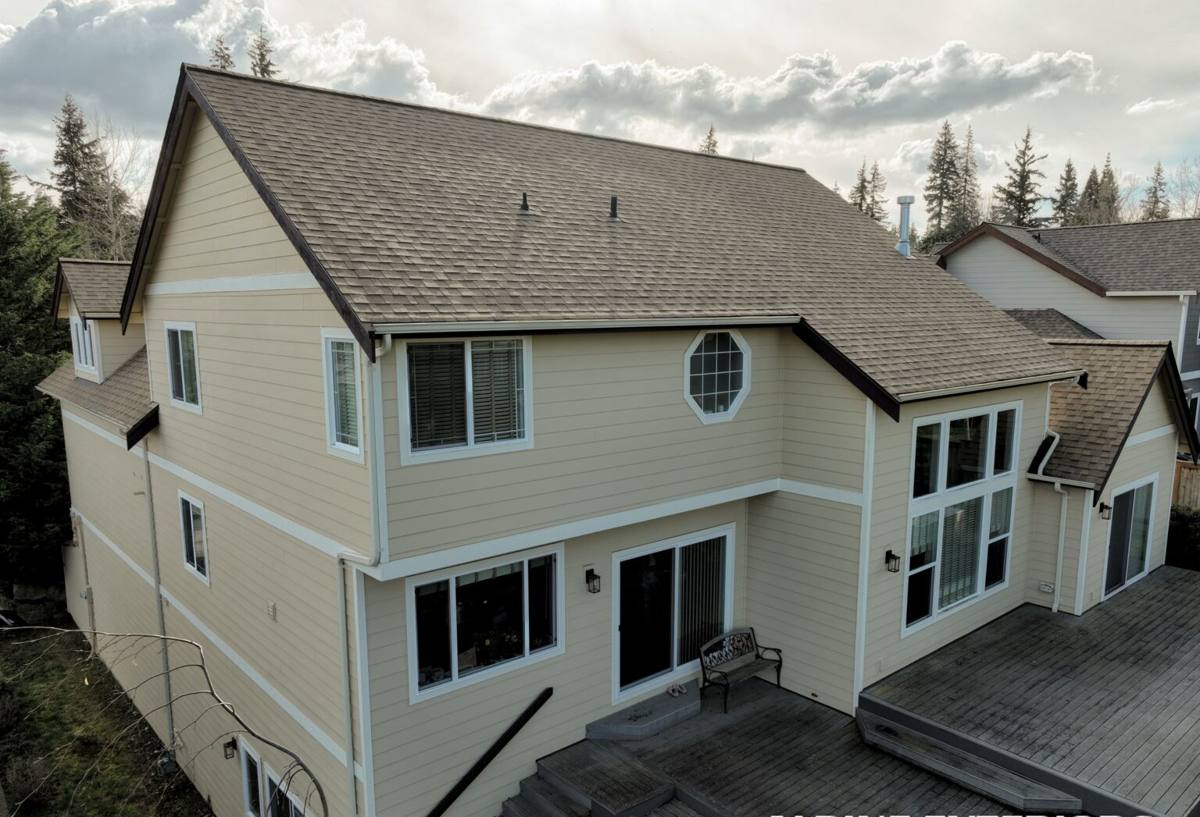
What a Correctly Installed Roof Actually Involves
A new roof is not just shingles or panels laid over a deck. The parts a homeowner doesn't see are what determine whether the roof performs for its full expected life or starts leaking in year eight.
The Deck Comes First
Before anything goes down, the roof deck itself needs to be sound — no soft spots, no delamination, no hidden rot from a slow leak that's been going unnoticed. Installing new roofing over a compromised deck just hides the problem under a fresh warranty label.
Underlayment and Water-Shedding Layers
In a climate with driving rain, the underlayment is doing real work, not just serving as a backup. Self-adhered ice-and-water shield belongs at eaves, valleys, and around penetrations, with synthetic underlayment across the rest of the field. Every valley, wall intersection, chimney, and vent pipe needs properly lapped, corrosion-resistant flashing — not just sealant, which degrades and is never a substitute for correct flashing geometry.
Fastening and Ventilation
Shingles or panels need to be fastened to the manufacturer's exact nailing pattern; under- or over-driven fasteners are one of the most common causes of premature failure and voided warranties. And the attic below needs balanced intake and exhaust ventilation, which matters as much for moss prevention as it does for energy efficiency.
Choosing a Roofing Material Suited to This Microclimate
There's no single "best" roofing material — the right choice depends on the home's roof pitch, tree cover, budget, and how much long-term maintenance the homeowner wants to take on. Here's how the common options stack up specifically against Cordata's salt air, rain, and moss pressures.
| Material | Moss & Algae Resistance | Wind-Driven Rain Performance | Typical Maintenance | Relative Cost Tier |
|---|---|---|---|---|
| Standard asphalt composition shingle | Moderate — improves with algae-resistant granules | Good when properly flashed and underlaid | Periodic moss removal on shaded slopes | Budget to mid-range |
| Architectural (laminated) asphalt shingle | Better — heavier profile sheds debris more readily | Very good, thicker mat resists wind uplift | Lower than 3-tab, still needs moss checks | Mid-range |
| Standing seam metal | Excellent — smooth surface discourages growth | Excellent, minimal seams for water to find | Low; occasional fastener and sealant checks | Premium |
| Synthetic/composite shake or slate | Good, varies by product | Very good with correct installation | Low to moderate | Mid to premium |
For most Cordata homes, an architectural asphalt shingle with algae-resistant granules gives the best balance of upfront cost and real-world durability against moss. Homes with heavy tree canopy or a long ownership horizon often find the higher upfront cost of standing seam metal pays off in lower maintenance over the decades.
Ventilation and Moisture Control — The Part Most Roofs Get Wrong
Moisture trapped in an attic is one of the leading causes of both premature roof failure and moss growth from the underside out. Proper ventilation means balanced intake at the soffits and exhaust at the ridge, with enough net free area to actually move air through the attic space — not just a token ridge vent with no matching intake.
Insulation baffles at the eaves keep loose-fill or batt insulation from blocking soffit vents, which is a common issue we find on older Cordata homes where insulation has settled or been added over the years without anyone checking the vent paths were still clear. Without that airflow, humid indoor air condenses against the cold underside of the roof deck, feeding rot and giving moss an extra moisture source from below.
What Tear-Offs on Older Cordata Homes Usually Reveal
Cordata is a mix of established homes from past decades alongside newer construction in the neighborhood's more recently developed sections. On the older housing stock, a full tear-off regularly uncovers a few recurring issues:
- Rotted or delaminated decking near valleys and under moss-covered north-facing slopes, where moisture sat the longest
- Missing or undersized ice-and-water shield at eaves and valleys, common on roofs installed before that detail was standard practice
- A second layer of shingles installed over the original roof, hiding deck condition and adding weight the structure wasn't necessarily sized for
- Flashing that was caulked over instead of properly replaced during a prior reroof
These are exactly the reasons a full tear-off — rather than a shingle-over-shingle recover — is usually the right call on an older roof, even though it costs more upfront. It's the only way to actually inspect and correct what's underneath, and most jurisdictions limit how many layers of roofing a structure can legally carry anyway.
Our Installation Process, Step by Step
- On-site inspection and honest estimate — we walk the roof and attic, not just look from the ground, before quoting anything
- Material selection — matched to the home's exposure, roof pitch, and the homeowner's maintenance preference
- Permit pulled — handled before work starts, per Whatcom County and City of Bellingham requirements
- Property protection — landscaping, siding, and gutters shielded before tear-off begins
- Tear-off and deck inspection — old roofing fully removed and the deck checked, with any damaged sheathing replaced
- Underlayment and flashing — ice-and-water shield, synthetic underlayment, and new flashing at every penetration and valley
- Roofing installation — shingles or panels installed to manufacturer nailing and exposure specifications
- Ventilation tie-in — ridge and soffit ventilation confirmed balanced before closing out
- Cleanup and magnetic sweep — job site and surrounding yard cleared of debris and stray fasteners
- Final walk-through — homeowner sees the finished roof and gets warranty paperwork before we call it done
Keeping a Roof Healthy Long-Term in a Marine Climate
A well-installed roof still needs a little ongoing attention in a climate this wet. A few practices go a long way toward protecting the investment:
- Zinc or copper strips near the ridge let rainwater carry trace metal ions down the roof face, which discourages moss regrowth over time
- Trimming back overhanging tree limbs reduces the shade and debris buildup that gives moss its foothold in the first place
- Gentle, low-pressure moss removal — never high-pressure washing, which strips granules and shortens shingle life
- Keeping gutters clear so water isn't backing up under the eaves during heavy rain events
None of this replaces a correctly installed, well-ventilated roof — it just extends what a good installation already gives you.
Permits, Codes, and Warranties in Whatcom County
A full roof replacement in Bellingham and unincorporated Whatcom County requires a building permit, and inspections confirm the work meets current wind exposure and structural requirements for the area. Skipping this step — or hiring a contractor who does — can create real problems at resale or with an insurance claim down the road.
It's also worth understanding that a roof carries two separate warranties: the manufacturer's warranty on the material itself, and the installer's workmanship warranty covering the labor. A high-end shingle installed with a poor nailing pattern or bad flashing detail can still fail early, and that failure is a workmanship issue the material warranty won't cover. Ask any contractor you're considering to spell out both, in writing.
Why a Crew That Already Works Cordata Matters
Roofing crews who work this specific area regularly build a feel for how conditions vary block to block — which streets sit under heavier tree canopy, which lots catch more wind off open exposure, where moss tends to come back fastest. That local pattern recognition shapes real decisions: how much ventilation a particular roof needs, whether a zinc strip is worth adding, which valleys deserve extra underlayment.
A local crew is also easier to hold accountable. We're not driving in from out of the area for one job and gone — we're pulling permits at the same county office, buying materials from the same regional suppliers, and standing behind work that our neighbors can see. If a storm rolls through and something needs a look, we're close enough to actually show up.
If you're weighing a new roof for a Cordata home, we're happy to walk the roof, answer questions honestly, and put together a straightforward estimate — no pressure, no hard sell. The form below is the easiest way to get started.