 Bellingham Siding
 Why Edgemoor Siding Wears Differently Than Other Neighborhoods
Edgemoor sits close to the water, under heavy tree cover, in one of the wettest corners of Washington. That combination is hard on exterior siding in three distinct ways: salt-laden air off Bellingham Bay slowly corrodes exposed metal fasteners and trim, wind-driven rain pushes moisture sideways into seams and laps that would stay dry in a more sheltered location, and the shade from mature trees keeps siding damp long after a storm has passed, giving moss and algae a head start. None of these factors are dramatic on their own, but stacked together over years they explain why siding repair needs in this part of Bellingham often look different from what we see on an open, sunny lot a few miles inland.
A siding repair job done right in Edgemoor has to account for all three factors at once — not just patch the visible damage, but address the moisture path and the fastener condition underneath it. That's the difference between a repair that lasts a season and one that lasts a decade.
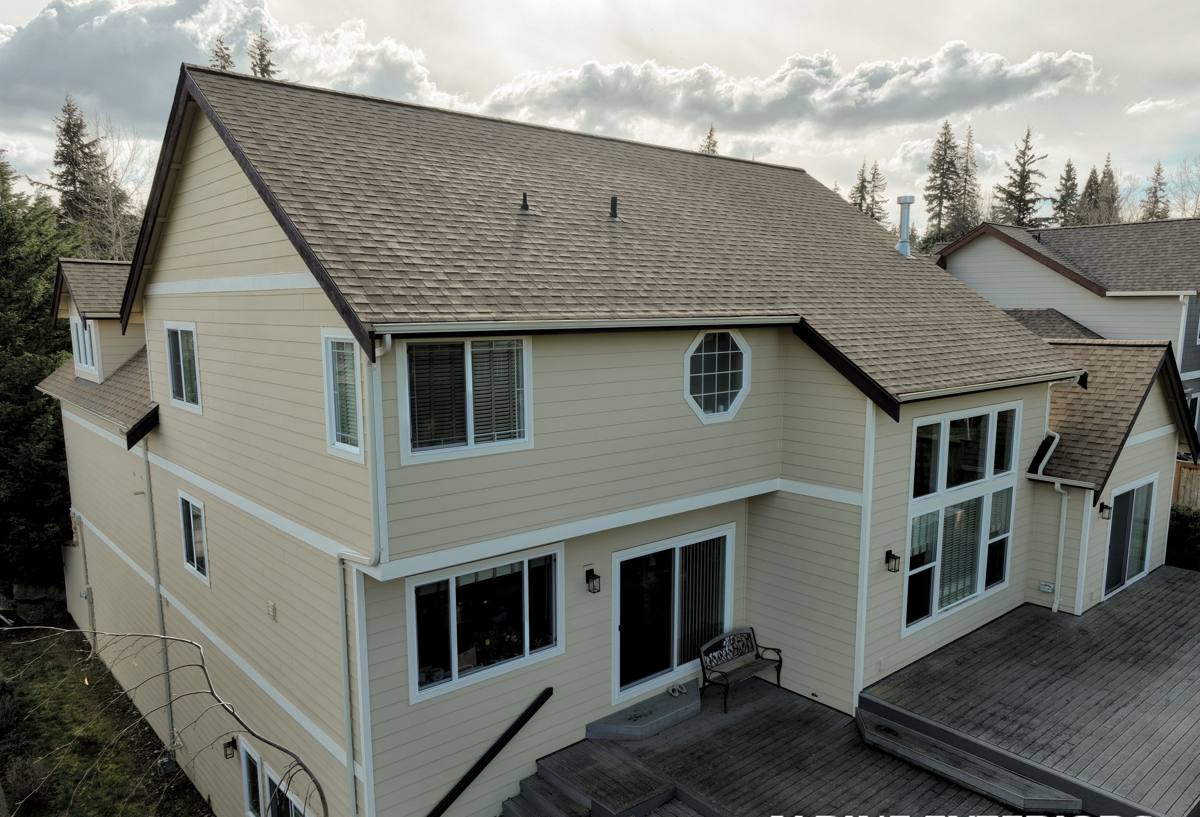
What Actually Causes Siding Damage Here
Wind-Driven Rain and Water Intrusion
Whatcom County's rain rarely falls straight down. Storms moving in off the water tend to drive rain sideways, which means siding laps, butt joints, and trim intersections take on water that a standard installation wasn't necessarily detailed to shed. Over time, water finds its way behind panels through gaps that were never caulked, through fastener holes that have widened, or through trim boards that have started to separate from the wall.
Salt Air and Fastener Corrosion
Homes closer to the water deal with a slow, steady exposure to salt-laden air. Standard fasteners and some trim hardware corrode faster in this environment than they would further inland. Rust streaking below nail heads or screws is one of the more common signs we see on Edgemoor siding inspections, and it's often the first clue that the fastening system needs attention, not just the surface finish.
Shade, Moisture Retention, and Moss
Mature tree canopy is part of what makes Edgemoor desirable, but it also means many homes get long stretches of shade where siding simply doesn't dry out between rain events. That extended dampness is exactly what moss, algae, and mildew need to establish themselves, and once moss gets a foothold on a seam or a damaged panel edge, it holds moisture against the material and accelerates whatever damage is already underway.
Signs an Edgemoor Home Needs Siding Repair
Most siding problems give warning signs well before they become structural. Homeowners in this area should walk the exterior a couple times a year, particularly after the wetter months, and look for:
- Cracked, split, or visibly warped siding panels or boards
- Soft or spongy spots when pressed, especially near the bottom courses and around windows
- Moss or algae buildup concentrated on shaded walls or north-facing sections
- Rust streaking below fastener heads or corroded trim hardware
- Gaps or separation at trim boards, corners, and butt joints
- Peeling, bubbling, or chalky paint that keeps failing in the same spots
- Visible staining or discoloration on interior walls that back up to exterior siding
Any one of these on its own might just need a targeted repair. Several appearing together, especially combined with interior staining, usually means water has been getting behind the siding for a while and the repair needs to go deeper than the surface.
Repair or Replace? How We Make That Call
Not every damaged section of siding needs a full re-side, and not every "small" crack is actually small once you get behind it. We look at the extent of the damage, the age and condition of the rest of the siding, and whether there's evidence of ongoing moisture intrusion versus a one-time, contained issue.
| Situation | Repair Usually Makes Sense | Replacement Is the Better Call |
|---|---|---|
| Damage extent | Isolated to one or two panels, boards, or trim pieces | Spread across multiple walls or elevations |
| Siding age/condition | Rest of the siding is sound and within its useful life | Siding is near or past its expected service life overall |
| Moisture evidence | No sign of hidden rot or interior staining | Sheathing or framing shows signs of water damage |
| Material match | Matching material and profile are readily available | Original material is discontinued or a poor long-term match |
| Underlying cause | A single identifiable cause (impact, one bad seam) | Systemic issue (failed house wrap, chronic moss/moisture) |
When the damage is contained and the underlying wall assembly is dry, a well-executed repair is the right, cost-effective answer. When we find soft sheathing, active rot, or damage spread across the exterior, we'll tell you honestly that a repair is a temporary patch on a bigger problem, and walk through what replacement would actually involve.
What a Correct Siding Repair Actually Involves
A repair that's done properly is not just swapping a cracked board for a new one. It involves:
- Diagnosing the cause, not just the symptom — is this impact damage, a fastener failure, a flashing gap, or ongoing moisture intrusion?
- Opening up enough of the wall to check the condition of the water-resistive barrier and sheathing behind the damaged section, not just the visible siding.
- Correcting the moisture path — re-flashing, re-caulking, or adjusting laps so water sheds the way it's supposed to, especially at trim and window intersections where wind-driven rain tends to concentrate.
- Matching materials and finish so the repaired section doesn't stand out or age differently than the surrounding siding.
- Addressing moss and organic growth at the source, not just cleaning the surface, since moss regrows quickly in shaded, damp conditions if the underlying moisture issue isn't resolved.
Skipping the first three steps is the most common shortcut we see in siding repair work — replacing what's visible while leaving the actual cause of the damage in place. That's how the same repair ends up needing to be redone in a few years.
Why Material Choice Matters for Repair Longevity
We install and repair James Hardie fiber cement siding exclusively, and in a climate like Edgemoor's, that choice has real consequences for how well a repair holds up. Fiber cement is non-combustible, dimensionally stable, and engineered for wet Pacific Northwest conditions in Hardie's HZ5 product line — it doesn't swell, cup, or absorb water the way wood-based siding can, which means a properly executed repair stays flat and tight instead of working itself loose again as the material moves with moisture.
Hardie's factory-applied ColorPlus finish is also relevant to repair work specifically: touch-up and caulk products are formulated to match the factory finish, so a repaired section can blend in rather than becoming an obvious patch that ages at a different rate than the rest of the wall. That's a meaningfully different repair experience than trying to patch vinyl, which can fade unevenly and become difficult to color-match after a few years in the sun, or wood-based products, where a repaired area is prone to absorbing moisture faster than the surrounding, already-weathered siding.
If a home in Edgemoor currently has vinyl, LP SmartSide, or cedar siding, we'll still repair what's there when a repair is the right call — but we'll also give you an honest read on how that material is likely to hold up long-term in this specific location, and what fiber cement would change if replacement ever becomes the better option.
Our Process for Edgemoor Homeowners
We keep siding repair straightforward and low-pressure:
- Inspection — we walk the full exterior, not just the spot you called about, since salt air and shade-driven moisture problems rarely stay contained to one section.
- Honest diagnosis — we tell you what we find, including whether it's a simple repair, a bigger moisture issue, or something in between.
- Clear estimate — a written scope of work and cost before anything is touched, with repair and replacement options laid out separately if both are on the table.
- The work itself — matched materials, correct flashing and sealing details, and cleanup that leaves your property the way we found it.
- Follow-through — if we find something during the repair that changes the scope, we stop and talk it through with you before continuing.
Why It Matters to Hire a Crew That Already Works This Area
Edgemoor's terrain and tree cover create access and staging challenges that a crew unfamiliar with the neighborhood has to figure out on the fly — sloped lots, mature landscaping close to the house, and limited driveway space all affect how a repair job gets set up and how long it takes. A crew that already works in this part of Bellingham knows what to expect before the first ladder goes up.
More importantly, familiarity with Edgemoor's specific exposure — its proximity to the water, its shade patterns, and how those interact with wind-driven rain off the bay — means we know where to look for hidden damage even when the visible symptom is small. That local pattern recognition is often the difference between a repair that solves the actual problem and one that just replaces what's easiest to see.
Keeping Repaired Siding in Good Shape Going Forward
Once a repair is done, a little seasonal attention goes a long way in this climate. Rinse moss and algae off shaded walls before it builds up rather than after. Keep gutters clear so runoff isn't sheeting down siding it wasn't meant to handle. Trim back vegetation that's keeping any wall section in constant shade or contact. And do a quick visual check after major windstorms, since wind-driven rain events are when small gaps and loose trim tend to reveal themselves first.
If you're noticing cracked panels, moss buildup, rust streaking, or you're just not sure whether what you're looking at is a simple repair or something bigger, we're happy to take a look. We offer free, no-pressure estimates for Edgemoor homeowners — walk the exterior with you, tell you honestly what we find, and lay out your options with no obligation. The form below is the quickest way to get that scheduled.