 Bellingham Siding
 New-Construction Windows for Sunnyland's Marine Climate
Sunnyland is one of Bellingham's older, established neighborhoods, but it still sees its share of new builds, additions, and teardown-rebuilds — infill lots, ADUs, and full new homes going up on streets lined with mature trees and post-war bungalows. When a house is framed and ready for windows, that installation only happens once before the siding, trim, and interior finishes close everything up. Get it right at that stage and the windows perform for decades. Get it wrong, and the mistakes get sealed behind walls where nobody finds them until there's a stain on the drywall.
Whatcom County's marine climate makes this a higher-stakes job than it looks. Sunnyland sits close enough to Bellingham Bay to get salt-laden air moving through on a west wind, driving rain arrives sideways more often than straight down, and a long, damp moss season keeps every exterior surface wet for months at a stretch. New-construction windows here need to be installed with that reality in mind from the first flashing strip, not treated as a generic install that happens to be in Washington.
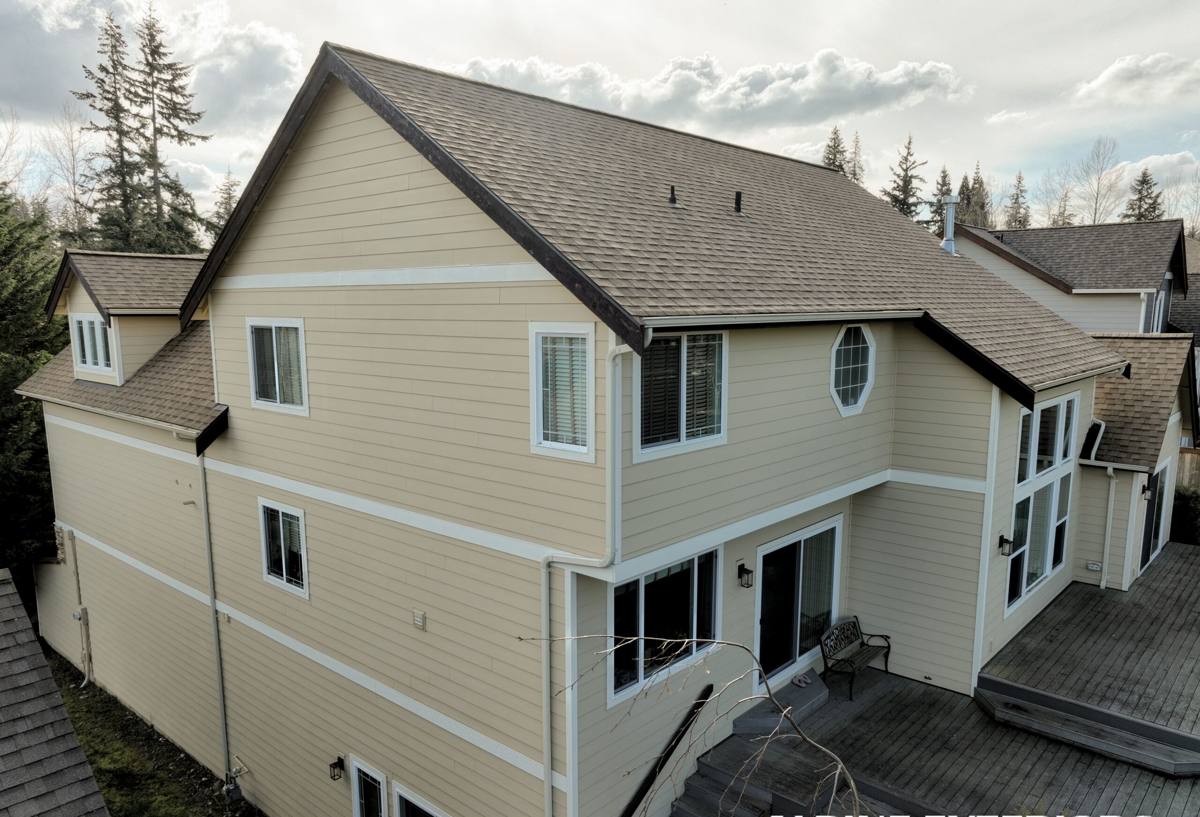
What Local Homes Actually Need From This Installation
New-construction window work is fundamentally a water-management job before it's anything else. The window unit itself is usually solid — most manufacturers build a reasonably weathertight product. What fails, almost every time we get called to fix a problem years later, is the interface between the window and the rest of the wall assembly: the flashing, the weather-resistive barrier (WRB) laps, and the sealant details that either shed water outward or let it track inward.
- Salt air: accelerates corrosion on fasteners, hinges, and unprotected metal flashing — material choice and fastener spec matter more here than in drier inland areas.
- Driving, wind-driven rain: pushes water sideways and upward under laps that would be fine in a straight-down rain climate — every flashing lap has to be installed shingle-fashion with no reverse laps.
- Long moss season: means siding, trim, and sills stay damp for extended periods, so any wood trim or sill material around the window needs a drainage path, not just a sealant bead, or it will hold moisture against the frame.
None of this is exotic. It's standard building science. But it only works if it's actually followed on site, on a schedule, before the siding crew closes it up.
Where New-Construction Window Installs Go Wrong
Most of the window-related water damage we see in Bellingham homes didn't come from a bad window. It came from one of a handful of installation shortcuts:
- No sill pan flashing, or a sill pan that wasn't sloped to drain outward
- Housewrap or WRB taped in the wrong order — head flashing tucked under the wrap instead of over it, which funnels water behind the barrier instead of over it
- Caulk used as the primary seal instead of a backup to proper flashing — sealant fails; flashing, installed correctly, doesn't
- Nailing fins fastened without a drainage gap, trapping water against the sheathing
- No integration plan with the siding system, so the rain screen gap (if there is one) doesn't actually carry water past the window
Any one of these can sit invisible for years. In a climate that stays wet as long as ours does, they tend to show up eventually — usually as rot at the sill or staining at the corners, discovered during a remodel or a routine inspection.
Flashing and Water Management
A correct installation follows a strict sequence: sloped sill pan flashing first (so any water that gets past the window drains back out, not into the framing), then the window unit set in sealant at the sides and top only — never the sill, which needs to stay a drainage plane — then jamb flashing lapped over the sill pan, and finally head flashing lapped under the WRB above the window and over the jamb flashing below it. Every lap works like shingles on a roof: upper piece over lower piece, always shedding down and out.
Window Selection for a Coastal Climate
Material matters more here than in a dry inland climate. Vinyl frames handle moisture well and need little maintenance, which suits a long wet season. Fiberglass holds up to temperature swings and coastal air with minimal expansion and contraction. Wood and wood-clad windows can look great but need diligent maintenance of exposed wood surfaces and finishes — in a neighborhood with a long moss season, that's a real ongoing commitment, not a one-time choice. We'll walk through the trade-offs honestly rather than push whatever's easiest to install.
Energy Performance
Washington's energy code sets minimum performance requirements for new construction, and for this climate zone a lower U-factor (better insulating value) matters more than a low SHGC (solar heat gain), since Bellingham doesn't get the intense summer sun that drives cooling-focused glass choices in other parts of the country. We spec glass packages based on orientation — north- and west-facing openings that catch the weather get different treatment than a sheltered south wall.
Our Process for a New-Construction Job in Sunnyland
- Rough opening check — verify every opening is square, level, and sized correctly before a single window arrives on site, so there's no field-cutting or shimming to fix a framing error.
- WRB and flashing plan review — walk the house with the builder or GC to confirm lap sequence and rain screen strategy before siding starts.
- Sill pan installation — sloped, sealed, and tested at every opening.
- Window set and fasten — shimmed plumb and square, fastened per manufacturer spec, sealed at jambs and head only.
- Flashing integration — jamb and head flashing lapped correctly into the WRB, ready for siding to lap over the top.
- Interior air-seal — low-expansion foam or backer rod and sealant at the interior gap, which matters as much for draft control as the exterior does for water.
- Photo documentation — every flashing detail photographed before it's covered by siding, so there's a record if a question ever comes up later.
That last step matters more than people expect. Once siding goes on, nobody can see the flashing again without tearing into the wall. A documented install gives you and any future inspector, appraiser, or buyer something to point to.
Window Frame Material Comparison
| Material | Coastal/moisture behavior | Maintenance | Relative cost |
|---|---|---|---|
| Vinyl | Won't rot or corrode; handles damp climate well | Low — occasional cleaning | Lower |
| Fiberglass | Stable through temperature swings; strong coastal air resistance | Low | Mid to upper |
| Wood-clad | Good performance if maintained; exposed wood needs protection | Higher — finish upkeep, especially in a long wet season | Upper |
| Aluminum | Prone to condensation and corrosion near salt air without thermal breaks | Moderate | Varies |
We'll talk through which fits your build, your budget, and how much upkeep you actually want to take on over the next 20 years.
Timing It With Your Build Schedule
Window installation sits at a pinch point in most builds — framing has to be done and squared, but siding can't start until the windows and flashing are in and inspected. On Sunnyland lots, where setbacks and existing tree canopy sometimes limit staging space, we coordinate directly with your general contractor or builder so windows show up on site ready to install the day the opening's ready, not sitting shrink-wrapped in a driveway for weeks. We also plan around the local inspection schedule so the weather-resistive barrier and flashing are ready for sign-off without holding up the siding crew behind us.
Why a Crew That Already Works Sunnyland Matters
Sunnyland's mix of older lot lines, mature trees, and infill construction means every site has its own quirks — narrow access, uneven grade, neighboring structures close to the property line. A crew that's already worked the neighborhood knows what City of Bellingham inspectors look for on flashing details, knows how the local weather behaves through the build season, and isn't learning the site's access constraints on your dime. That familiarity shows up as fewer surprises and fewer change orders once work starts.
Homeowner and Builder Checklist
- Confirm sill pan flashing is sloped and installed before the window goes in
- Ask to see the flashing lap sequence — head flashing should lap over jamb flashing, under the WRB above
- Confirm fasteners and flashing metal are rated for coastal/salt-air exposure
- Get photos of flashing details before siding covers them
- Check that the sill itself isn't sealed solid — it needs to stay a drainage path
- Confirm window U-factor meets Washington energy code for your climate zone
- Ask how the window integrates with your specific siding system's rain screen gap
If you're building, adding on, or replacing a wall section in Sunnyland and want windows installed the way this climate actually demands, we're happy to walk your site, review your plans, and put together a free, no-pressure estimate.