 Bellingham Siding
 Birchwood Homes Take a Real Beating From This Climate
Birchwood sits close enough to Bellingham Bay that salt-laden air is a constant factor on exterior surfaces, and close enough to the hills and tree cover around Lake Whatcom that shade, moisture, and moss are just as constant. That combination is harder on siding than either factor alone. Salt air accelerates corrosion on fasteners and metal trim. Shade and moisture keep wood-based products damp for days after a storm passes. Put both together and you get the pattern we see on a lot of older Birchwood homes: paint failing years before it should, trim soft at the corners, and green-black staining creeping up from the bottom courses no matter how often someone pressure-washes it off.
None of this is unusual for Whatcom County. It's just the reality of building an exterior envelope in the Pacific Northwest's wet, marine-influenced belt. The homes that hold up well here aren't lucky — they're sided with a material and a method that were chosen with this exact climate in mind.
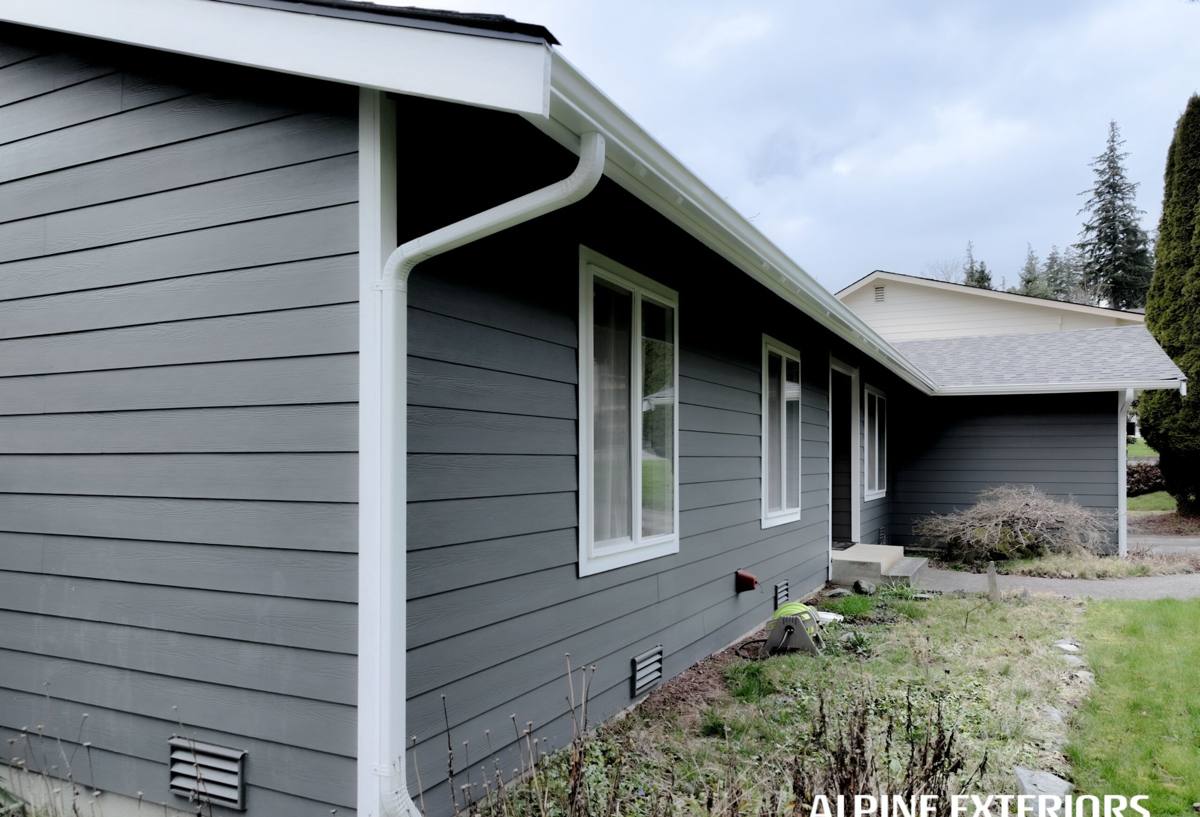
What "Correct" Siding Installation Actually Means Here
A lot of siding failure isn't a material problem — it's an installation problem that a wetter, cooler climate exposes faster than a dry one would. In Birchwood, a correct install has to account for:
- A continuous water-resistive barrier behind the siding, lapped correctly at every seam so wind-driven rain can't work its way behind the cladding
- Proper flashing at windows, doors, and any roof-to-wall transitions, since these are the points where driving rain actually gets in
- Correct fastener type and placement — the wrong nail in the wrong spot corrodes faster in salt-influenced air and can void a manufacturer's warranty outright
- Manufacturer-specified clearances between the bottom edge of the siding and grade, decks, roofs, and walkways, so splashback and standing moisture don't sit against the material
- Caulking and joint treatment that matches the product's actual expansion and moisture behavior, not a generic bead applied out of habit
Skip any one of these and the siding itself almost doesn't matter — moisture will find the gap. This is why we treat installation method as being at least as important as the product choice, and it's a big part of why we don't install every product a homeowner might ask for.
Why We Only Install James Hardie Fiber Cement
We install James Hardie fiber cement siding exclusively — not vinyl, not LP SmartSide, not Cemplank or Allura, not primed spruce or cedar. That's a deliberate standard, not a brand preference, and it comes down to how each of those materials behaves over years of Whatcom County weather rather than in a showroom.
Wood-based and engineered-wood products can perform fine for a while, but they depend on paint film and edge sealing staying intact to keep moisture out of the substrate — and in a climate with this much sustained dampness and shade, that film gets tested constantly. Vinyl is inexpensive and low-maintenance in dry climates, but it moves with temperature swings, can distort or crack in impact, and doesn't offer the same fire performance or the substantial, factory-baked finish that a lot of homeowners want on a long-term investment. We're not here to disparage any of these products — plenty of them are engineered well for the conditions they were designed for. We simply concluded that for a marine climate with this much sustained moisture and moss pressure, James Hardie's fiber cement gives our customers the best odds of the siding still looking and performing well fifteen and twenty years out.
Hardie's fiber cement is non-combustible, doesn't swell or rot the way wood-based products can, and its ColorPlus factory finish is baked on under controlled conditions rather than field-applied — which matters a great deal in a region where you can't count on a long stretch of dry, moderate days to cure a job-site paint job correctly. Hardie also engineers specific product lines (HZ5 and HZ10) for different climate zones, which lets us match the product to the specific moisture and temperature profile of a Whatcom County installation rather than using a one-size-fits-all board.
Our Installation Process for Birchwood Properties
Every job starts with a walk of the property to assess the existing wall assembly, look for any moisture damage already hiding behind the current siding, and check drainage patterns around the foundation — a step that matters more in Birchwood than it would somewhere drier, since trapped moisture behind old siding is common on homes that have had multiple layers of cladding over the decades.
Tear-off and inspection
We remove the existing siding down to the sheathing so we can actually see the wall, not guess at its condition. Any soft sheathing, compromised framing, or existing water intrusion gets addressed before anything new goes up — installing new siding over a hidden problem just buries it for the next owner to find.
Weather barrier and flashing
A new water-resistive barrier goes on with correct lapping and sealed penetrations, followed by flashing at every window, door, and transition point. This layer is what actually keeps driving rain out — the siding on top of it is the second line of defense, not the first.
Hardie installation to spec
Panels and planks go up per James Hardie's published installation manual — correct fastener spacing, correct clearances from grade and roof lines, and correct caulking at joints. We don't deviate from spec to save time, because the deviations are exactly what shows up as a callback two or three winters later.
Final detail and cleanup
Trim, caulking, and touch-up finish out the job, and the site is cleaned of debris and old material before we consider the job done.
Comparing Siding Options for a Whatcom County Home
| Factor | James Hardie Fiber Cement | Vinyl | Wood / Engineered Wood |
|---|---|---|---|
| Moisture resistance in a wet, shaded climate | Strong — cement-based, does not rot | Moderate — material itself doesn't rot, but seams can trap moisture | Depends heavily on paint film and edge-sealing staying intact |
| Finish durability | Factory-baked ColorPlus finish, long fade resistance | Color molded in but can fade and chalk over time | Field-applied paint, needs repainting on a shorter cycle here |
| Fire performance | Non-combustible | Combustible | Combustible |
| Behavior in salt-influenced air | Not affected by salt exposure the way metal fasteners/trim can be | Generally stable but can become brittle with age | Accelerated wear where salt air keeps surfaces damp longer |
| Warranty structure | Strong, transferable manufacturer warranty when installed to spec | Varies by manufacturer, often prorated | Varies, often shorter and product-dependent |
Signs a Birchwood Home Needs New Siding
Because of the moisture and moss exposure typical here, watch for these earlier than you might in a drier climate:
- Green or black staining that returns within weeks of cleaning, especially on north-facing or shaded walls
- Paint that's peeling, bubbling, or chalking well before the expected repaint interval
- Soft spots when you press on siding near the bottom edge or around window trim
- Visible gaps, warping, or separation at seams and corners
- Rising energy bills that suggest the wall assembly behind the siding is no longer performing
A Hiring Checklist Before You Sign Anything
- Ask for proof of current Washington contractor licensing and insurance, not just a business card
- Ask specifically how they handle flashing at windows, doors, and roof lines — a vague answer is a red flag
- Ask whether they're a James Hardie-certified or preferred installer, since manufacturer warranties often depend on correct, certified installation
- Ask for the full clearance and fastening spec they'll follow, not just "we'll do it right"
- Ask how they handle existing moisture damage found during tear-off, before it becomes a change-order surprise
Why Hiring a Crew That Already Works in Birchwood Matters
A crew that regularly works Bellingham and greater Whatcom County jobs already understands things a crew unfamiliar with the area has to learn on your dime: how much shade and moisture a given lot actually gets, how local permitting and inspection typically runs, and what moss and algae pressure does to a wall assembly over a full Pacific Northwest winter. That familiarity shows up in small decisions — where extra flashing attention is warranted, which wall orientations need closer inspection during tear-off, how aggressively to plan for drainage and clearance — that a generic install crew might not think to prioritize.
Maintenance After Installation
James Hardie fiber cement is low-maintenance, not no-maintenance. In this climate, an annual rinse to knock down surface moss and algae buildup, a periodic check of caulking at joints and trim, and prompt attention to any impact damage will keep the system performing the way it's designed to. None of this compares to the paint and edge-sealing upkeep that wood-based siding demands here, but it's worth building into a yearly routine regardless of what's on the wall.
If you're weighing a siding project on a Birchwood property, we're happy to take a look and give you a straightforward, no-pressure estimate — just fill out the form below.