 Bellingham Siding
 Board & Batten Siding Built for Lynden's Climate
Lynden sits in the Nooksack Valley, and that location comes with its own set of siding challenges. The valley holds moisture longer than the hillier parts of Whatcom County, morning fog is common much of the year, and the broader region's marine-influenced air keeps humidity elevated even on days without rain. Add in a long, wet Pacific Northwest winter and a moss season that can stretch from October into May, and you have conditions that punish the wrong siding choice fast.
Board and batten is a popular look for Lynden's farmhouse and craftsman-style homes — the vertical lines read as classic Northwest agricultural architecture, and it pairs well with the barns, outbuildings, and rural properties common throughout the area. But the style is only as good as the material and installation behind it. Get either wrong in a climate like this and you're looking at swelling, moss colonization, cupping boards, and premature paint failure within a handful of years.
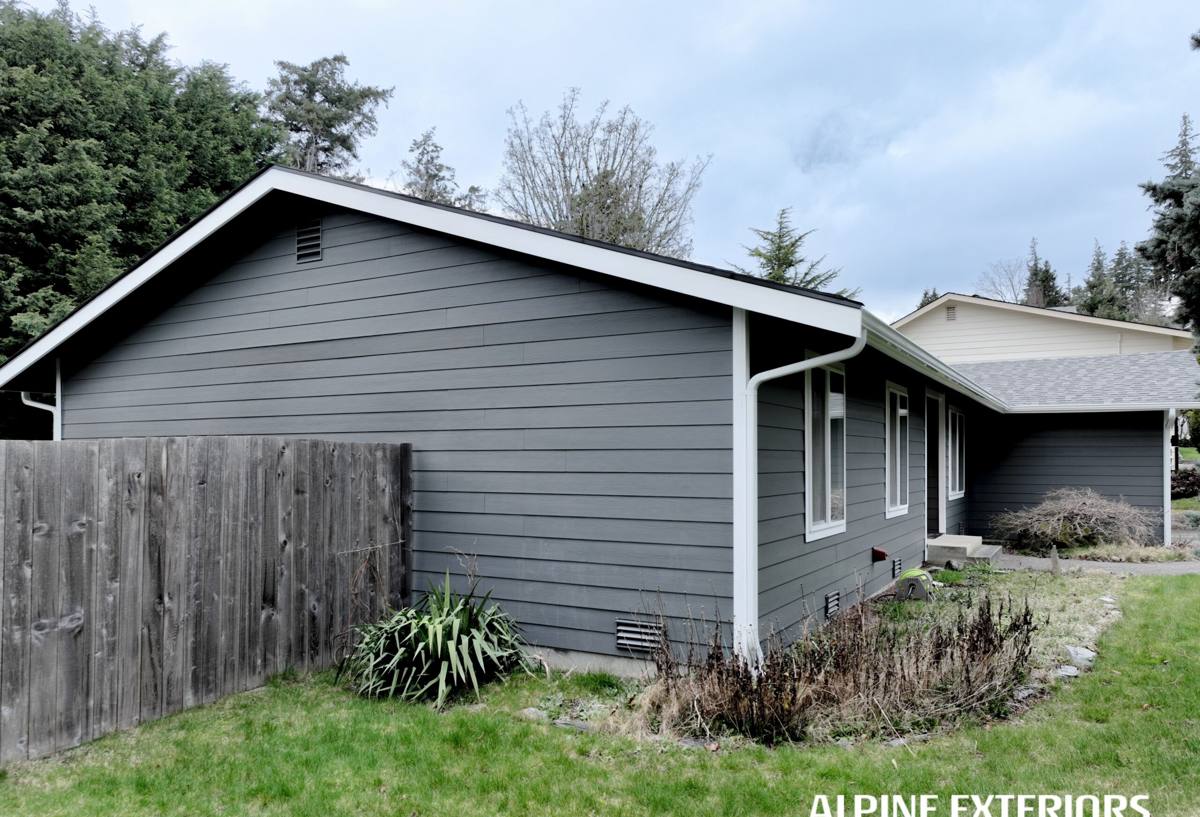
What Board & Batten Siding Actually Is
Board and batten is a vertical siding pattern: wide flat panels installed side by side, with narrower strips (the "battens") covering the seams between them. It's one of the oldest siding styles in North America, originally developed as a practical way to cover gaps in vertical wood planking. Today it's chosen mostly for its clean, linear look — but the underlying construction still matters just as much as it did a century ago.
Why the Pattern Matters in a Wet Climate
Vertical siding sheds water differently than horizontal lap siding. Done correctly, water runs straight down the face of the panel and off the bottom edge. Done poorly — wrong batten spacing, wrong fastening, no drainage path behind the panel — water finds the seams, gets trapped behind the battens, and sits there. In a climate with Lynden's rainfall and humidity, that trapped moisture is exactly what feeds moss, mildew, and eventually rot in the substrate behind the siding.
Why We Install Board & Batten in James Hardie Fiber Cement Only
We don't offer board and batten in vinyl, LP SmartSide, primed spruce, or cedar. We install it exclusively in James Hardie fiber cement, and that's a deliberate standard, not a sales preference.
Wood-based board and batten — cedar or primed spruce — looks great on day one, but wood is dimensional lumber, and dimensional lumber moves with moisture. In a valley climate where boards rarely get a long enough dry stretch to fully release humidity, that movement shows up as cupping, splitting, and open seams behind the battens, which is exactly where you don't want an opening. Vinyl board and batten avoids the rot problem but is a thin, flexible plastic product that telegraphs every irregularity in the wall behind it and can warp when temperatures swing. Fiber cement solves both problems: it's dimensionally stable across our wet winters and dry summers, it's non-combustible, and James Hardie's ColorPlus factory finish is baked on and warrantied rather than field-applied, which matters a lot for a product with narrow batten strips that are otherwise easy to over-caulk and under-paint.
The Two Ways We Build It
| Approach | How It's Built | Best For |
|---|---|---|
| HardiePanel vertical siding + battens | Large fiber cement panels installed vertically, joints covered with trim battens on a rainscreen gap | Full board and batten look, most common choice for Lynden farmhouse and craftsman homes |
| Board and batten accent | Same system applied to gables, dormers, or a porch feature while the rest of the home uses HardiePlank lap siding | Homeowners who want the look as a design accent rather than whole-house treatment |
What a Correct Installation Actually Involves
The visible battens are the least important part of a good board and batten job. Everything that determines whether it lasts is hidden behind the panel.
Weather Barrier and Drainage Gap
Every installation starts with a code-compliant weather-resistant barrier over the sheathing. Behind that, we build in a drainage gap — furring strips or a purpose-made rainscreen product — so that any moisture that does get past the panel face has somewhere to go besides sitting against the wall. In a climate with as much sustained rainfall as Lynden gets, skipping this gap is the single most common shortcut that leads to hidden rot behind board and batten siding.
Panel Gaps and Fastening
James Hardie specifies exact gapping between panels and precise fastener placement and spacing. Panels need room to expand and contract seasonally, and fasteners need to hit framing, not just sheathing. Battens are then face-nailed or blind-nailed at spacing that keeps them tight without trapping water behind the joint.
Flashing at Every Transition
Windows, doors, roof lines, and the bottom termination at the foundation are where board and batten siding fails first if flashing is skipped or done casually. We flash every one of those transitions before a single panel goes up, because that flashing — not the siding itself — is usually the actual water barrier at those points.
Field Priming and Painting Cut Edges
ColorPlus factory finish covers the face of the panel, but any edge cut on site is raw fiber cement until it's sealed. We prime and paint every field cut before installation, which is a step that's easy to skip and impossible to check once the batten is nailed over it.
Our Process for a Lynden Board & Batten Project
- On-site assessment — we look at existing siding, sheathing condition, and any signs of past moisture intrusion, particularly around windows and at grade level.
- Tear-off and sheathing check — old siding comes off and we inspect the sheathing underneath before covering it back up; this is the only point in the project where hidden damage is visible.
- Weather barrier and rainscreen installation — the drainage system goes in before any Hardie product is fastened.
- Flashing at all penetrations and transitions — windows, doors, and roof intersections first.
- Panel and batten installation to James Hardie spec — correct gapping, fastener pattern, and batten spacing.
- Caulking, priming cut edges, and final finish check — before we consider the job done.
Cost Factors for Board & Batten in Lynden
| Factor | Why It Affects Cost |
|---|---|
| Tear-off scope | Removing old cedar, vinyl, or damaged siding costs more when hidden rot or pest damage is found underneath |
| Whole-house vs. accent application | Full board and batten costs more than using it as a gable or dormer accent over standard lap siding |
| Sheathing repair | Any rotted or damaged sheathing found during tear-off has to be replaced before new siding goes on |
| Trim and batten density | Narrower batten spacing means more material and more labor hours per square foot |
| Home height and access | Two-story gables and steep rooflines increase labor time and equipment needs |
Maintenance and Longevity
James Hardie board and batten needs far less upkeep than cedar or primed wood alternatives, but "low maintenance" doesn't mean "no maintenance." A rinse-down once or twice a year keeps moss spores and organic buildup from getting a foothold, especially on north-facing walls that stay shaded and damp longest through Lynden's winter. Caulking at trim joints should be checked periodically, since caulk is the one component that wears out well before the siding does. Beyond that, ColorPlus finish is engineered to hold its color and resist moss and mildew far longer than field-applied paint, which is a meaningful advantage in a climate that gives painted wood surfaces very little time to fully dry between rain events.
Why Hiring a Crew That Already Works in Lynden Matters
Board and batten installed to a generic national spec doesn't automatically hold up in Whatcom County. A crew that already works in Lynden knows how deep to run the drainage gap for a valley climate that stays damp longer than the coast, knows which sides of a house need extra attention for moss, and knows how prevailing wind-driven rain patterns in this area tend to find weak flashing details. That local repetition is what turns a correct installation on paper into siding that's still performing the way it should after fifteen or twenty years.
Questions Worth Asking Any Contractor Before You Hire
- Do you install a drainage gap or rainscreen behind board and batten, or fasten it directly to the weather barrier?
- How do you flash window and door transitions specifically?
- Are cut edges primed and painted before installation, not after?
- What batten spacing and fastener pattern do you follow, and is it to manufacturer spec?
- Can you show examples of board and batten work you've completed in this area?
- What does your workmanship warranty cover, separate from the manufacturer's material warranty?
If you're considering board and batten siding for a home in Lynden, we're happy to take a look and walk you through what a correct installation looks like for your specific house. The estimate is free, there's no pressure, and you'll get a straight answer about what your home actually needs.