 Bellingham Siding
 Why Decks in Columbia Wear Out Faster Than Homeowners Expect
Columbia sits close enough to the water and the weather patterns that roll off Bellingham Bay that decks here take a beating most inland homes never see. Salt-laden air accelerates corrosion on fasteners, brackets, and any exposed metal hardware. Driving rain off the Sound doesn't just fall straight down — it gets pushed sideways into ledger boards, stair stringers, and the gaps between deck boards where it has no easy way to drain. And then there's moss season, which in this part of Whatcom County can run from early fall through late spring. Moss holds moisture against wood and composite surfaces for months at a time, and where it takes hold, rot and surface degradation aren't far behind.
Individually, none of these factors is dramatic. Together, over ten or fifteen years, they're exactly why a deck that looks fine from the yard can have a substructure that's failing underneath. A deck replacement done right in this neighborhood has to account for all three — not just swap old boards for new ones.
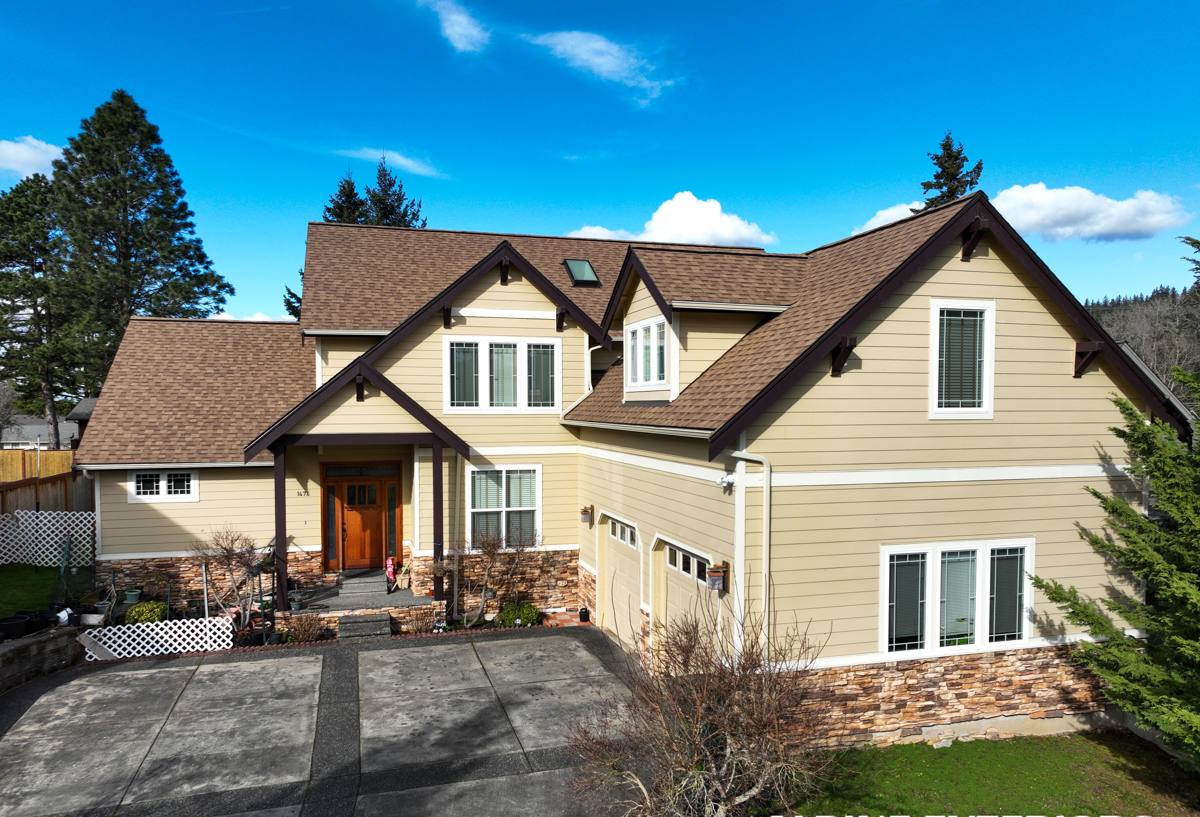
Signs a Columbia Deck Needs Replacement, Not Just Repair
Not every tired-looking deck needs to come out entirely. But there's a point where patching becomes false economy, and it's worth knowing where that line is before you spend money on the wrong fix.
Structural red flags
- Soft, spongy, or spring-loaded decking boards, especially near the house or in shaded corners
- Visible gaps or rust streaks at the ledger board where the deck attaches to the house
- Wobbly railings or posts that move independently of the deck frame
- Footings that have shifted, cracked, or heaved
- Persistent moss or algae growth in the same spots year after year, even after cleaning
Cosmetic wear versus structural failure
Faded color, minor surface checking on wood, or a few loose screws are cosmetic issues — those can often be addressed without a full tear-out. But once you're dealing with rot at structural connections, undersized or corroded framing hardware, or a ledger board that's separating from the house, repair work is just delaying a bigger problem. In our experience, a deck that's showing structural symptoms in more than one area is almost always cheaper to replace outright than to keep patching piece by piece.
What a Correct Deck Replacement Actually Involves
A deck replacement isn't just pulling up old boards and screwing down new ones. Done properly, it's a rebuild of everything that keeps water out and weight supported.
Tear-out and inspection
We remove the decking, railings, and any framing that's compromised, then inspect what's left — joists, beams, posts, and footings — before deciding what stays and what gets rebuilt. In a climate like ours, hidden rot at connection points is common even when the visible framing looks solid, so this step isn't optional.
Ledger board and flashing
This is the single most important part of a deck replacement in a region with as much driving rain as Bellingham gets. The ledger board — where the deck bolts to your house — needs proper flashing that directs water away from the house structure, not into it. A poorly flashed ledger is one of the most common causes of hidden water damage behind decks, and it's a detail that's easy to get wrong if it's rushed.
Footings and posts
Where footings have shifted or are undersized for current code, we replace or supplement them. Posts get proper post bases that keep the wood off standing water, rather than sitting directly in or on concrete where moisture collects.
Fasteners and hardware
Given the salt air near the water, we use fasteners and structural connectors rated for coastal or wet-climate exposure. Cheaper, uncoated hardware corrodes faster here than it would inland, and corroded fasteners are a slow, invisible way for a deck to lose structural integrity.
Choosing Decking Material for This Climate
There's no single "best" decking material — it depends on how much maintenance you want to do, your budget, and how the deck is used. Here's how the common options actually perform under Bellingham's conditions.
| Material | Moisture Performance | Maintenance | Typical Lifespan |
|---|---|---|---|
| Pressure-treated wood | Good if sealed regularly; prone to moss and mildew if neglected | Annual cleaning and re-sealing recommended | 10–15 years |
| Cedar | Naturally rot-resistant but still needs sealing in wet climates | Periodic cleaning and finish maintenance | 15–20 years with upkeep |
| Capped composite | Excellent — resists moisture absorption and moss staining better than wood | Occasional washing; no sealing or staining | 25–30 years |
| PVC decking | Excellent — fully synthetic, doesn't absorb water | Low; occasional washing | 25–30+ years |
We install both quality wood and composite/PVC systems, and we'll tell you honestly which fits your situation. Wood costs less up front but asks more of you every year — sealing, cleaning moss off shaded boards, watching for soft spots. Composite and PVC cost more initially but hold up better against the moss and moisture cycle that defines a Whatcom County winter. Where we're cautious is with lower-grade composite products that lack a full cap layer — those can absorb moisture at cut edges and fastener holes over time, which defeats the purpose of going composite in the first place. We'll walk you through what's actually under the surface of any product we quote.
Our Process for a Columbia Deck Replacement
- On-site assessment — We look at the existing deck, ledger connection, framing, and footings, and give you an honest read on repair versus replacement.
- Design and material selection — We talk through layout, railing style, and decking material based on your budget and how you use the space.
- Permitting — We handle the permit application and coordinate any required inspections with the local building department.
- Tear-out and disposal — Old materials are removed and hauled off; we protect landscaping and access points during demolition.
- Rebuild — Framing, ledger flashing, footings, and posts go in first and get inspected before decking and railings are installed.
- Final walkthrough — We go over the finished deck with you, including care instructions specific to the material you chose.
Permits and Code Requirements
Most full deck replacements in this area require a building permit, particularly when framing, footings, or railings are being rebuilt rather than just the surface decking. Requirements can vary depending on deck height, size, and proximity to property lines, and Whatcom County and the City of Bellingham don't always apply identical rules depending on exactly where a property sits. We pull the necessary permits and build to current code rather than to whatever the old deck happened to meet when it was built, since code requirements around guardrail height, stair geometry, and structural connections have generally gotten stricter over time.
Living With Your Deck After Replacement: Moss Season and Beyond
A new deck still needs some seasonal attention in this climate — the goal is just to make that attention minimal and predictable rather than reactive.
- Sweep leaves and debris off the deck surface regularly in fall, especially between boards where organic matter collects and holds moisture
- Rinse off moss and algae buildup before it has a chance to establish, particularly in shaded or north-facing areas
- Keep gutters and downspouts near the deck clear so runoff isn't dumping directly onto the deck surface
- For wood decks, plan on cleaning and re-sealing on a regular schedule rather than waiting until the finish has visibly failed
- For composite or PVC decks, an occasional wash with a soft brush and mild cleaner is usually all that's needed
- Check railing posts and stair connections once a year for movement or looseness
Why a Crew That Already Works in Columbia Makes a Difference
A deck built to a generic spec sheet and a deck built for a specific property in this neighborhood aren't the same job. A crew that's already worked on homes in Columbia knows how the salt air affects fastener choice, how the local rain pattern tends to find weak points in ledger flashing, and how aggressively moss establishes itself in the shadier lots around here. That familiarity shows up in the details — the flashing detail at the ledger, the hardware spec, the drainage slope — the things that don't show up in a photo but determine whether the deck is still solid in fifteen years.
It also means someone who understands the permitting relationship with local building officials and won't be guessing at requirements specific to this area. That's less back-and-forth for you and fewer surprises mid-project.
Get a Straight Answer About Your Deck
If your deck is showing its age, we're happy to take a look and give you an honest assessment — repair, partial rebuild, or full replacement — along with a clear, no-pressure estimate. Use the form below to request a time that works for you.