 Bellingham Siding
 Building Decks for Cordata's Wet Northwest Climate
Cordata sits in north Bellingham, close enough to Bellingham Bay to pick up salt-laden air off the water and far enough into the Whatcom County tree cover to sit under shade and dampness for months at a stretch. That combination is hard on outdoor structures. A deck here isn't just dealing with rain — it's dealing with rain that doesn't fully dry between storms, moss and algae that take hold on any surface that stays damp, and a fall-through-spring stretch where the sun barely gets a chance to do its job. Any decking material you put down in this neighborhood needs to handle that reality, not the drier, sunnier climate most decking products are marketed around.
We install composite decking for homes in and around Cordata regularly enough to know which details matter here specifically — where water actually collects on a Bellingham lot, which board profiles shed moss better, and how a substructure needs to be built so it isn't fighting moisture from day one. This page is about that one job, done right, for this one area.
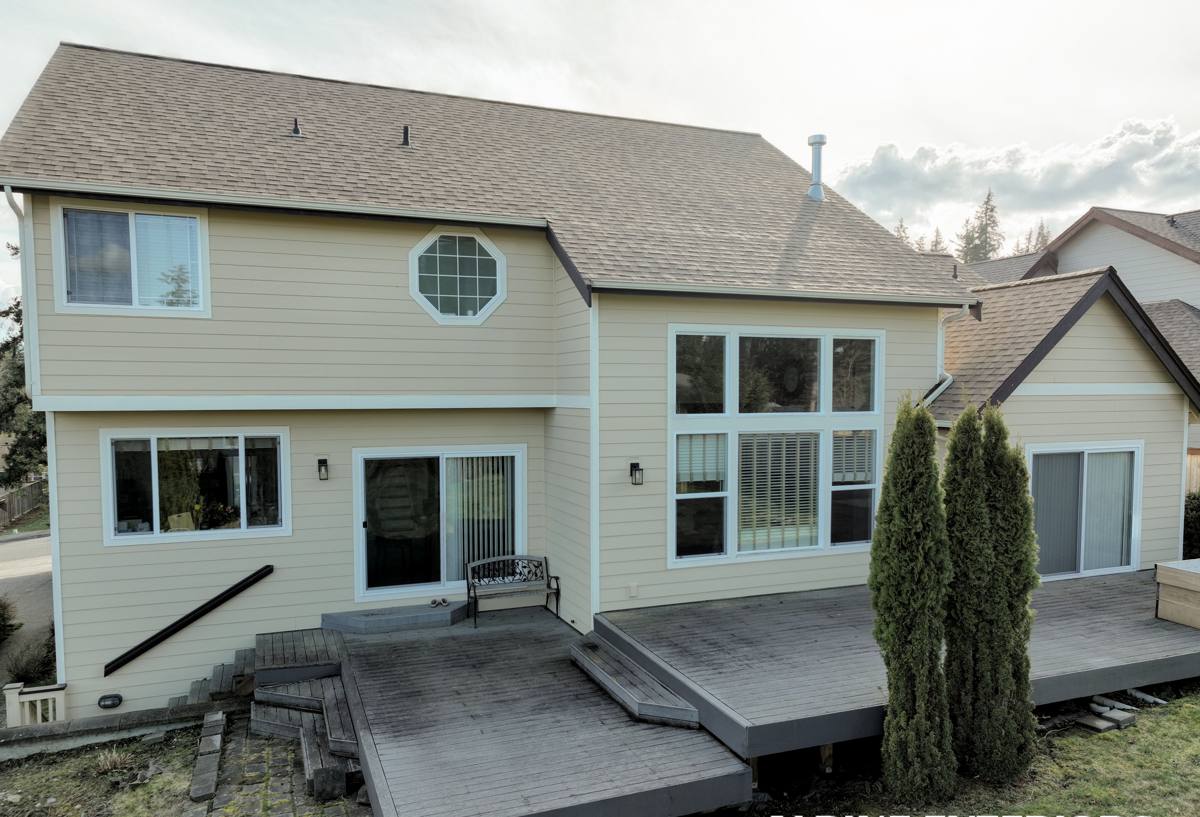
Why Composite Makes Sense in This Climate
The Trouble With Wood Here
Wood decking isn't a bad product — it's a maintenance commitment. In a climate that stays wet as long as Whatcom County's does, that commitment is bigger than most homeowners expect. Untreated or under-maintained wood decking in this area will gray, splinter, and grow moss within a season or two if the annual cleaning and sealing schedule slips even once. Given how long our wet season runs, that schedule slips a lot.
What Composite Actually Changes
Composite decking swaps that maintenance cycle for an upfront material cost. The boards don't absorb water the way wood fibers do, they don't need annual staining or sealing, and they don't splinter. That doesn't mean composite is maintenance-free — it still needs to be kept clean of moss and organic debris — but the maintenance is periodic washing rather than a yearly refinishing project. For a lot of Cordata homeowners, especially those with decks under tree cover or in shaded side yards, that trade-off is the whole reason to go composite in the first place.
What a Correct Composite Deck Installation Involves
Composite boards are only as good as what's underneath them. Most of the complaints we hear about composite decking — soft spots, board sagging, moisture trapped underneath — trace back to a substructure or installation shortcut, not the decking material itself.
The Substructure Nobody Sees
In a climate this wet, joist spacing and joist protection matter more than they would somewhere dry. We use joist tape on the framing to keep moisture from wicking into the wood substructure from the top down, and we hold to manufacturer joist-spacing specs rather than stretching them to save a few boards. Ground clearance and airflow underneath the deck also matter — a deck built low and tight to damp ground in a shaded Cordata yard is a deck that stays wet longer and invites the substructure rot that composite boards were supposed to prevent.
Fastening and Board Layout
Hidden fastener systems are standard on most composite lines now, and they matter for more than looks — a clean top surface with no exposed screw heads is also a surface with fewer places for water and debris to sit and start growing moss. Board layout should account for water flow off the deck surface, not just visual symmetry from the door.
Flashing and Ledger Connections
Where a deck attaches to the house, proper ledger flashing keeps water from working its way behind siding or into the rim joist. This is one of the most common failure points on decks we're asked to repair or rebuild, and it has nothing to do with the decking brand — it's a framing and flashing detail that has to be right the first time, because it's the part that's hardest to inspect once the boards are down.
Choosing the Right Composite for a Cordata Deck
Not all composite decking is built the same way, and the differences matter more in a wet climate than they would somewhere dry. The table below breaks down the main tiers we see homeowners choosing between.
| Decking Type | Upfront Cost | Moisture Behavior | Ongoing Maintenance |
|---|---|---|---|
| Basic / uncapped composite | Lower | Can absorb some moisture at cut edges and fastener points over time | Occasional washing; edge sealing recommended |
| Capped composite | Mid-range | Protective outer shell resists moisture and staining | Periodic washing to clear moss and pollen film |
| Solid PVC decking | Higher | No wood content, so it doesn't absorb moisture at all | Lowest of the three; mainly surface cleaning |
| Pressure-treated wood (for comparison) | Lowest | Absorbs and releases moisture constantly, especially in shade | Annual cleaning, sealing, and inspection |
For most Cordata properties — especially anything with shade from mature trees or a north-facing exposure that doesn't dry out quickly — we recommend capped composite as the baseline. Uncapped composite still leaves cut edges and fastener areas more exposed to the moisture this area gets for months at a time. Solid PVC is worth the upgrade for decks that stay wet or shaded almost year-round, but it isn't necessary for every yard, and we'll tell you honestly when it isn't.
Our Process, From First Call to Finished Deck
- Site visit and assessment — we look at drainage, sun and shade exposure, existing substructure condition (if there's a deck to replace), and how the deck ties into the house.
- Straightforward proposal — material options, realistic cost ranges, and a timeline, explained in plain terms rather than a sales pitch toward the most expensive option.
- Framing and substructure work — this is where most of the long-term durability of the deck actually gets decided, and where we spend the extra time joist tape and proper flashing require.
- Board installation — hidden fastening, correct board gapping for drainage and seasonal expansion, and clean edge finishing.
- Final walkthrough — we check the deck with you before calling the job done, not after.
Moss, Algae, and Long-Term Deck Care in Whatcom County
Even the best composite deck will pick up a film of pollen, algae, or moss spores over a Bellingham winter — the difference is that composite sheds it easily instead of letting it root into the material the way it can with wood grain. A seasonal wash with a deck brush and a mild cleaner (avoiding pressure washing directly into capped composite surfaces at close range, which can damage the cap) keeps most decks looking clean without any special products. Decks that sit under heavy tree cover or get very little direct sun will need this more often than decks in open, sunnier parts of a Cordata lot — that's simply the reality of this climate, and it's worth factoring into how you place a new deck if you have any flexibility in the design.
Signs Your Current Deck Needs Attention
Whether you're deciding between a repair and a full replacement, these are the things worth checking before the next wet season sets in:
- Soft, spongy, or bouncy spots when you walk across the deck surface
- Boards that have visibly cupped, warped, or separated at the seams
- Persistent moss or algae that comes back within days of cleaning
- Rust staining or loose fasteners around board edges
- Gaps or water staining where the deck meets the house siding or ledger board
- Visible rot or darkened wood on any exposed substructure or stair stringers
- A deck older than 15–20 years that has never had the substructure inspected
Any one of these on its own might just need a repair. Several together, especially soft framing combined with ledger staining, usually mean it's time to talk about a full rebuild rather than patching around the problem.
Why a Crew That Already Works Cordata Matters
A lot of decking problems in this region aren't material problems — they're the result of a build that didn't account for how wet and shaded a Whatcom County lot can stay for half the year. A crew that installs decks across a range of climates might default to standard spacing, standard flashing, and standard joist protection because that's what works most places. We build every Cordata deck assuming it will spend months at a time damp, under moss pressure, and exposed to salt-tinged air off the bay — because around here, that's not the exception, it's the normal season.
If you're weighing a new deck, a replacement, or just want an honest read on whether your current one is worth repairing, we're happy to come take a look. The estimate is free, there's no pressure to commit on the spot, and you'll get a straight answer about what your deck actually needs — use the form below to get started.