 Bellingham Siding
 Siding Built for the Way Cordata Actually Gets Weathered
Cordata sits on the north end of Bellingham, close enough to Bellingham Bay and the Salish Sea that salt-laden air reaches the neighborhood on a regular basis, especially during winter storms pushing in off the water. Add Whatcom County's long wet season, driving horizontal rain during winter fronts, and a moss season that can run eight months or more in shaded, north-facing exposures, and you have a climate that is genuinely hard on exterior siding. Homes in Cordata don't fail because the neighborhood is unusual — they fail because too much siding gets installed as if it were going on a house in Spokane or Boise, with product and detailing that were never engineered for this kind of moisture load.
This page is about one thing: what it actually takes to install siding correctly on a Cordata home, given the climate this neighborhood sits in, and why the crew you hire matters as much as the product you choose.
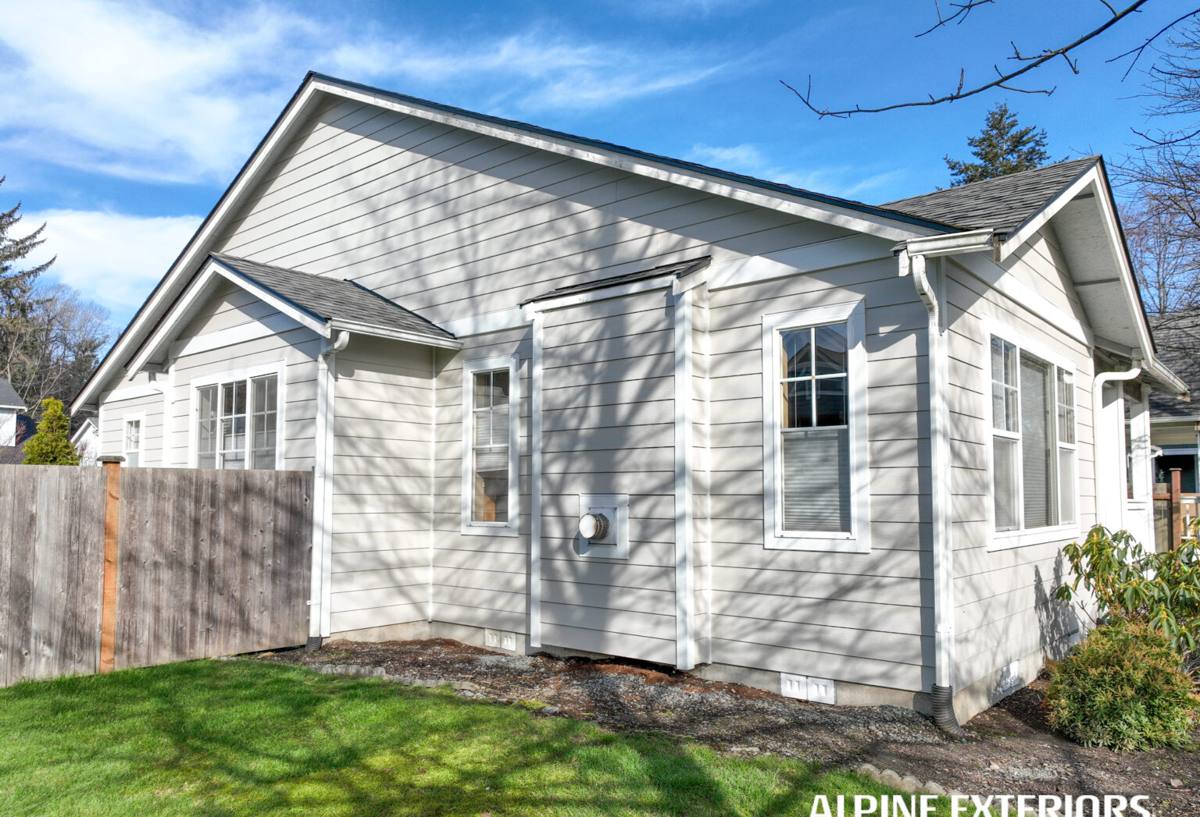
What Bellingham's Climate Does to Siding Over Time
Salt Air
Airborne salt doesn't just affect homes directly on the waterfront. It travels inland on wind, settles on exterior surfaces, and accelerates corrosion of fasteners, flashing, and any metal trim components. Over years, salt exposure can also degrade lower-quality paint films and finishes, leading to chalking and color loss well before a product's expected lifespan.
Driving Rain
Bellingham's winter storms frequently bring rain at an angle, not straight down. That matters because siding systems are only as good as their ability to shed water that's being pushed sideways into laps, seams, and penetrations. Flat, calm-weather-only installation practices — minimal flashing, caulk relied on as a primary water barrier, tight or nonexistent clearances — tend to hold up fine in dry climates and fail here within a handful of seasons.
Moss Season
North-facing walls, shaded elevations under mature trees, and areas that stay damp longest are where moss and algae take hold first. Moss holds moisture against the siding surface, which is a problem for any material that isn't dimensionally stable and rot-resistant. It's also cosmetically the first thing homeowners notice, since it shows up as dark green-black streaking and patches well before any structural issue is visible.
Common Problems We See on Cordata Homes
- Moss and algae staining concentrated on shaded, north- and west-facing walls
- Soft or delaminating siding at the bottom courses, near grade, where splash-back moisture collects
- Failed or missing kick-out flashing where rooflines meet walls, letting water track behind the siding
- Caulk-dependent seams that have cracked and opened gaps after a few freeze-thaw cycles
- Warped, buckled, or faded vinyl panels on southern and western exposures
- Paint film breakdown on wood-based or primed-only products, exposing raw substrate to moisture
Almost all of these trace back to two root causes: a product that wasn't suited to sustained moisture exposure, or an installation that didn't account for how water actually moves across a wall in this climate.
What a Correct Siding Installation Actually Involves
Siding is a water management system, not just a finish material. A correct installation in Cordata's climate includes several things that are easy to skip and hard to notice once the siding is up:
Behind the Siding
- A continuous weather-resistive barrier (housewrap) installed shingle-style so every layer sheds water downward and outward
- Proper flashing at every window, door, and roof-to-wall intersection — not caulk substituting for flashing
- Kick-out flashing at roof-wall junctions to divert water away from the wall plane, not down behind the siding
- A drainage gap or rainscreen strategy where appropriate, so any moisture that does get behind the cladding can drain and dry rather than sit against the wall sheathing
The Siding Itself
- Correct fastener type, spacing, and penetration depth per the manufacturer's engineering specs — not framing-crew guesswork
- Proper clearance from grade, decks, patios, and roof lines so splash-back and standing water don't sit against the bottom edge
- Factory-finished color and coating rather than field-applied paint, which is far more consistent in coverage and adhesion
- Caulk used only where it's supposed to be used — as a secondary seal, never as the only line of defense against water intrusion
Skip any one of these and the siding may still look fine for a year or two. In Bellingham's climate, that's usually about how long it takes for the shortcuts to start showing.
Why We Install Only James Hardie Fiber Cement
We standardized on James Hardie fiber cement siding for every home we side, including in Cordata, because it's engineered for exactly the conditions this neighborhood deals with. James Hardie's HZ5 product configuration is formulated specifically for Pacific Northwest weather — moisture cycling, moss and mildew exposure, and temperature swings — rather than being a one-size-fits-all product shipped to every region.
What Sets It Apart
- Non-combustible — fiber cement doesn't burn, which matters for insurance and long-term risk, unlike vinyl or wood-based products
- Dimensionally stable — it doesn't warp, buckle, or expand and contract the way vinyl does in temperature swings, and it doesn't absorb and swell with moisture the way wood-based products can
- ColorPlus factory finish — a baked-on finish applied under controlled conditions, far more consistent and durable than field-applied paint, and it resists the fading and chalking that salt air accelerates
- Moss and mildew resistant — the material itself doesn't feed organic growth the way wood-based siding can, which matters directly for Cordata's shaded, damp elevations
- Strong transferable warranty — backed by the manufacturer, and transferable to a future buyer if the home sells, which matters for resale in a market where buyers increasingly ask what the siding is
We get asked why we don't also install LP SmartSide, vinyl, Cemplank, Allura, or primed wood. Each of those has legitimate uses and each has honest trade-offs — vinyl can crack and fade in UV and cold, wood-based products are more moisture- and pest-sensitive, some fiber cement competitors have thinner factory finishes or shorter track records in this specific climate. We made a professional call to install one system, understand it completely, warranty it properly, and stand behind it — rather than spreading our crew's expertise across five product lines.
Our Installation Process
| Step | What Happens |
|---|---|
| 1. On-site assessment | We inspect existing siding, sheathing, flashing, and problem areas specific to your home's exposure and shading |
| 2. Written estimate | Clear scope, product selection, and pricing — no vague allowances |
| 3. Tear-off and sheathing check | Remove old siding, inspect sheathing for rot or moisture damage, repair before anything new goes on |
| 4. Weather barrier and flashing | Housewrap, window/door flashing, and kick-out flashing installed per manufacturer specs |
| 5. Hardie installation | Fastened, spaced, and finished to James Hardie's published installation instructions |
| 6. Final walkthrough | We walk the exterior with you before calling the job done |
Cost Factors for a Cordata Siding Project
| Factor | Why It Affects Cost |
|---|---|
| Home size and wall complexity | More corners, gables, and cutouts mean more cutting, fitting, and labor time |
| Existing siding removal | Tear-off of old vinyl, wood, or damaged siding adds labor and disposal cost |
| Sheathing repair | Rot or moisture damage found underneath the old siding needs to be fixed before new siding goes on |
| Hardie product line and profile | Lap width, panel style, and trim details vary in material cost |
| Color and finish | Standard ColorPlus colors versus custom finishes affect pricing |
| Access and site conditions | Multi-story sections, steep lots, or tight access affect scaffolding and labor time |
Why Hiring a Crew That Already Works in Cordata Matters
Siding installed correctly on paper can still fail if it's not adapted to a specific home's exposure. A crew that regularly works in Cordata and north Bellingham already knows which elevations tend to hold moss, how local roof-to-wall details typically need to be flashed, and what Whatcom County's building department expects for weather-resistive barrier and clearance requirements. That local pattern recognition is what separates a siding job that looks good at handoff from one that still looks good in year ten.
It also means faster, more accurate estimates. When a crew has seen dozens of homes with similar construction and exposure in this neighborhood, they're not guessing at problem areas — they know where to look first.
Signs Your Cordata Home May Need New Siding
- Visible moss or algae staining that returns quickly after cleaning
- Soft spots, bubbling, or delamination anywhere on the siding surface
- Cracked, gapped, or missing caulk at seams and trim
- Paint that's peeling or chalking heavily, especially on south- and west-facing walls
- Visible warping, buckling, or waviness in the siding panels
- Water stains or discoloration on interior walls near exterior corners or window headers
If your home shows one or two of these, it may be a repair. If it shows several, especially combined with soft sheathing underneath, full replacement is usually the more cost-effective long-term answer.
If you're in Cordata and want a straight answer about what your siding actually needs, we're happy to take a look. Fill out the form below for a free, no-pressure estimate — we'll tell you honestly whether you need a repair, a partial replacement, or a full re-side, and why.