 Bellingham Siding
 Edgemoor's Setting Is Beautiful — and Hard on Siding
Edgemoor sits close to Bellingham Bay, tucked under a heavy canopy of fir, cedar, and maple. That combination is part of what makes the neighborhood desirable, and it's also exactly what makes exterior siding work harder here than it does a few miles inland. Salt-laden air off the bay corrodes unprotected fasteners and trim over time. Driving rain off Puget Sound pushes water sideways into joints and laps that would stay dry in a calmer climate. And the shade from mature trees keeps siding damp long after a storm has passed, which is the exact condition moss and algae need to take hold.
None of this is unique to any one house in Edgemoor — it's a neighborhood-wide pattern tied to proximity to the water and tree cover. Siding that isn't engineered for that combination of salt exposure, wind-driven moisture, and prolonged dampness tends to show its age early: swelling at the seams, streaking, soft trim, and moss creeping up from the bottom courses. This page covers what James Hardie fiber cement siding does differently, what a correct installation looks like for a home in this setting, and how our process works from first estimate to finished job.
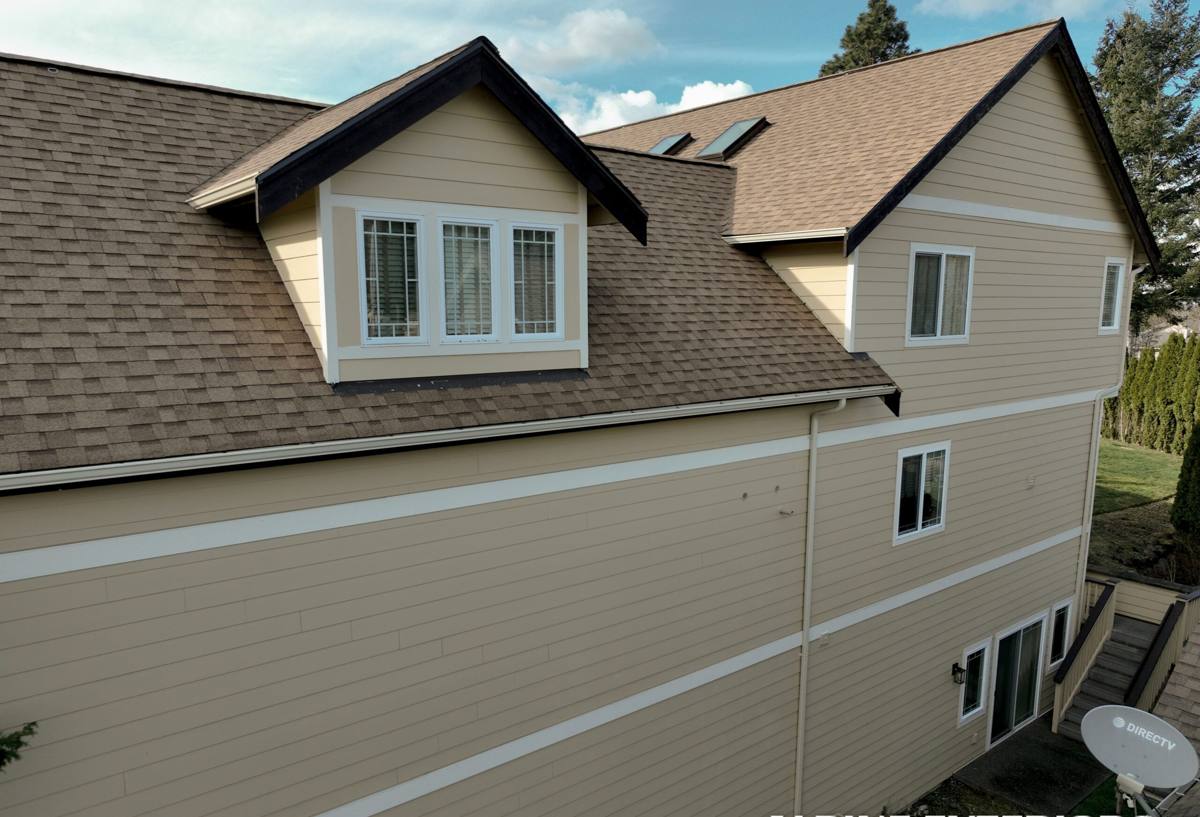
Why We Only Install James Hardie Fiber Cement
Our company installs one siding product: James Hardie fiber cement. We don't install vinyl, LP SmartSide, Cemplank, Allura, primed spruce, or cedar, and that's a deliberate standard, not a limitation. Fiber cement is a blend of cement, sand, and cellulose fiber, pressed and cured into a board that doesn't rot, doesn't attract insects, and doesn't burn the way wood-based products do. In a marine climate like Bellingham's, where moisture exposure is constant for months at a stretch, that composition matters more than it does in drier regions.
We're not going to tell you every alternative product is bad — vinyl is inexpensive and low-maintenance in mild conditions, and engineered wood siding has real fans. But we've made a professional call that in Whatcom County's wet, salt-air, moss-prone climate, those products carry trade-offs — moisture sensitivity at cut edges, seam gaps that widen with thermal movement, or finish systems that fade and chalk under years of damp shade — that we're not willing to put our name behind. James Hardie is what we install because it holds up to the specific conditions Edgemoor homes face, and because it comes with a strong transferable warranty backing that performance.
How Hardie's Climate Engineering Applies Here
James Hardie manufactures its siding in climate-specific formulations rather than one universal product. Homes in the Pacific Northwest fall under Hardie's HZ5 engineering, developed for regions with sustained moisture, freeze-thaw cycling, and higher humidity — as opposed to the HZ10 formulation built for hot, humid, termite-heavy regions of the South. That distinction isn't marketing language; it changes the board's moisture-resistance and durability profile for exactly the kind of weather Edgemoor sees off the bay.
ColorPlus Finish: Why the Coating Matters as Much as the Board
A fiber cement board is only half the equation — the finish is what actually faces the weather every day. James Hardie's ColorPlus Technology is a factory-applied, baked-on finish, cured in a controlled environment rather than sprayed or brushed on-site. That matters in a shaded, damp neighborhood like Edgemoor for a few concrete reasons:
- A factory-cured finish bonds more evenly than field-applied paint, leaving fewer thin spots where moss spores and algae can get a foothold
- ColorPlus finishes are formulated to resist fading and chalking under UV and damp-shade conditions, which keeps color consistent on the north- and east-facing walls that stay wet longest
- Factory finishing means color goes on before the boards are ever exposed to job-site moisture, so there's no risk of paint sealing in trapped dampness
- Touch-up paint is matched to the specific ColorPlus formulation, so repairs blend rather than leaving a visibly different sheen
Homes that keep their siding looking sharp for the longest stretch in this climate are almost always the ones where the finish was engineered for the siding, not added afterward.
What a Correct Installation Actually Involves
Fiber cement siding performs the way it's supposed to only when it's installed to spec — and in a wet, wind-exposed setting like Edgemoor, the margin for error is smaller than it would be somewhere drier. A rushed or generic install is where most premature siding problems actually start, not with the product itself. Correct installation includes:
- A drainage plane / weather-resistant barrier behind the siding, with a proper rain screen gap so any moisture that gets behind the boards can drain and dry out instead of sitting against the wall sheathing
- Flashing at every window, door, and horizontal trim transition, including kick-out flashing where a roofline meets a wall, to direct water away from seams instead of into them
- Correct fastener spacing and type — blind-nailed or face-nailed per Hardie's specification for the exposure and wind zone, using fasteners rated to resist corrosion from salt-laden air
- Minimum clearance from grade, roof lines, and decks (typically 6 inches from grade and 1–2 inches from roofing), so splash-back and standing moisture can't wick into the board's cut edges
- Field-cut edges sealed with Hardie-approved primer or caulk, since an unsealed cut edge is the one place fiber cement can absorb water if left exposed
- Proper joint treatment at butt seams — either a minimal gap with sealant or a flashed and shingled joint, never boards nailed tight edge-to-edge
Every one of those details is the kind of thing that's invisible once the job is finished and painted-looking — but it's the difference between siding that shrugs off twenty years of bay weather and siding that starts showing streaking, gapping, or soft spots at year five.
Our Process, Start to Finish
We keep the process straightforward because homeowners shouldn't have to guess what's happening to their house:
- Walkthrough and estimate — we look at your existing siding, trim, moisture patterns (especially on shaded or bay-facing walls), and any soft or damaged sheathing, and give you a written estimate with no pressure to sign on the spot
- Prep and moisture check — before new siding goes up, we check the sheathing underneath for existing rot or moisture damage, since covering a wet wall with new siding just hides the problem
- Weather barrier and rain screen installation — this is the layer that does the real long-term work, and it's the step that's easiest to shortcut and hardest to inspect later
- Hardie board installation — cut, fastened, flashed, and jointed to manufacturer spec, with sealed cut edges throughout
- Trim, caulking, and touch-up — matched ColorPlus touch-up paint on any field cuts or fastener heads that need it
- Final walkthrough — we go over the finished job with you before we consider it done
How Hardie Compares in Edgemoor's Climate
| Material | How It Handles Salt Air, Driving Rain, and Shade Moisture |
|---|---|
| James Hardie fiber cement | Non-combustible, dimensionally stable, engineered (HZ5) for wet Northern climates; factory ColorPlus finish resists fading and moss adhesion |
| Vinyl siding | Won't rot, but panels expand/contract more with temperature swings, and seams can loosen over years, giving wind-driven rain a path inward |
| LP SmartSide / engineered wood | Wood-strand core is more moisture-sensitive at cut edges and seams than fiber cement; performance depends heavily on flawless sealing and upkeep |
| Cedar or primed spruce | Natural material, but organic wood is the most susceptible to moss, mildew, and rot in a shaded, damp setting without frequent refinishing |
What Drives the Cost of a Siding Job Here
Every Edgemoor home is different, so a real number only comes from an on-site look — but these are the factors that typically move an estimate up or down:
| Factor | Why It Matters |
|---|---|
| Existing siding removal | Tear-off and disposal of old siding adds labor, especially if there's hidden moisture damage underneath |
| Sheathing repair | Soft or rotted sheathing found during prep has to be replaced before new siding goes on — this is common on shaded, moisture-prone walls |
| Home access and site layout | Mature trees, slopes, and tight side yards common in Edgemoor can affect scaffolding, material staging, and labor time |
| Trim and architectural detail | Homes with more window trim, corner boards, and roofline transitions require more flashing and cut work |
| Siding profile chosen | Lap siding, shingle-style panels, and vertical board-and-batten each have different material and labor costs |
Why a Crew That Already Works Edgemoor Matters
Siding contractors who mainly work drier, more open parts of Whatcom County don't always plan for what a shaded, bay-adjacent lot throws at an install. A crew that regularly works in and around Edgemoor knows to check for lingering dampness under tree cover before closing up a wall, knows which fastener and flashing details matter most on a bay-facing elevation, and isn't guessing at how the local moss season affects a finish choice. That familiarity shows up less in the sales pitch and more in the details you don't see once the siding's up — the flashing behind the trim, the sealed cut edge at a corner, the rain screen gap that lets a wall actually dry out after a wet week.
It also matters for practical reasons: knowing typical lot access, tree-canopy constraints, and the general character of the neighborhood's older versus newer housing stock helps us scope a job accurately at the estimate stage instead of running into surprises mid-project.
Living With Hardie Siding Through Bellingham's Moss Season
Even the right siding still needs basic upkeep in this climate. Fiber cement doesn't feed moss and algae the way organic wood siding can, but a shaded exterior in Whatcom County will still collect surface growth over time simply because of how much moisture sits in the air for months on end. The difference with Hardie is that routine maintenance is genuinely light:
- A periodic soft wash (not high-pressure) removes surface moss and algae without damaging the ColorPlus finish
- Keeping gutters clear and downspouts directed away from the wall prevents localized water concentration on specific siding sections
- Trimming back vegetation that holds branches or foliage directly against the siding reduces the shaded, damp micro-climate that feeds growth
- An annual visual check of caulked joints and trim catches small gaps before they become water intrusion points
That's a manageable list for a homeowner — nothing close to the refinishing or recaulking schedule that organic wood siding demands in a climate this wet.
Get a Straight Answer for Your Home
If your Edgemoor home's siding is showing streaking, soft trim, or moss that keeps coming back no matter how often it's cleaned, it's worth having someone look at what's actually happening behind the surface. We'll walk your home, look at the moisture patterns specific to your lot and tree cover, and give you a straightforward, no-pressure estimate for James Hardie siding built for this exact climate. Use the form below to get started.