 Bellingham Siding
 Windows Built for the Puget Area's Weather, Not Just the Catalog
If you live in the Puget neighborhood on Bellingham's waterfront side, your windows work harder than windows almost anywhere else in Whatcom County. You're close enough to the water to get salt-laden air rolling in off Bellingham Bay, you sit under a marine layer that keeps things damp for weeks at a stretch, and you get the same driving, wind-pushed rain that soaks siding and window trim across the rest of the county. Add a long moss season where anything shaded and slow-drying stays wet longer than it should, and you've got a climate that finds every weak seam in a window unit — the frame corners, the sill, the flashing, the glazing seal.
"Energy-efficient" gets used as a marketing word a lot. For a Puget-area home, it should mean something more specific: a window that keeps its seal, sheds water instead of trapping it, and doesn't let heat or moisture move through the frame where it shouldn't. That's the standard we build to, and it's a different conversation than what you'd have about a window job in a dry inland climate.
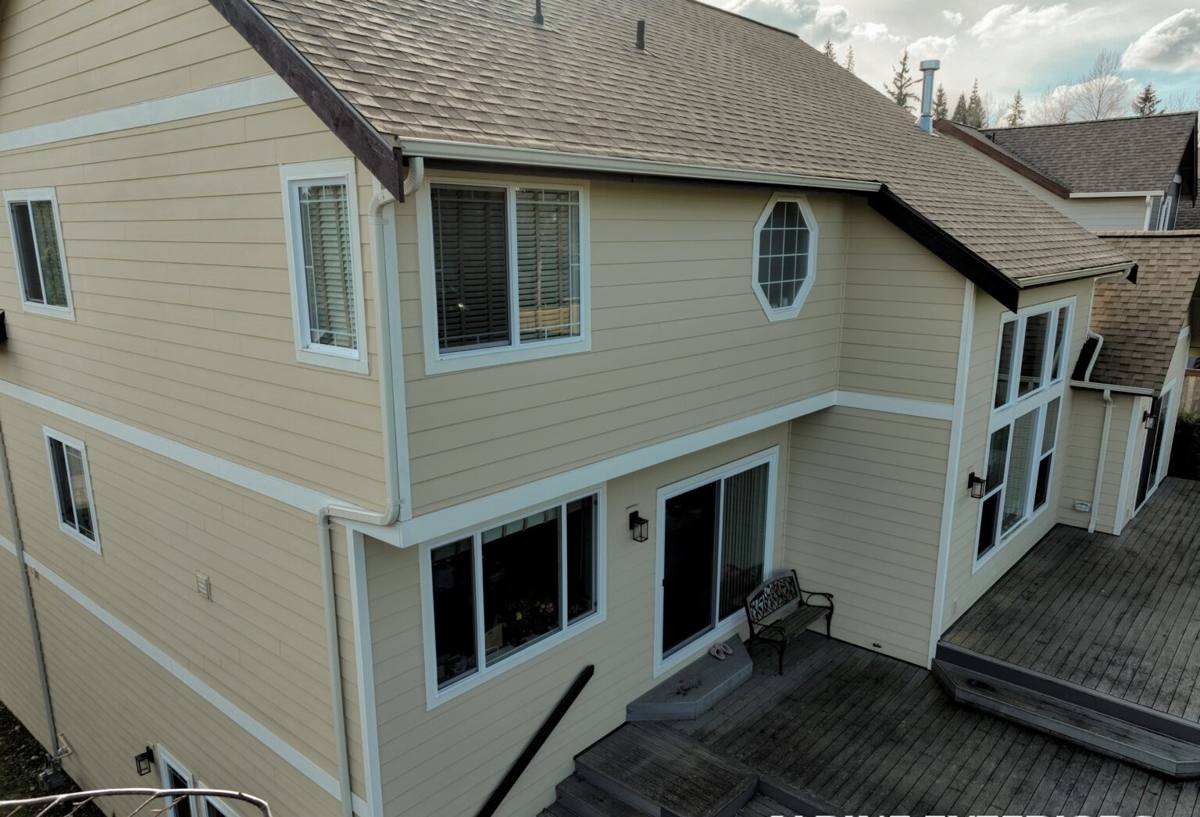
What Actually Goes Wrong With Windows Near the Water
Before talking about new installs, it's worth understanding what we typically find when we're called out to look at existing windows in this part of Bellingham. The patterns repeat:
- Fogged or hazy double-pane glass — the seal between the panes has failed and the gas fill (or trapped air) is letting moisture in. This is almost always a sign the unit is at the end of its life, not something you can fix from outside.
- Soft or discolored wood at the sill and lower corners — driving rain gets pushed sideways into the smallest gaps, and if flashing or sealant wasn't done right the first time, water tracks down into the framing.
- Persistent condensation on the inside of the glass — often blamed on the window itself, but frequently it's a sign of poor air sealing letting warm, moist interior air hit cold glass, or inadequate ventilation in the home.
- Chalky, pitted, or corroded hardware and frames — salt air accelerates wear on lower-grade aluminum components and hardware finishes faster than most manufacturers' literature assumes.
- Green or black growth in frame corners and tracks — a sign that water is sitting somewhere it shouldn't, usually because drainage weep holes are blocked or undersized for the amount of rain this area actually sees.
None of these are exotic problems. They're what happens over years when a window wasn't specified or installed with this specific climate in mind.
What "Energy-Efficient" Should Mean for This Climate
Every replacement window sold today carries an NFRC (National Fenestration Rating Council) label with a handful of numbers on it. In Whatcom County's marine climate, three of them matter most:
| Rating | What It Measures | Why It Matters Here |
|---|---|---|
| U-Factor | How much heat escapes through the window | Lower is better — this is your main defense against Bellingham's long, mild-but-chilly heating season |
| SHGC (Solar Heat Gain Coefficient) | How much solar heat passes through the glass | Moderate values work well here — we don't get the intense summer sun that drives cooling-focused specs further south |
| Air Leakage (AL) | How much outside air infiltrates through the sash and frame | Directly tied to drafts and to how much wind-driven rain can find its way in around the sash |
For this area, we generally steer homeowners toward windows that carry the ENERGY STAR Northern Climate Zone certification, which sets a stricter U-factor threshold than the national default. It's a simple way to filter out lower-tier products without having to become a glazing engineer yourself.
Glass Packages Worth Knowing About
Double-pane, low-E, argon-filled glass is the practical standard for this climate — it balances cost against real performance gains. Triple-pane glass exists and does perform better on paper, but the marginal energy savings in our relatively mild winters often don't justify the added weight, cost, and strain on hardware unless you're specifically trying to cut highway noise or you're in an unusually exposed, wind-battered spot. We'll give you an honest read on whether triple-pane is worth it for your specific house rather than upselling it by default.
Frame Material: The Decision That Matters Most Near Salt Air
The glass package gets most of the attention, but frame material is what determines how the window holds up over 15, 20, 30 years in this environment.
| Frame Material | Behavior in Salt Air & Moisture | Maintenance Reality |
|---|---|---|
| Vinyl | Doesn't corrode or rot; performs well in most residential applications | Low — occasional cleaning, no painting or sealing |
| Fiberglass | Very stable, minimal expansion/contraction, excellent in wet-cold cycling | Low, higher upfront cost |
| Aluminum (uninsulated) | Prone to pitting and corrosion near the water; conducts cold and can drive condensation | Higher — finish and hardware wear faster in salt air |
| Wood / wood-clad | Handsome, but exterior exposure to driving rain and moss growth demands consistent upkeep | Highest — periodic refinishing and moisture checks are non-negotiable |
We're not going to tell you wood windows are a bad product — plenty of homeowners want that look and are willing to keep up with the maintenance. What we will tell you honestly: in a house exposed to Bellingham Bay's salt air and this area's rain load, a wood exterior face needs real upkeep on a schedule, and skipping a year or two is exactly how the sill and lower corners start to soften. If low maintenance is the priority, vinyl or fiberglass frames are where most of our Puget-area customers land.
Our Installation Process, Step by Step
A window is only as good as its installation — this is the part that actually determines whether you get the energy performance printed on the label. Here's how we approach it:
- On-site assessment. We check the existing rough openings, look for hidden water damage or rot around the current windows, and measure for accurate, house-specific sizing rather than assuming standard dimensions.
- Removal and opening inspection. Once the old unit is out, we inspect the framing, sheathing, and any existing flashing before anything new goes in. If we find soft wood or a failed water barrier, we address it before installing — covering it up would just hide the same problem for the next window's lifespan.
- Flashing and water management. This is the step that matters most in a driving-rain climate. We integrate sill pan flashing and properly lapped weather-resistive barrier so water is directed out and down, never trapped behind the new unit.
- Setting and shimming the window. The unit is leveled, plumbed, and shimmed so the sash operates correctly and the frame doesn't rack or bind — a misaligned window is a future air-leak and seal-failure point.
- Air sealing. We seal the gap between the frame and the rough opening with appropriate low-expansion foam or backer rod and sealant — not just caulk smeared around the trim.
- Exterior trim and finish sealing. Exterior joints get sealed with a sealant rated for this climate's UV and moisture exposure, and drainage paths (weep holes, etc.) are checked and kept clear.
- Interior finish and final check. Interior trim is reinstalled or finished, and every window is operated and checked for square, smooth function, and a tight seal before we consider the job done.
Timing the Job Around Bellingham's Wet Season and Moss Cycle
Window replacement is weather-sensitive work — you're opening up the wall to the outside, even if only for an hour or two per opening. In the Puget area, that means we plan around rain forecasts closely and avoid stacking multiple openings during an active weather system. Late spring through early fall tends to give the most predictable install windows, but we do work through the shoulder seasons when there's a reasonable dry stretch; we just won't rush a flashing detail to beat incoming weather.
Moss season is also worth planning around if your home has north-facing or heavily shaded walls. Moss and algae growth on siding and trim near a window opening should be cleaned back before installation — it holds moisture against the wall longer than bare siding does, and starting a new window install against a damp, moss-covered surface is a bad foundation for a long-lasting seal.
Signs It's Time to Replace Rather Than Repair
Not every window problem means full replacement. Here's a practical way to think about it:
- Fogged glass between the panes — replace the sash or full unit; the seal can't be restored.
- Drafts around an otherwise solid frame — sometimes fixable with re-sealing or weatherstripping if the frame itself is sound.
- Soft wood at the sill or jamb — repair only if the damage is minor and caught early; extensive rot usually means replacement.
- Hard to open, painted shut, or warped sashes — often repairable, but worth having assessed alongside overall window age.
- Window is original to a home built before modern energy codes — even if it's not visibly failing, it's likely leaving real energy savings on the table.
What to Expect to Pay, in General Terms
Costs vary a lot based on window size, frame material, glass package, and how much of the surrounding trim, siding, or framing needs attention once the old window comes out. As a rough guide, straightforward vinyl replacements tend to sit at the lower end of the range, fiberglass and larger or custom-sized openings push toward the middle and upper end, and any job that uncovers rot or requires structural repair will add to the total. We'll always give you a clear, itemized number for your specific windows rather than a vague ballpark — and we'll flag any hidden damage we find before we proceed, not after.
Why a Crew That Already Works This Neighborhood Matters
A window installer who mostly works drier, inland parts of Whatcom County can still do competent work — but the details that matter in the Puget area are specific: how much sill pan flashing overlap you need for wind-driven rain coming off the bay, which sealants actually hold up under sustained salt air exposure instead of breaking down early, and how to sequence a job around a wet forecast instead of hoping the rain holds off. Crews who install here regularly build those habits in by default. It shows up years later as a window that's still sealing tight, not one that needs another look after the first hard winter storm.
If you're weighing repair versus replacement, comparing frame materials, or just want an honest read on your current windows' condition, we're happy to take a look. Reach out for a free, no-pressure estimate using the form below — we'll walk the exterior with you and tell you what we actually see, not just what sells.