 Bellingham Siding
 Why Ferndale Homes Need Siding Built for the Coast
Ferndale sits close enough to Bellingham Bay and the Strait of Georgia that salt-laden air is part of daily life here, not an occasional coastal event. That salt air works on exterior materials year-round, and it doesn't work alone. Whatcom County's fall and winter storms bring driving rain that comes in sideways more often than straight down, and the long stretch of low cloud cover common to this part of Washington keeps north- and west-facing walls damp for days at a time. Add a moss season that can run eight months or longer in shaded or low-airflow areas, and you have a climate that is genuinely tough on siding — tougher than what a lot of national siding guides assume when they talk about "Pacific Northwest weather" in general terms.
Homeowners in Ferndale feel this in specific ways: paint that fails early on the weather side of the house, wood trim that softens at the bottom edge, vinyl that discolors and grows a green film in shaded corners, and caulking that gives out faster than the manufacturer's estimate. None of that is a workmanship failure by itself — it's what happens when a material not suited to sustained moisture and salt exposure is asked to perform in exactly that environment for twenty or thirty years.
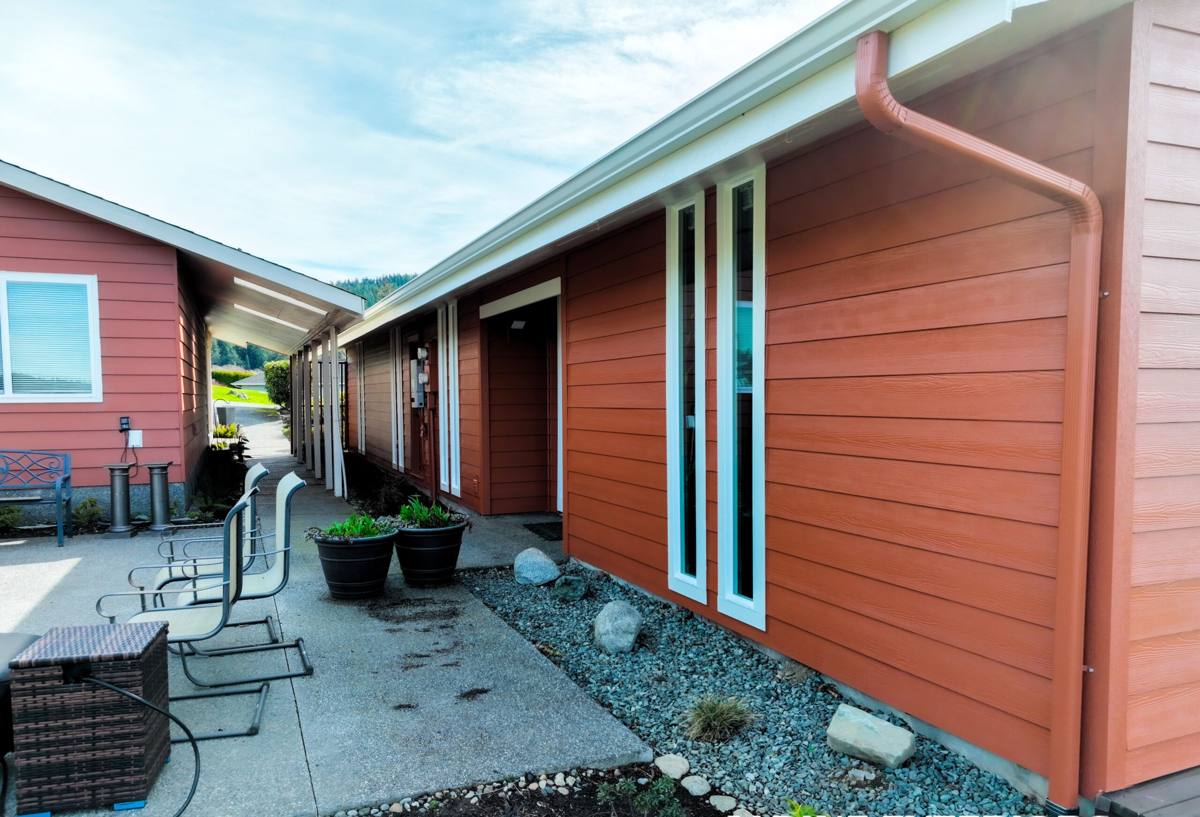
Why Fiber Cement Is the Right Call for This Area
Fiber cement siding is a mix of cement, sand, and cellulose fiber, engineered specifically to resist the things that damage siding fastest near water: moisture absorption, rot, insect damage, and UV breakdown. Unlike wood, it doesn't provide organic material for fungus and moss to feed on directly. Unlike vinyl, it doesn't expand, contract, and warp with temperature swings, and it won't soften or distort near heat sources. It holds paint and factory finish far longer than wood siding does in a marine climate, which matters when repainting a full house exterior in Whatcom County isn't a small expense.
We install James Hardie fiber cement exclusively. We don't install LP SmartSide, vinyl, Cemplank, Allura, primed spruce, or cedar, and we're upfront about why: those products each carry real trade-offs — moisture sensitivity, maintenance burden, warranty structure, or long-term appearance — that we don't think hold up well against what a Ferndale exterior actually has to survive. Hardie's engineered-for-climate product lines, factory-baked ColorPlus finish, and transferable warranty are, in our professional judgment, the better bet for a coastal Whatcom County home. That's a standard we hold across every job, not a sales pitch for this page.
What "Climate-Engineered" Actually Means
James Hardie formulates its siding differently depending on the region it's shipped to, under what the company calls its HZ5 engineered-for-climate system for areas with freeze-thaw cycles and sustained moisture exposure — which describes Whatcom County well. That's a meaningful distinction from a one-size-fits-all fiber cement product: the formulation is built to resist moisture absorption and hold dimensional stability through the wet, mild winters and damp shoulder seasons typical here, rather than being optimized for a hot, dry climate and shipped everywhere.
James Hardie Product Lines We Install in Ferndale
Most Ferndale homes we work on use one of a few core Hardie profiles, chosen based on the home's architecture and exposure:
- HardiePlank lap siding — the standard horizontal lap look, available in several textures and exposure widths; the most common choice for full re-sides.
- HardiePanel vertical siding — used for board-and-batten looks, gable accents, or modern facades.
- HardieShingle — a shingle-profile option for homes wanting a traditional coastal or craftsman look without the maintenance of real cedar shingle.
- HardieTrim — fiber cement trim boards used around windows, doors, and corners so the whole envelope, not just the field siding, resists moisture the same way.
All of these are available with ColorPlus Technology, Hardie's factory-applied, baked-on finish. In a climate like Ferndale's, where field-applied paint is fighting salt air and prolonged dampness from day one, a factory finish that's cured and bonded under controlled conditions holds color and resists fade meaningfully longer than a site-painted finish.
What a Correct Fiber Cement Installation Actually Involves
Fiber cement performs the way it's supposed to only when it's installed to spec. This is where a lot of the material's reputation gets made or broken, and it's also where corners get cut on rushed jobs. A correct install includes:
- Proper clearance between the bottom of the siding and grade, decks, patios, and roof lines, so water has somewhere to go besides against the wall.
- A weather-resistant barrier installed and lapped correctly behind the siding, with attention to how it integrates with window and door flashing.
- Correct fastener type, spacing, and penetration depth — Hardie specifies these closely, and getting them wrong affects both wind performance and long-term durability.
- Butt joints, seams, and penetrations sealed with the right sealant, not general-purpose caulk that fails in a few years.
- Proper flashing at every horizontal transition — window heads, roof-to-wall intersections, and trim-to-field siding joints — since these are the spots water actually gets in.
- Painted or factory-finished cut edges, since an exposed raw edge is the fastest way for moisture to work into the board.
None of this is exotic. It's the difference between following the manufacturer's installation manual and eyeballing it, and in a wet climate that difference shows up in five to ten years, not immediately.
How We Approach a Ferndale Project
Assessment and Planning
We start by walking the exterior with the homeowner, looking at exposure on each elevation, existing moisture damage, trim condition, and any spots where past water intrusion has already caused problems — these often need repair before new siding goes on, not underneath it.
Prep and Tear-Off
Where existing siding is being removed, we check the sheathing underneath for rot or soft spots before anything new goes up. Covering damaged sheathing with new siding just hides a problem that gets worse behind the wall.
Weather Barrier and Flashing
This is the step that decides how the house performs in year eight, not year one. We install and integrate the weather-resistant barrier and flashing system before a single piece of Hardie board goes up, paying particular attention to window and door openings.
Installation
Siding, trim, and accessories go up to Hardie's fastening and clearance specifications, with attention to how each elevation actually faces prevailing wind and rain in this specific location.
Final Walkthrough
We walk the finished exterior with the homeowner, checking caulk lines, paint touch-up on cut edges, and clearances before calling the job done.
Comparing Siding Options for a Marine Climate
| Material | Moisture Resistance | Maintenance in Salt Air | Typical Lifespan Here |
|---|---|---|---|
| James Hardie Fiber Cement | Engineered for wet climates; doesn't rot or swell | Occasional rinse; ColorPlus finish resists fade | 30+ years with correct install |
| Vinyl | Doesn't rot, but seams and edges can trap moisture | Prone to discoloration and moss film in shaded areas | 15-25 years, shorter with UV/impact damage |
| Cedar / Primed Spruce | Absorbs moisture; needs a sound paint film to perform | Repainting/staining every 3-7 years near the coast | Highly variable, maintenance-dependent |
| LP SmartSide (engineered wood) | Treated, but still wood-based and moisture-sensitive at cut edges | Edge sealing and touch-up required regularly | Variable; sensitive to installation quality |
Cost Factors Homeowners Should Understand
Fiber cement isn't the cheapest siding material up front, and we won't pretend otherwise. What changes the real cost picture over time is what happens after installation — repainting, repair, and replacement. The table below outlines the main factors that affect what a Ferndale fiber cement project actually costs, without attaching invented numbers to it.
| Factor | Why It Matters |
|---|---|
| Tear-off vs. new construction | Removing and disposing of existing siding, plus any sheathing repair, adds labor beyond the siding install itself. |
| Number of stories and roofline complexity | Steep rooflines, dormers, and multiple stories increase staging, flashing detail, and labor time. |
| Trim and accessory scope | Full HardieTrim packages around every opening cost more than field siding alone but reduce long-term moisture entry points. |
| Existing moisture damage | Rot found during tear-off needs to be repaired before siding goes back on — this is common on older Whatcom County homes. |
| Profile and finish selection | Shingle profiles and custom ColorPlus colors typically run higher than standard lap siding in a stock color. |
Maintenance and Longevity in Ferndale's Climate
One of fiber cement's real advantages here is how little upkeep it needs compared to wood. A rinse-down once or twice a year to knock off salt residue and any early moss growth in shaded corners is typically enough. Because ColorPlus finish is baked on at the factory rather than field-applied, it resists the fading and chalking that field paint shows first in coastal exposure, which means homeowners aren't looking at a repaint cycle every few years the way they would with painted wood trim. Caulking at joints and penetrations should still get a visual check periodically, since sealant is the one component that ages faster than the siding itself regardless of material — that's true of any siding system, not just fiber cement.
Why a Crew That Already Works Ferndale Matters
Whatcom County's mix of coastal exposure, agricultural flatland, and river-adjacent low ground means moisture behavior varies noticeably from one part of the county to another, sometimes street to street. A crew that already works Ferndale and the surrounding Bellingham area knows which elevations on a typical local home take the worst of the weather, how local permitting and inspection processes run, and what moisture problems tend to show up in homes of a given age in this specific area. That local pattern recognition doesn't replace following the installation manual — it adds to it, catching site-specific issues a generic install approach would miss.
Questions to Ask Before You Sign a Siding Contract
- Is the crew installing to the manufacturer's written specifications, or working from general experience with "fiber cement" as a category?
- Will cut edges be sealed and painted before installation, not after?
- What weather-resistant barrier and flashing details are included, and can they explain them plainly?
- Is the warranty from the manufacturer transferable, and what does the installer's own labor warranty cover?
- Will they inspect sheathing condition during tear-off before re-siding over it?
If you're weighing a re-side in Ferndale or anywhere else in Whatcom County, we're glad to walk your exterior with you, point out what your home's specific exposure needs, and put together a free, no-pressure estimate using the form below.