 Bellingham Siding
 Why Lynden Homes Need Siding Built for This Climate
Lynden sits inland from Bellingham Bay in the farm country of Whatcom County, but it shares the same weather pattern that defines siding performance across the whole region: long stretches of wet weather, wind-driven rain off the Strait of Georgia and the Sound, and shade-heavy lots where moss and algae get a permanent foothold. Homes here don't fail from one big storm. They fail slowly, from siding that stays damp for days at a time and never gets a real chance to dry out between rain events.
That's the backdrop for every siding decision a Lynden homeowner makes. The product has to shed water, resist the moisture that drives moss and rot, and hold its finish through years of gray, humid stretches without cracking, swelling, or delaminating. That's exactly the case for James Hardie fiber cement, and it's why we only install it.
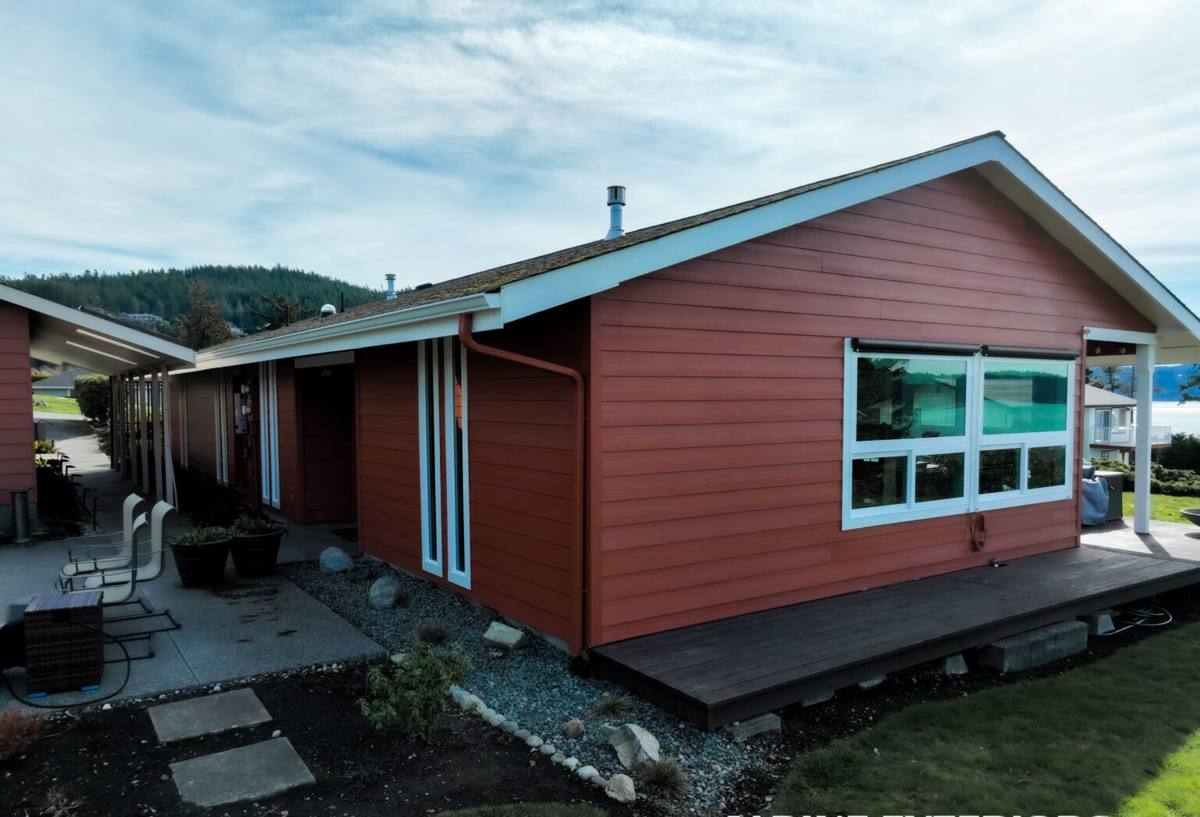
What the Regional Climate Actually Does to Siding
Driving Rain and Prolonged Dampness
Wind off the water pushes rain sideways into wall assemblies, not just straight down onto roofs. Siding that isn't installed with correct clearances, flashing, and drainage behind it holds that moisture against the wall sheathing. Wood-based products swell, and the paint or coating on top cracks along the swollen seams — which lets even more water in.
Moss, Algae, and Shaded Exposures
A long moss season is one of the defining features of siding maintenance out here. North-facing walls, siding tucked under mature trees, and anything near ground level or a downspout stays damp long enough for moss and algae to colonize the surface. On some materials that's a cosmetic problem you can wash off. On absorbent or poorly sealed products, moss growth holds moisture directly against the surface and accelerates whatever damage is already happening underneath.
Salt Air and Humidity
Even set back from the water, homes in this part of Whatcom County get some benefit — and some cost — from proximity to Bellingham Bay and Puget Sound. The marine air keeps humidity high nearly year-round, which is good for wood siding's worst enemy (dry-out cracking) but bad for anything that can't handle sustained moisture exposure without breaking down.
Why We Install Only James Hardie
James Hardie fiber cement is cement, sand, and cellulose fiber — not wood, and not vinyl. It doesn't absorb water the way wood-based siding does, it won't rot, and it's non-combustible, which matters more every year as wildfire smoke seasons stretch further into the Pacific Northwest calendar. We standardized on Hardie because it's the product that consistently performs in exactly the conditions Lynden throws at a house: prolonged dampness, shaded moss-prone walls, and decades of freeze-thaw cycling through the wet season.
Hardie's HZ5 product line is engineered specifically for climates like this one — colder, wetter regions where moisture cycling is the dominant stress on a wall system, as opposed to the HZ10 line built for hot, humid, termite-heavy climates in the South. Installing the right HZ designation for our zone isn't a marketing detail; it affects how the product is engineered to expand, contract, and shed water here specifically.
The factory-applied ColorPlus finish is the other half of the equation. It's baked on under controlled conditions with better adhesion and UV resistance than a field-applied coat of paint, and it comes with its own finish warranty separate from the product warranty. In a climate where a house might not see three consecutive dry days for weeks at a stretch, that's the difference between a repaint in year eight and a repaint in year twenty.
What a Correct Installation Actually Involves
Fiber cement siding is only as good as the installation behind it. Most of the failures we get called out to look at aren't Hardie's fault — they're installation shortcuts that undermine a product that was engineered to last decades.
The Details That Get Skipped
- Clearance and gap spacing: Hardie panels need a minimum gap from grade, roof lines, decks, and other siding boundaries so water has somewhere to go instead of wicking up into the board.
- Weather-resistive barrier and flashing: A correctly lapped house wrap and properly flashed windows, doors, and penetrations behind the siding — not caulk used as a substitute for flashing.
- Fastener pattern and placement: Hardie specifies fastener type, spacing, and blind- vs. face-nailing by product and exposure. Wrong fasteners or over-driven nails crack the board or void the warranty.
- Butt joints and caulking: Joints need to be back-primed or factory-primed at the cut and sealed with a compatible sealant, not just butted together and painted over.
- Starter strip and first course: A level, correctly spaced starter course sets the drainage plane for every course above it — get this wrong and it compounds up the whole wall.
None of this is visible once the job is finished and painted. It's the difference between siding that performs for thirty-plus years and siding that looks fine for two years before problems show up at the seams.
Choosing the Right Hardie Product for a Lynden Home
Hardie makes several distinct siding profiles, and the right one depends on the home's style and exposure, not just preference.
| Product | Best fit | Notes for this climate |
|---|---|---|
| HardiePlank lap siding | Most traditional and farmhouse-style homes | Widest color and texture range; the standard choice for full re-sides |
| HardiePanel vertical siding | Modern builds, accent walls, gable ends | Fewer horizontal laps means fewer water-catching ledges on exposed walls |
| HardieShingle | Craftsman and cottage-style homes | More labor-intensive install; detailing at the coursing matters even more in wet climates |
| HardieTrim | Corners, window and door trim, fascia | Matched fiber cement trim avoids the classic wood-trim rot point at outside corners |
ColorPlus comes in a curated palette designed to hold up under UV and moisture exposure without fading unevenly. For homes where a very specific custom color is required, field-applied paint over primed Hardie is possible, but it carries a shorter finish life and a separate maintenance clock than ColorPlus — something worth weighing honestly before deciding.
What This Project Actually Costs
Every Lynden home is different — square footage, number of stories, trim complexity, and how much of the existing wall assembly needs repair before new siding goes on all move the number. Rather than quote a figure that won't hold up house to house, here's what actually drives the cost of a Hardie project in this area:
| Cost factor | Why it matters here |
|---|---|
| Sheathing and framing condition | Moisture-damaged sheathing found once old siding comes off has to be replaced before new siding goes up — common on homes with a history of wet-climate exposure |
| Wall complexity and trim | Dormers, multiple gables, and extensive trim detail add labor hours regardless of siding brand |
| Product line and profile | HardieShingle and custom reveals cost more in labor than a straightforward HardiePlank lap install |
| ColorPlus vs. field paint | ColorPlus carries a modest premium up front but avoids a repaint cycle within the first decade |
| Site access and story height | Multi-story homes and tight lot access add staging and labor time |
We walk every home before quoting, because guessing at what's behind the existing siding is how homeowners end up with surprise change orders mid-project.
Our Process on a Lynden Job
We start with an in-person walk-around, not a drive-by estimate — checking existing siding condition, trim, window flashing, and any signs of moisture intrusion before we ever price the job. From there:
- Written estimate covering product, labor, and any sheathing repair contingencies identified during the walk-around.
- Removal of existing siding and inspection of the wall assembly underneath, with photos and a direct conversation before covering anything up.
- Repair of any damaged sheathing or framing found — this is not optional, and it's not something a reputable crew skips to save time.
- Installation of weather-resistive barrier, flashing, and Hardie siding to manufacturer spec and correct fastening schedule.
- Final walkthrough with the homeowner before the crew leaves the site.
Maintaining Hardie Siding Once It's Up
Hardie is low-maintenance compared to wood or engineered wood siding, but "low-maintenance" isn't "no-maintenance," especially with the moss and algae pressure common on shaded Whatcom County lots.
- Rinse siding annually with a garden hose and soft brush on shaded or north-facing walls where moss tends to establish.
- Keep gutters clear so overflow doesn't run down the wall face and feed algae growth at specific spots.
- Trim back vegetation and tree limbs that keep a wall section shaded and damp longer than the rest of the house.
- Re-caulk joints and trim intersections if you ever see a gap open up — small sealant failures are easy to fix before they become water intrusion points.
- Watch for any paint failure at cut ends or joints, which usually means a detail wasn't sealed correctly at installation.
Why a Local Crew Matters for This Job
A crew that already works Lynden and the surrounding Whatcom County towns has already seen how the local weather pattern plays out on real houses — which wall orientations grow moss first, how much clearance actually holds up over a wet winter, and where flashing details get tested hardest. That's not something you get from a national installer passing through once. We stand behind the work because we're not going anywhere, and because the reputation we build on one Lynden street is the reputation that gets us the next job on it.
If you're weighing a siding project on a Lynden home — whether it's full replacement, storm or moisture damage repair, or you're just trying to understand what's actually going on with your current siding — we'll come take a look and give you a straight, no-pressure estimate. There's no obligation, and no upsell to a product we don't stand behind. Use the form below to get started.