 Bellingham Siding
 Fairhaven's Climate Is a Real Test for Siding
Fairhaven sits along Bellingham Bay, and that stretch of shoreline puts real, sustained stress on whatever material is covering a house. This page isn't about exterior remodeling in general — it's specifically about James Hardie fiber cement siding, the one product we install, and what it takes to put it on a Fairhaven home correctly. The neighborhood's mix of older homes closer to the waterfront and newer construction built into the surrounding hillside all deal with the same three things: salt-tinged marine air, rain that arrives sideways more often than straight down, and a moss season that barely takes a break most of the year.
We don't offer a menu of siding brands here. We install James Hardie, and only James Hardie, because of what we've consistently seen come off older walls in this exact climate. This page walks through why that product fits Fairhaven specifically, what a correct installation actually requires in this environment, and how our process works from the first walkthrough to the final inspection.
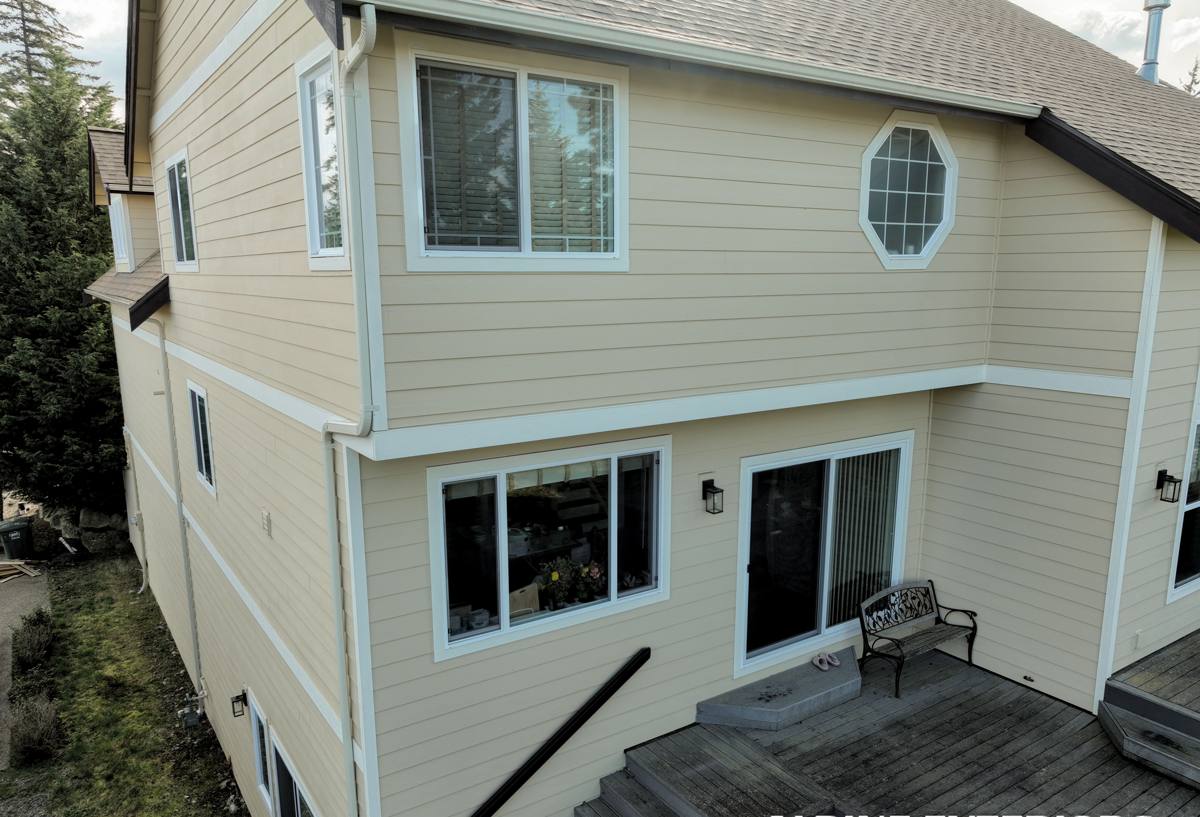
What Salt Air, Driving Rain, and Moss Actually Do to a Wall
Salt-Laden Marine Air
Proximity to the bay means a steady, mildly corrosive drift of moisture in the air, not just during storms but as a near-constant background condition. It's slow damage — fasteners rust from the head down, caulk loses adhesion earlier than it should, and lower-grade finishes chalk and fade well ahead of their rated life. None of that shows up in the first year. It shows up in year six or seven, on a wall that looked fine until it suddenly didn't.
Wind-Driven Rain at Joints and Trim
Open water means wind has room to build, and wind-driven rain doesn't behave like a normal rainstorm. It gets pushed sideways into lap joints, up under trim edges, and through gaps that would never see water in a calmer inland setting. A siding system and an installation crew both need to account for that angle of attack, not just a straight-down rain event.
A Moss Season That Doesn't Really End
Mild, damp conditions combined with mature tree cover common on Fairhaven's older residential lots keep north-facing and shaded walls wet longer between dry spells. Porous or moisture-retentive materials become a growth surface for moss and mildew over time, and it typically starts in spots nobody checks — behind shrubs, under eave lines, along the side of the house that never sees direct sun.
Why James Hardie Is the Product We Put on Fairhaven Homes
These conditions are exactly why we standardized on one fiber cement system instead of carrying multiple brands and letting price make the decision:
- Non-combustible core: fiber cement doesn't burn the way wood-based siding can, which matters for household safety and can matter to insurers.
- Factory-applied ColorPlus finish: the color coat is cured under controlled factory conditions rather than brushed on-site, which gives it real resistance to fading, chalking, and moisture intrusion at the surface.
- Climate-engineered HZ5 formulation: built specifically for regions with heavy sustained moisture and freeze-thaw cycling — a closer match to coastal Whatcom County than a generic national spec.
- Dimensional stability: it doesn't swell, cup, or warp the way engineered wood can after repeated wet-season moisture cycles.
- A strong transferable warranty: backed by Hardie, provided the installation follows their specification.
We don't install LP SmartSide, vinyl, Cemplank, Allura, primed spruce, or cedar. Those are legitimate products and other contractors install them well. Our call was simpler: in a climate this consistently wet and salt-exposed, we'd rather stand fully behind one system we understand completely than offer a cheaper option that quietly shifts maintenance risk onto the homeowner a few winters down the road.
What a Correct James Hardie Installation Actually Involves
Choosing the right material is only half the job. Hardie's own warranty and performance depend on the installation following spec, and in a marine environment the margin for error is smaller than it is elsewhere.
Fastening and Clearance From Grade
Fastener choice matters more here than in a drier inland location — corrosion-resistant nails or screws, driven at the correct depth and spacing, are non-negotiable this close to salt air. Clearance from grade, roofline, and any horizontal surface (decks, roofs, walkways) has to meet Hardie's minimums, because a board sitting too close to standing water or splash-back is a board that stays wet longer than it's designed to.
Flashing and the Water-Resistive Barrier
Siding is only one layer of a wall's water-management system. Behind it, house wrap, flashing at every penetration, and kick-out flashing where a roofline meets a wall all have to work together as one continuous barrier. In wind-driven rain, a single gap in that barrier — around a window, at a roof-to-wall transition, behind a light fixture — is exactly where water gets in, and it's usually invisible from the outside until the damage is already done underneath.
Joints, Laps, and Sealant
Lap joints need correct overlap and, where Hardie specifies it, proper sealant rather than relying on caulk alone to do a joint's job. Butt joints away from a stud need to land on solid backing. These are small details on paper, but they're the difference between a wall that sheds wind-driven rain and one that slowly absorbs it at every seam.
Choosing the Right Hardie Profile for a Fairhaven Home
James Hardie makes more than one siding profile, and the right choice depends on the home's age, style, and how much of Fairhaven's older neighborhood character you want to preserve or complement.
| Profile | Best Fit | Consideration in This Climate |
|---|---|---|
| HardiePlank lap siding | Most home styles, including older Fairhaven housing stock | Horizontal reveal and lap detail need correct overlap and fastening to shed wind-driven rain |
| HardiePanel vertical siding | Gables, accents, more modern styling | Fewer horizontal laps means fewer joint locations, but batten seams still need careful sealing |
| HardieShingle | Homes wanting a traditional, textured look | More individual pieces and exposed edges mean more attention to flashing at each course |
Texture (smooth versus cedarmill) and ColorPlus color selection are separate decisions from the profile itself, but they interact with how the finished wall reads against Fairhaven's older streetscape and how it holds up against fading from salt exposure over the long run.
Our Install Process, Start to Finish
Walkthrough and Assessment
We start by walking the actual property — not estimating off square footage — noting wall orientation, shade patterns, existing damage, and anything about the site (slope, drainage, mature landscaping) that affects how water moves around the house.
Tear-Off and Substrate Check
Once old siding comes off, we check the sheathing and framing underneath before anything new goes up. This is often where hidden moisture damage from years of a failing wall assembly finally becomes visible, and it needs to be addressed before new siding goes over it, not after.
Installation
Hardie board goes up to manufacturer spec: correct fastening, correct clearance, flashing integrated as the work proceeds rather than added afterward, and joints detailed as we go rather than caulked over at the end.
Final Inspection and Cleanup
We walk the finished exterior looking specifically at the details that tend to get rushed on other jobs — joint sealing, trim transitions, flashing at penetrations — before calling the job complete.
Cost Factors for a Fairhaven Hardie Project
| Factor | What It Affects | Why It Matters Here |
|---|---|---|
| Tear-off vs. overlay | Labor scope and substrate access | Tear-off is usually the right call this close to the bay, since it exposes moisture damage that's common under decades-old siding |
| Substrate repair | Costs before new siding goes on | Trapped moisture behind failing siding can rot sheathing before it's ever visible from the street |
| Profile and texture choice | Material cost and labor detail | Shingle and panel profiles involve more joints and cuts than standard lap siding |
| Site slope and access | Staging, scaffolding, and labor time | Hillside lots common around Fairhaven can add setup time and equipment needs |
| Trim and flashing scope | Material and labor | Wind-driven rain makes correct flashing detail non-negotiable, which adds labor time versus a minimal-flashing approach |
Real numbers depend on the specific house and what's found once tear-off starts, which is why we quote in person rather than off a square-footage formula.
Signs Your Current Siding Is Already Behind
- Moss or dark staining that returns quickly after cleaning, especially on shaded or north-facing walls
- Soft or spongy siding near the base of the wall or around window and door trim
- Peeling, bubbling, or chalking paint on siding boards or trim
- Visible gaps at seams, corners, or trim joints where wind-driven rain can track in
- Rust staining around fasteners or flashing, an early sign of marine air exposure
- Cracked or missing siding sections after a windstorm off the bay
Why a Crew That Already Works Fairhaven Matters
James Hardie performs the way it's engineered to when the details are done right, and getting those details right in Fairhaven means understanding how salt air, wind-driven rain, and a long moss season actually behave on a real wall here, not just on a spec sheet. A crew that works this stretch of Whatcom County regularly knows which orientations stay damp longest, where extra flashing attention pays off, and which shortcuts show up as callbacks two winters later.
Before hiring anyone for siding work on a Fairhaven home, it's worth asking a few direct questions:
- Are they a licensed, insured Washington contractor, and can they confirm it in writing?
- Which siding brand and product line do they install, and why that one specifically?
- How do they handle hidden substrate damage discovered during tear-off?
- Will they walk you through their flashing and water-barrier approach before work starts, not just describe the finished look?
If your Fairhaven home needs new siding, a repair to an existing Hardie wall, or just a straight answer about what's actually going on behind an aging exterior, we're happy to take a look. Reach out using the form below to schedule a free, no-pressure estimate.