 Bellingham Siding
 Why Puget Homes Put Different Demands on a Roof
Puget sits close enough to the water that salt-laden air is a daily fact of life, not an occasional event. Add Whatcom County's long wet season, and you've got a roof environment that punishes anything installed with shortcuts. Salt air accelerates corrosion on unprotected metal and fasteners. Driving rain off the water finds any gap in flashing or underlayment that a calmer climate might let slide. And the region's long moss season means organic growth has months at a time to take hold on any roof surface that holds moisture or shade.
None of this is unique to Puget in the abstract sense — plenty of coastal Pacific Northwest neighborhoods deal with some combination of these factors. What matters is that a roofing job here has to account for all three at once, on the same house, for decades. A roof that handles rain well but wasn't detailed for salt exposure will show premature fastener corrosion. A roof that resists corrosion but wasn't designed to shed moss will need pressure washing and moss treatment far more often than it should.
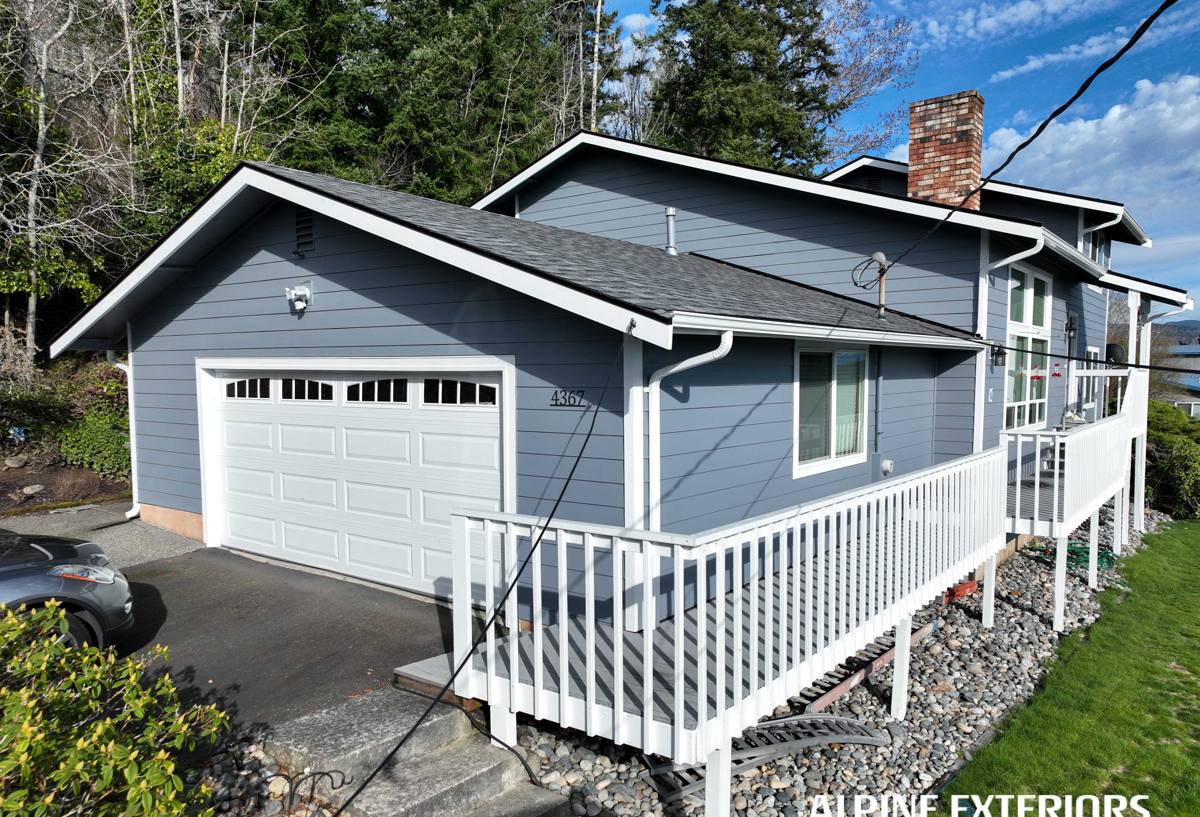
Why Metal Roofing Fits This Climate Well
Metal roofing has real advantages for a property in this part of Whatcom County, provided it's the right metal system, installed correctly.
- Steep, slick surface: A properly installed metal panel sheds water fast and gives moss spores far less to grip than a textured surface like asphalt shingles or wood shake.
- Long service life: A quality metal roof, correctly flashed and fastened, is built to outlast most other roofing materials by decades — which matters when you're weighing cost against how long you'll actually own the house.
- Wind and rain performance: Standing seam and properly fastened panel systems handle wind-driven rain better than materials that rely on overlap alone, because the seams themselves are engineered to interlock or lock down mechanically.
- Low maintenance ceiling: Metal doesn't absorb water the way wood or composite products can, so it isn't feeding the kind of moisture retention that speeds up moss and algae growth.
None of that is automatic, though. Metal roofing only delivers on these advantages when the coating, fastener, and flashing choices match the environment it's going into — which is where a lot of installs fall short.
What a Correct Metal Roof Install Actually Involves in a Salt-Air Environment
Fastener and Coating Selection
Not all metal roofing hardware is built for salt exposure. We select coatings and fastener materials rated for coastal-adjacent conditions rather than defaulting to whatever is cheapest or most common inland. Galvanic corrosion — where dissimilar metals react against each other in the presence of moisture and salt — is a real risk if fasteners, flashing, and panel material aren't compatible. Getting this wrong doesn't show up as a failure in year one; it shows up as rust streaking and loosening fasteners five or ten years down the line.
Underlayment That Backs Up the Panel
The panel is the visible layer, but the underlayment underneath it is what protects the deck if wind-driven rain ever gets past a seam, a penetration, or an edge detail. In a driving-rain climate, we don't treat underlayment as an afterthought — it's a synthetic, water-resistant layer installed with the same care as the metal itself, especially at valleys, eaves, and anywhere water concentrates.
Flashing at Every Transition
Chimneys, vents, skylights, and wall-to-roof transitions are where most roof leaks actually start, regardless of the roofing material. Metal roofing raises the bar on flashing work because the panels are rigid and unforgiving of poor fit — flashing has to be custom-formed and properly integrated with the panel profile, not just caulked into place.
Ventilation
A roof deck that can't breathe traps moisture, and trapped moisture is what invites rot, mold, and the kind of hidden damage that costs far more to fix than it would have cost to prevent. We check and correct attic ventilation as part of a metal roofing job, not as a separate add-on sale.
Comparing Metal Roofing Panel Types for Puget Properties
| Panel Type | How It Handles Salt Air & Rain | Moss Resistance | Typical Use Case |
|---|---|---|---|
| Standing seam (concealed fastener) | Best — no exposed fasteners for salt to attack, mechanically locked seams shed wind-driven rain well | Excellent — smooth, steep profile with minimal ledges | Primary roofs where longevity and low maintenance matter most |
| Exposed-fastener panel | Good with correctly rated fasteners, but fasteners need periodic inspection over time | Very good | Budget-conscious projects, outbuildings, some primary roofs |
| Corrugated / ribbed panel | Good, similar fastener considerations as exposed-fastener systems | Good — profile can hold slightly more debris in the ribs than standing seam | Garages, shops, secondary structures |
What Drives the Cost of a Metal Roof in This Area
| Cost Factor | Why It Matters Here |
|---|---|
| Panel system chosen | Standing seam costs more upfront than exposed-fastener panels but needs less long-term maintenance in salt air |
| Roof complexity | More valleys, dormers, and penetrations mean more custom flashing labor — the details that matter most in driving rain |
| Tear-off vs. overlay | Removing the old roofing lets us properly inspect and repair the deck, which matters if moisture has already gotten in |
| Coating and fastener grade | Coastal-rated materials cost more than standard-grade but avoid premature corrosion issues |
| Ventilation corrections | Adding or fixing ridge and soffit ventilation adds labor but protects the investment |
We give straightforward, itemized estimates so you can see exactly where the cost is going rather than a single lump number that hides the tradeoffs.
Our Process for Puget Metal Roofing Projects
- On-site inspection: We look at the existing roof, deck condition, ventilation, and any signs of moisture or moss buildup before recommending anything.
- System recommendation: Based on the roof's exposure, complexity, and your budget, we recommend a panel type and coating suited to this specific property — not a one-size-fits-all package.
- Written estimate: You get a clear breakdown of materials, labor, and any deck repair or ventilation work identified during inspection.
- Tear-off and deck prep: Old roofing comes off, the deck is inspected and repaired as needed, and any moisture damage is addressed before new material goes down.
- Underlayment and flashing: Water-resistant underlayment and custom-formed flashing go in first, at every valley, penetration, and transition.
- Panel installation: Panels are installed with fasteners and coatings matched to the coastal-adjacent environment.
- Final walkthrough: We review the completed roof with you, including basic care and what to watch for going forward.
Keeping a Metal Roof Performing Through Moss Season
Even a well-installed metal roof benefits from some basic attention, especially given how long moss season runs in this part of Whatcom County. A roof that sheds moss well from the start still needs occasional checks, particularly where trees overhang the roofline or shade keeps sections damp longer than the rest of the roof.
- Keep gutters and downspouts clear so water isn't backing up against roof edges
- Trim back overhanging branches that keep sections of roof shaded and damp
- Do a visual check after major storms for any shifted flashing or debris buildup in valleys
- Avoid pressure washing metal panels directly — it can damage coatings and force water under seams
- Have a professional look at fasteners and flashing every few years, even if nothing looks obviously wrong
None of this is heavy maintenance. It's the kind of light, occasional attention that keeps a correctly installed metal roof performing the way it's supposed to for its full service life.
Why Local Experience with Puget Homes Matters
A roofing crew that hasn't worked much near the water can still install a technically sound metal roof — but they're making judgment calls about coatings, fasteners, and flashing details based on general standards rather than what actually holds up in this specific combination of salt exposure, rain, and moss. A crew that already works properties in and around Puget and greater Bellingham has seen which details matter most here: where corrosion tends to start first, which flashing points take the worst of the driving rain, and how much ventilation a given roof style actually needs in a climate this wet.
That local pattern recognition doesn't replace good workmanship, but it does mean fewer surprises and a roof that's specified correctly the first time, rather than corrected after a few winters expose the gaps.
If you're weighing a metal roof for a Puget-area home, we're happy to walk the property, look at what you're working with, and put together a straightforward, no-pressure estimate — just fill out the form below.