 Bellingham Siding
 Blaine Roofs Deal With a Different Set of Problems
Blaine sits right up against the water at the top of Whatcom County, and that location shapes everything about how a roof ages here. Salt-laden air off the Strait of Georgia works into fasteners, flashing, and exposed metal faster than it does even a few miles inland. Add the region's pattern of driving, wind-pushed rain — the kind that hits roofs sideways instead of straight down — and you get moisture finding its way into laps and seams that would stay dry in a calmer climate. Layer on a moss season that, in this part of Whatcom County, can run from fall through late spring, and you have three separate aging processes working on a roof at once, year-round.
None of that means a Blaine roof needs constant attention. It means the specific things that go wrong here are somewhat predictable, and a repair crew that understands the pattern can catch and fix them before they turn into a full tear-off. That's the point of this page: what actually breaks down on roofs in this area, what a correct repair looks like, and how to tell when a patch is the right call versus when it's time to talk about replacement.
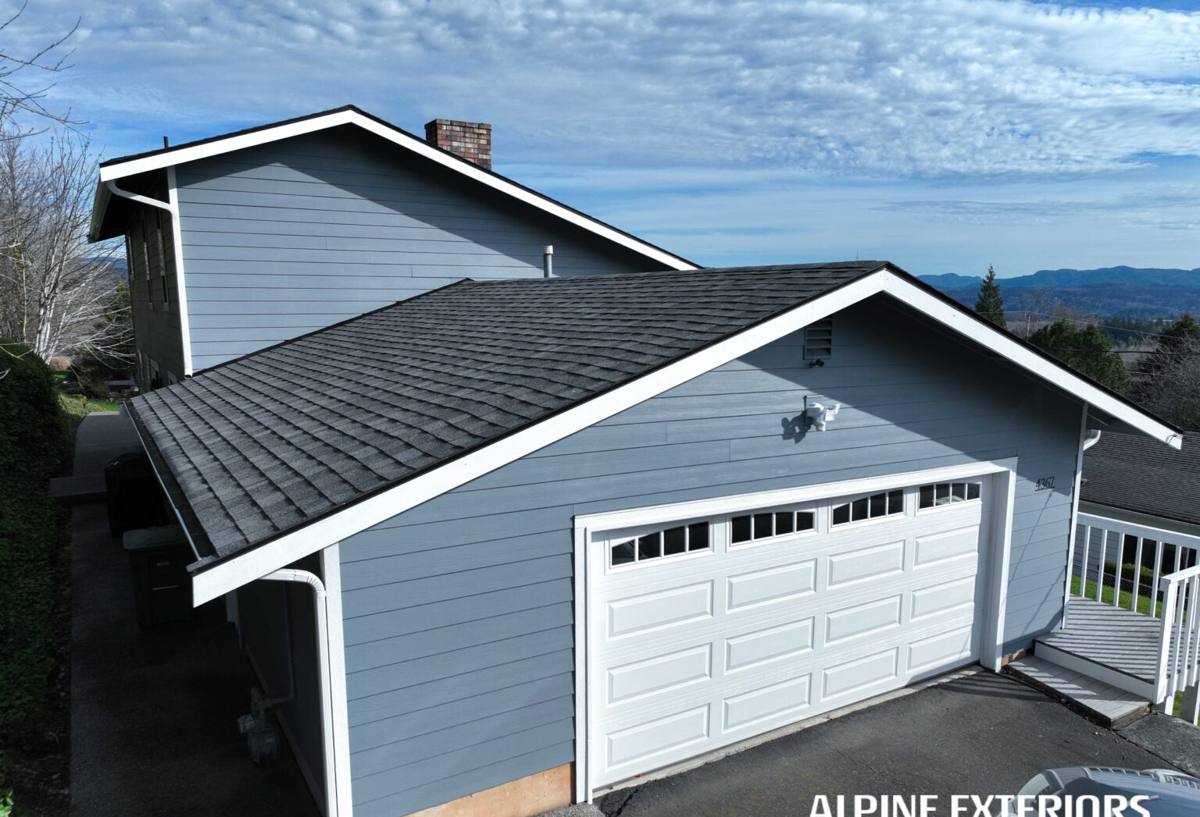
Signs a Blaine Roof Needs Repair, Not a Full Replacement
Most roofs don't fail all at once. They show localized trouble first — and catching it early is usually the difference between a repair bill and a replacement bill. Homeowners in and around Blaine should watch for:
- Granule loss concentrated on one slope, especially a west- or south-facing one that takes the brunt of storm winds
- Dark streaking or a greenish-black cast, particularly on north-facing slopes and anywhere shade lingers — early moss and algae growth, not just cosmetic staining
- Soft spots or slight sagging near valleys, chimneys, or skylights, which usually means water has already gotten under the surface
- Rust bleed or lifted edges on flashing around vents, chimneys, and wall intersections
- Interior signs: a ceiling stain that appears after a windy rainstorm specifically, rather than every time it rains
- Granules collecting in gutters after a storm, which signals accelerated wear rather than normal aging
Any one of these, caught early, is usually a repair. Multiple issues showing up across several slopes at once — especially combined with a roof that's already past its expected service life — starts to tip the conversation toward replacement. A straightforward inspection is the only reliable way to tell which situation you're in.
What a Correct Roof Repair Actually Involves
Diagnosis before anything else
A repair that lasts starts with figuring out the actual water path, not just patching where the stain showed up inside. Water travels — it can enter at a flashing seam near a chimney and show up as a stain on a ceiling ten feet away. We look at the whole assembly: shingles or panels, underlayment where it's exposed, flashing, and the decking underneath where accessible, before deciding on a fix.
Matching materials, not just covering the hole
Roofing materials weather and fade over time, and a repair patch that doesn't match the surrounding material — in type, profile, or color — stands out and can also behave differently in wind and rain. Where an exact match isn't available, we're upfront about that trade-off rather than pretending it won't be visible.
Flashing gets special attention here
In a salt-air environment, flashing is usually the first thing to go, well before the field of the roof itself. Fasteners and thin-gauge metal corrode faster near the water, and a flashing failure at a valley, chimney, or wall intersection is one of the most common repair calls we get in this area. Any proper repair addresses the flashing itself, not just the shingles around it — recaulking a symptom while the metal underneath is still failing just buys a season, not a fix.
Common Blaine Roof Problems and What They Actually Need
| Problem | Likely Cause in This Climate | Typical Repair |
|---|---|---|
| Corroded or lifted flashing | Salt air accelerating metal fatigue, especially near the coast | Remove and replace flashing section; reseal with compatible sealant |
| Moss buildup on north slopes | Extended shade and moisture retention through a long wet season | Careful mechanical removal, zinc or copper strip installation, treatment |
| Granule loss on windward slopes | Repeated wind-driven rain and gusts off the Strait | Section replacement of affected shingles; check underlayment condition |
| Valley leaks | Heavy water volume concentrating in valleys during storms | Re-flash valley, confirm proper underlayment lap direction |
| Fastener back-out / popped nails | Wind uplift combined with material expansion/contraction cycles | Reset or replace fasteners, reseal, inspect surrounding shingles |
How Our Repair Process Works
- Inspection and honest assessment. We walk the roof (or use safe close-range methods when conditions call for it) and document what we find, including the parts that are fine and don't need work.
- A clear explanation of options. If it's a straightforward repair, we say so. If we think a repair is only a short-term fix given the roof's overall condition, we say that too — with our reasoning, not just a recommendation to replace.
- A written scope and price before work starts. No verbal estimates that change once the ladder goes up.
- The repair itself. Matched materials where possible, proper flashing work, and cleanup so the site looks like we were never there.
- A final check. We confirm the repair addresses the actual water path we diagnosed, not just the visible symptom.
Repair vs. Replacement: What Actually Drives That Decision
| Factor | Leans Toward Repair | Leans Toward Replacement |
|---|---|---|
| Age of roof | Well within expected service life | At or past expected lifespan for the material |
| Extent of damage | Localized to one area or slope | Spread across multiple slopes or systemic |
| Underlying decking | Solid, no rot found during inspection | Soft, delaminated, or water-damaged decking |
| Flashing condition | Isolated corrosion or lifting | Widespread flashing failure throughout |
| History of repairs | First or second repair on this roof | Repeated patches in the same areas over time |
Cost ranges vary a lot depending on the scope — a single flashing repair is a very different job than re-decking a valley — so we'd rather give you an honest number after a look at your specific roof than a broad figure that doesn't mean much either way.
Dealing With Moss and Algae Over a Long Wet Season
Moss doesn't just sit on top of a roof looking bad. It holds moisture against the surface, works its way under shingle edges, and can lift material enough to let water in underneath. In a climate where the wet season stretches across most of the year, moss management is less a one-time cleanup and more an ongoing part of roof care. A few things matter more than people expect:
- Moss should be removed carefully, not scraped aggressively — hard scraping strips granules and shortens the life of the shingle you're trying to protect
- Zinc or copper strips near the ridge let rain carry trace metals down the roof, which discourages regrowth without chemical treatment
- Trees that keep a slope shaded most of the day are worth trimming back where practical — sunlight exposure does more for moss prevention than any single product
- Gutters clogged with moss and debris compound the problem by holding water against the roof edge and fascia
- Pressure washing a roof is generally not something we recommend — it can drive water under shingles and strip protective granules
Why It Matters That We Already Work in This Area
A crew that repairs roofs across Whatcom County, including Blaine and Bellingham, sees the same failure patterns often enough to recognize them quickly instead of guessing. We know that flashing near the water corrodes faster than a manufacturer's general specs might suggest, that certain slopes hold moss longer because of how the wet season sets in here, and that a repair done without accounting for wind-driven rain direction tends to fail again within a season or two. That local pattern recognition is part of what a fair repair estimate should include — not just labor and materials, but judgment about what this specific climate does to a roof over time.
It also means we're not a crew that disappears after the invoice is paid. If a repair doesn't hold the way it should, we're a short drive away, not a call center for a company that worked here once.
What Homeowners Can Do Between Professional Inspections
- Look at the roof from the ground after major windstorms for obviously lifted or missing shingles
- Check gutters for granule buildup, which can indicate accelerated shingle wear
- Watch for moss or dark streaking starting on shaded slopes, and address it early rather than waiting a full season
- Keep an eye on interior ceilings near chimneys and skylights after storms specifically, since that's where flashing leaks tend to show up first
- Have the roof professionally inspected periodically rather than only after a problem appears — small flashing and sealant issues are far cheaper to fix before they become a leak
None of this replaces a proper inspection, but catching a problem a season earlier is usually the difference between a small repair bill and a much larger one.
Get an Honest Look at Your Roof
If you're seeing signs of trouble on a Blaine or greater Bellingham roof — or just want an honest read on where things stand before the next storm season — we're happy to take a look. The estimate is free, there's no pressure to sign anything on the spot, and if the right answer is "this doesn't need work yet," we'll tell you that. Use the form below to get started.