 Bellingham Siding
 Siding Replacement Built for Blaine's Exposure
Blaine sits about as close to the water and the border as a Whatcom County home can get, and that location comes with a specific kind of weather punishment. Salt-laden air off the strait works differently on a house than inland humidity does — it accelerates corrosion on fasteners and trim, and it settles into porous or poorly sealed siding surfaces over years, not months. Add driving rain that comes in sideways during winter storms and a moss season that can run from fall through spring, and you have a climate that is genuinely harder on exterior cladding than most of the state realizes. A siding replacement here isn't a cosmetic upgrade. It's the single biggest factor in whether a home's sheathing, framing, and insulation stay dry for the next several decades.
We install exclusively James Hardie fiber cement siding, and on Blaine homes specifically, that choice comes down to how the material behaves in salt, moisture, and shade — not just how it looks once it's up.
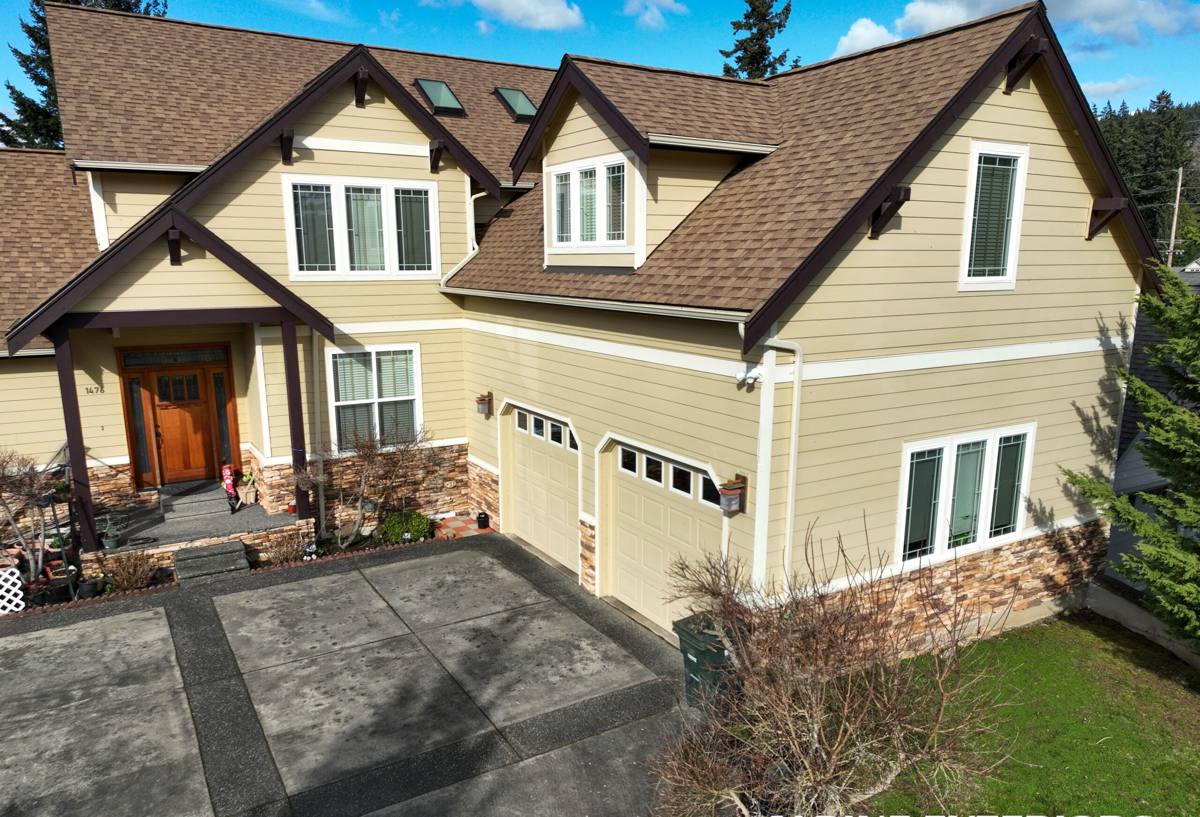
What Blaine's Climate Actually Does to Siding
Salt Air and Coastal Exposure
Homes within a mile or two of the water take airborne salt on every surface, all year. Salt is hygroscopic — it pulls moisture out of the air and holds it against whatever it lands on. On wood-based siding products, that means the surface stays damp longer after every rain or fog event, which is exactly the condition that lets rot and mold get started. On metal fasteners and trim, salt accelerates corrosion, which is why fastener selection matters as much as the siding panel itself in a job done right.
Driving Rain and Wind-Driven Moisture
Blaine gets weather straight off the water with little to break it up. Rain doesn't just fall here, it's pushed sideways into wall assemblies, which stresses every seam, joint, and butt edge in a siding system. A product that swells, cups, or delaminates when it takes on water is a bad match for this kind of exposure. A product that's dimensionally stable when wet holds its factory finish and its seal integrity through storm after storm.
Moss, Shade, and Long Damp Seasons
Mature tree cover and long stretches of overcast, damp weather mean moss and algae growth on north-facing and shaded walls is a near-constant battle. Organic growth doesn't just look bad — moss holds moisture against the siding surface, which is a slow but real threat to anything that isn't inherently rot-resistant. Siding that can't be power-washed or treated without damaging the finish turns a maintenance task into a replacement problem.
Why We Only Install James Hardie in This Market
We don't install vinyl, LP SmartSide, cedar, primed spruce, Cemplank, or Allura, and Blaine's climate is a big part of why. Fiber cement in general resists moisture absorption and won't rot, but James Hardie specifically engineers products for this region's exposure class, which matters more here than in drier parts of the state.
- Non-combustible core — fiber cement doesn't feed a fire, which matters given Whatcom County's mix of wildfire risk and dense tree cover near property lines.
- HZ5 engineering — Hardie's HZ product line is built for the Pacific Northwest's freeze-thaw cycles and sustained moisture exposure, not a generic national spec.
- ColorPlus factory finish — a baked-on finish that resists fading and holds up to salt air and UV far better than field-applied paint, which means fewer repaint cycles over the life of the siding.
- Dimensional stability — it doesn't swell or warp when saturated, so seams and butt joints stay tight through Blaine's wet winters.
- Moss and algae resistance — the surface can be gently cleaned without damaging the finish, which matters on shaded, north-facing walls.
We've said no to products that perform fine in a showroom but ask too much of a homeowner living a few blocks from saltwater. Wood-based siding needs a maintenance schedule that most people don't keep up with, and once it slips, moisture problems compound fast in this climate. Vinyl can crack in cold snaps and doesn't hold up structurally the way fiber cement does. Fiber cement brands outside Hardie's engineered lines don't always match the HZ specification for coastal, high-moisture exposure — and in a market like Blaine, that specification is the whole point.
What a Correct Siding Replacement Involves
Replacing siding on a coastal home isn't just pulling off old panels and nailing up new ones. The work that happens underneath the siding determines whether the new material actually lasts.
Tear-Off and Sheathing Inspection
Once the old siding comes off, we inspect the sheathing for rot, soft spots, and prior water intrusion — common on homes that have taken decades of driving rain without adequate flashing. Any compromised sheathing gets replaced before anything new goes up. Skipping this step is the single most common reason a siding job fails early.
Weather-Resistive Barrier and Flashing
A correctly installed water-resistive barrier, properly lapped and taped, along with correct flashing at windows, doors, and any wall penetrations, is what actually keeps wind-driven rain out of the wall cavity. Salt air also means fastener corrosion resistance matters here more than in inland installations — we use fasteners rated for the exposure, not just whatever's fastest to run.
James Hardie Installation to Spec
James Hardie's warranty is tied to installation meeting their published specifications — proper clearances from grade and roof lines, correct fastener spacing and placement, proper caulking at joints, and manufacturer-approved trim details. Installing to spec isn't optional if you want the warranty to mean anything, and it's where a lot of shortcuts get taken by crews that don't do this work daily.
Trim, Caulking, and Finish Details
The small details — corner trim, J-channel around openings, caulk joints sized and placed correctly — are what keep water from finding a way in over the following years. In a climate with this much sustained moisture exposure, those details aren't cosmetic; they're functional.
Comparing Siding Options for a Coastal Whatcom County Home
| Factor | James Hardie Fiber Cement | Vinyl | Wood / Cedar |
|---|---|---|---|
| Salt air resistance | Engineered for coastal exposure (HZ5) | Can become brittle over time | Vulnerable without frequent maintenance |
| Moisture / rot resistance | Won't rot, dimensionally stable wet | Doesn't rot, but seams can leak | Rot-prone without diligent upkeep |
| Moss/algae cleaning | Can be cleaned without damaging finish | Cleans easily, but can crack from pressure | Cleaning can strip or damage finish |
| Fire resistance | Non-combustible | Combustible, can melt/warp | Combustible |
| Finish longevity | Factory ColorPlus finish, long fade resistance | Color molded in, can fade/chalk | Needs repainting/staining on a cycle |
| Typical maintenance | Low — occasional wash, caulk checks | Low, but hardware/seams degrade with age | High — regular sealing, staining, inspection |
Our Process for Blaine Homeowners
- On-site assessment — we look at exposure (how close to the water, how shaded, prevailing wind direction) and inspect the current siding and visible trim for signs of moisture damage.
- Honest scope and estimate — we tell you what we find, including sheathing concerns that may only be confirmed once tear-off starts, and what that means for cost.
- Tear-off and structural check — old siding comes off, sheathing gets inspected and repaired as needed before anything new goes up.
- Barrier, flashing, and fastener work — the unseen layer that actually keeps the house dry, installed to manufacturer and code standards for this exposure.
- James Hardie installation to spec — panel, trim, and fastening done to the standard that keeps the warranty valid.
- Final walkthrough — we go over the finished work with you before calling the job done.
What to Check Before Hiring Any Crew for This Work in Blaine
- Do they inspect sheathing before quoting a final price, or promise a flat number sight-unseen?
- Can they explain their flashing and water-resistive barrier approach in plain terms?
- Are they factory-certified to install the product they're selling you?
- Do they use fasteners rated for coastal, high-moisture exposure — not just whatever's standard inland?
- Will the manufacturer's warranty actually apply based on how they install, or does their method void it?
- Have they worked on homes with similar exposure — close to the water, heavy tree cover, or both?
Why Local Experience in Blaine Matters
A crew that's worked in Blaine already knows which walls take the worst of the wind-driven rain, how much shade a given lot holds moisture, and what flashing details actually hold up against salt air over time. That's not something you learn from a spec sheet — it's learned from doing the work here repeatedly and seeing what happens to different approaches five and ten years later. We'd rather tell you honestly what your home's exposure calls for than sell you the fastest job available.
Whatcom County's coastal edge is unforgiving on siding that isn't built for it. We've made James Hardie our only product for exactly that reason, and Blaine is one of the clearest examples in our service area of why that standard matters.
If your siding is showing moss buildup, moisture staining, or you're just planning ahead for a home this close to the water, we're glad to walk the exterior with you and give you a straight assessment. Request a free, no-pressure estimate below.