 Bellingham Siding
 Decks in Sudden Valley Take a Different Kind of Beating
Sudden Valley sits close to Lake Whatcom, tucked into tree cover that keeps a lot of the neighborhood shaded for much of the year. That's part of what makes it a great place to live, but it's tough on a deck. Shade plus lake humidity plus Whatcom County's long wet season means decks here dry out slower than decks in open, sunny parts of Bellingham. Wood that stays damp longer grows moss and algae faster, and moisture that can't evaporate quickly works its way into joints, fastener holes, and end grain.
We've repaired enough decks around the lake to know the failure patterns are consistent: ledger boards that trap water against the house, joists that rot from the top down under boards that never fully dry, and railing posts that loosen because the wood around the anchor bolts has softened. None of this is unusual or a sign of bad luck — it's what happens to any deck in a shaded, moisture-heavy microclimate when it isn't inspected and maintained on a schedule that matches the environment.
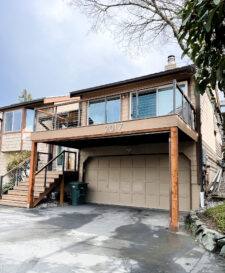
Why Salt Air, Rain, and Moss Matter Here
Bellingham's marine climate brings driving rain for much of the fall, winter, and spring, and coastal air carries salt and moisture that accelerates corrosion on fasteners and hardware. Add Sudden Valley's tree canopy and proximity to the lake, and you get a longer moss season than most inland Whatcom County neighborhoods see. Moss isn't just cosmetic — it holds water against the wood surface, blocks airflow, and keeps boards from drying between rain events. Over a few seasons, that trapped moisture breaks down the wood fibers and starts corroding the fasteners underneath.
What This Looks Like on an Actual Deck
- Dark green or black staining that comes back within weeks of cleaning
- Boards that feel spongy or flex more than they used to, especially near the house
- Rust streaks below screw heads or around joist hangers
- Railing posts that wiggle at the base even though the rail itself looks fine
- A musty smell coming from underneath the deck, especially after rain
What a Correct Repair Actually Involves
A lot of "deck repair" in wet climates is really just replacing what's visible and leaving the cause untouched. That's how the same problem comes back in two years. A repair that holds up in Sudden Valley's conditions has to address moisture management, not just the symptom.
Structural Inspection First
Before we replace a single board, we check the ledger connection to the house, the condition of the joists (especially the ends, where water pools), the posts and footings, and the fasteners themselves. Surface rot on a board is easy to see. Rot inside a joist under a board that looks fine is what actually causes a deck to fail, and it's the reason we probe and check moisture content rather than just eyeballing the top surface.
Fixing the Moisture Path, Not Just the Symptom
If a ledger board or joist is rotting because water has nowhere to go, replacing the board without correcting drainage or flashing just resets the clock. Depending on what we find, that might mean adding or repairing ledger flashing, improving the gap between boards for airflow, or correcting a low spot where water collects instead of shedding.
Matching or Upgrading Fasteners
Coastal, humid conditions are hard on hardware. We use fasteners and connectors rated for exterior, corrosive-prone environments rather than whatever matches the deck cosmetically. A board that's otherwise sound but held on with corroding fasteners is a repair waiting to happen, not a finished job.
Common Repair Scope
| Issue | What's Involved | Typical Trigger |
|---|---|---|
| Surface board replacement | Swap individual boards showing rot, splitting, or persistent moss staining | Localized moisture trapping, foot traffic wear |
| Joist or ledger repair | Sister or replace damaged framing, correct flashing at the house connection | Water intrusion at the ledger, poor original flashing |
| Railing and post repair | Reset or replace posts, reinforce anchor points, check code-required height and spacing | Loosening at the base from softened wood or corroded bolts |
| Full resurfacing | Replace decking surface across the whole deck while keeping sound substructure | Widespread surface aging with a structurally sound frame underneath |
| Full rebuild | Remove and replace substructure and surface | Structural rot has spread beyond isolated repair |
Repair vs. Replace: How We Make That Call
Homeowners often assume visible board damage means the whole deck needs to go. Just as often, we find a deck where the surface boards are tired but the framing underneath is solid — that's a resurfacing job, not a rebuild. The reverse also happens: boards that look fine on top while the joists underneath have been quietly rotting in the shade for years. We won't recommend a full rebuild unless the structure genuinely needs it, and we won't patch over a framing problem just to keep the job smaller. We'll walk you through what we find and why, so the decision makes sense to you, not just to us.
Material Choices for a Shaded, Wet Site
What we recommend for a Sudden Valley deck depends heavily on how much shade and moisture exposure the specific deck sees, not a one-size-fits-all answer.
Wood Decking
Pressure-treated lumber and cedar both perform fine in this climate when they're maintained — cleaned, sealed, and inspected on a regular schedule. In heavy shade near the lake, that maintenance schedule needs to be tighter than it would be for a sun-exposed deck elsewhere in Bellingham. If a homeowner isn't planning to keep up with annual cleaning and resealing, wood in this specific location will show moss and wear faster than the same wood would in an open, sunnier yard.
Composite Decking
Composite boards resist moss staining better than wood and don't need sealing, which is a real advantage in a shaded, damp spot. The trade-off is upfront cost and the fact that composite still needs proper airflow underneath — composite doesn't rot, but the framing underneath it still will if moisture management is ignored. We won't install composite over a substructure that isn't first corrected for drainage and ventilation, because that just hides the same problem under a low-maintenance surface.
Fasteners and Hardware
Regardless of decking material, we use corrosion-resistant fasteners and connectors rated for coastal, high-moisture exposure. This is a small cost difference on the invoice and a large difference in how long the repair actually lasts.
Our Process for Sudden Valley Deck Repairs
- On-site inspection — we check the surface, framing, ledger connection, posts, and fasteners, and probe for hidden moisture or soft spots
- Written scope and estimate — you get a clear breakdown of what needs repair, what's optional, and why, before any work starts
- Repair or replacement — matched to what the deck actually needs, from a handful of boards to a full framing repair
- Moisture correction — flashing, airflow gaps, and drainage fixes wherever the inspection shows water has been getting trapped
- Final walkthrough — we go over what was done and what to watch for going forward, including a realistic maintenance schedule for your deck's specific sun and shade exposure
Maintenance That Actually Fits Sudden Valley's Conditions
A maintenance plan written for a sunny, open lot doesn't work well for a shaded lakeside deck. Decks here generally need more frequent moss removal and a shorter interval between sealing or cleaning cycles than decks in drier, sunnier parts of Whatcom County.
- Clean moss and algae off the surface as soon as it appears, rather than waiting for the annual wash
- Keep gutters and downspouts near the deck clear so runoff isn't adding to what the deck already deals with from rain and shade
- Check underneath the deck once or twice a year for standing water, soft wood, or rust at fastener heads
- Reseal wood decking on a shorter cycle than manufacturer defaults suggest if the deck sits in heavy shade
- Trim back overhanging branches where practical to let more light and air reach the deck surface
Why Local Experience Matters for This Job
A deck repair crew that mostly works drier, sunnier neighborhoods can miss what's actually going on with a shaded, lakeside deck — they're used to different failure patterns and may underestimate how fast moisture problems come back here. We work in Sudden Valley and other Whatcom County neighborhoods with similar shade and moisture conditions regularly enough to know what to check first, what tends to fail, and what actually holds up through another wet Bellingham winter. That local pattern recognition is the difference between a repair that lasts and one that's back on the schedule in two years.
If you're noticing moss that won't stay gone, soft spots, or a deck that just feels less solid than it used to, we're happy to take a look. Reach out for a free, no-pressure estimate — we'll tell you honestly what your deck needs and what it doesn't.