 Bellingham Siding
 Sunnyland's Climate Is Harder on Siding Than Most Homeowners Realize
Sunnyland sits close enough to the water and the tree canopy that its siding takes a different kind of beating than siding on the drier east side of the state. Bellingham Bay puts salt-laden air into the wind that moves through the neighborhood, and that salt content accelerates corrosion on fasteners, trim, and any siding product that isn't built to shrug it off. Add in Whatcom County's long stretch of driving rain — often blown sideways against west- and south-facing walls — and you have a recipe for moisture finding every gap, seam, and unsealed joint a lesser installation leaves behind.
Then there's moss. Bellingham's moss season isn't a two-week nuisance; it's a standing condition for much of the year on shaded walls, north-facing elevations, and anywhere tree cover keeps siding from drying out between storms. Moss and algae don't just look bad — they hold moisture against the siding surface for extended periods, which is exactly the condition that punishes products with weak moisture resistance or thin factory coatings. A siding system that can't handle sustained dampness will show it here faster than almost anywhere else in the state.
This combination — salt air, wind-driven rain, and chronic moss exposure — is why we treat Sunnyland siding projects as a climate problem first and a cosmetic upgrade second. The right product and the right installation details matter more here than they would in a milder, drier part of the country.
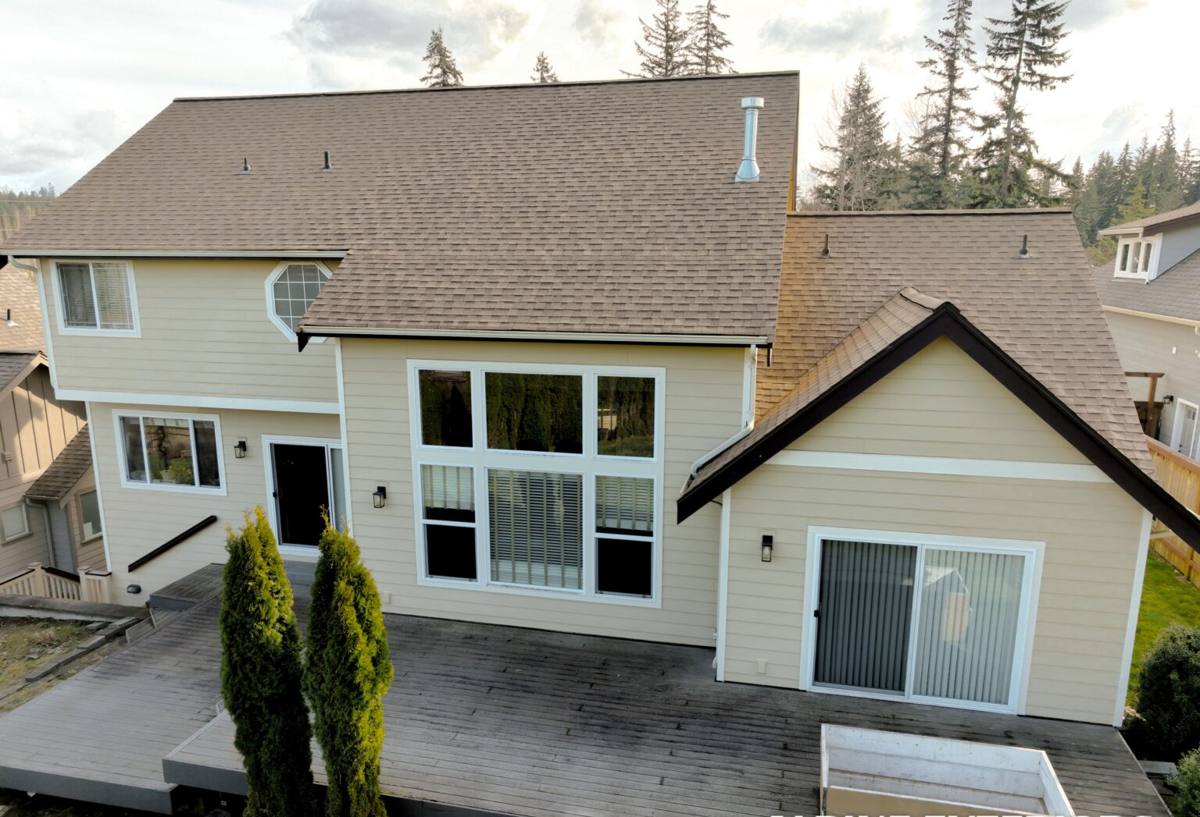
Why We Install Only James Hardie Fiber Cement
We don't install vinyl, LP SmartSide, Cemplank, Allura, primed spruce, or cedar. That's not a marketing position — it's a standard we settled on after weighing how each of those products actually performs under sustained coastal moisture and moss exposure over decades, not just in the first few years.
Vinyl expands, contracts, and can warp or crack in temperature swings, and it offers no real fire resistance. Wood products — cedar and primed spruce — look good on day one but require an ongoing maintenance commitment (painting, sealing, moss treatment) that most homeowners underestimate, and any lapse lets moisture in fast. Engineered wood products like LP SmartSide use a wood-strand substrate that, while treated, is still an organic material that depends on an intact outer coating to keep water out; once that coating is compromised at a cut edge or fastener hole, the substrate is vulnerable. Other fiber cement brands like Cemplank and Allura are legitimate materials, but we've standardized our crews, our fastening schedules, our flashing details, and our warranty conversations around one manufacturer so we can guarantee the installation, not just sell the material.
James Hardie fiber cement is non-combustible, dimensionally stable in wet-dry cycling, and — critically for this area — engineered specifically for climate zones like ours. That last point matters enough to explain on its own.
Built for This Climate Zone, Not a Generic One
James Hardie engineers its siding for specific climate zones rather than shipping one formulation everywhere. Homes in Whatcom County fall into the manufacturer's cooler, wetter climate engineering zone, which is formulated for regions with sustained moisture exposure and freeze-thaw cycling — as opposed to the hot, dry zone formulation used in the Southwest. Installing the correct zone-engineered product is one of the first things we verify on every Sunnyland job, because using the wrong regional formulation undermines the moisture performance homeowners are paying for.
Choosing the Right Hardie Product Line for a Sunnyland Home
Sunnyland's housing stock is a mix of older, established homes and newer infill construction, which means the right Hardie profile varies house to house. Matching the product to the home's age, exposure, and architectural style is part of getting this right — not just picking whatever's fastest to install.
| Product Line | Best Fit For | Why It Works Here |
|---|---|---|
| HardiePlank Lap Siding | Most single-family homes, traditional and modern styles | Widest color and texture range; proven moisture performance on exposed walls |
| HardieShingle | Craftsman and cottage-style homes, accent gables | Staggered or straight-edge shingle look without cedar's maintenance burden |
| HardiePanel | Modern builds, accent walls, garages | Clean vertical lines; pairs well with board-and-batten trim details |
| HardieTrim | Corners, window and door casings, fascia | Matches siding durability so trim doesn't fail before the field siding does |
For homes tucked under heavier tree cover — common on Sunnyland's more established, tree-lined streets — we also weigh how much shade a wall gets before recommending texture and color, since darker, deeply shaded walls hold moisture and moss longer regardless of product.
What a Correct Installation Actually Involves
The material is only half the equation. Most of the siding failures we get called out to inspect on wet-climate homes trace back to installation shortcuts, not product defects. On a Sunnyland job, correct installation means:
- A properly flashed and drained weather-resistive barrier behind the siding, with attention to every window, door, and penetration
- Correct starter strip placement so the bottom course sheds water instead of wicking it
- Fastener spacing and embedment per Hardie's published specs — not "close enough"
- Corrosion-resistant fasteners appropriate for a salt-air environment
- Proper clearance between siding and grade, decks, and roof lines to prevent standing moisture contact
- Correctly sized gaps at butt joints and trim, sealed with a compatible sealant rated for exterior movement
- Factory-applied ColorPlus finish specified wherever possible, since it holds up to UV and moisture far longer than field-applied paint
Skipping any one of these doesn't show up on day one. It shows up in year three or four, when a homeowner notices staining, a soft spot, or a seam that's opened up — usually right where the driving rain hits hardest.
Our Process, Start to Finish
We keep the process straightforward because a siding job is disruptive enough without added confusion:
- Walkthrough and assessment — we inspect the existing siding, sheathing, and any moisture damage, and take exposure and shade into account for your specific lot
- Product and profile selection — we recommend the Hardie line, profile, and color that fit the home and its exposure
- Written estimate — a clear scope of work and cost, no vague allowances
- Prep and moisture check — we address any rot or compromised sheathing before new siding goes up, not after
- Installation to manufacturer spec — flashing, fastening, and clearances done to the standard the warranty actually requires
- Final walkthrough — we review the finished job with you before calling it done
What a Sunnyland Siding Project Typically Costs
Every home is different, but the biggest cost drivers on a Sunnyland job tend to be the same handful of factors:
| Cost Factor | Why It Matters |
|---|---|
| Existing siding removal and disposal | Older homes often have multiple layers or damaged sheathing underneath |
| Sheathing and moisture repair | Rot found during tear-off has to be fixed before new siding goes on |
| Home size and wall complexity | Dormers, gables, and multiple stories add labor and material cuts |
| Product line and profile mix | Combining lap siding with shingle accents or panel details adds cost over a single profile |
| Trim scope | Full HardieTrim replacement costs more than reusing sound existing trim |
We give a written, itemized estimate before any work starts, so there's no guessing at what's driving the price.
Living With Moss, Mold, and Rain After Installation
Correctly installed James Hardie siding dramatically reduces moisture problems, but it doesn't make moss growth disappear on its own — nothing does in this climate. What changes is how the siding handles it. Because fiber cement doesn't absorb and swell the way wood does, surface moss and algae stay a cosmetic issue you can gently rinse off rather than a structural one working its way into the material. We recommend a periodic soft rinse on shaded, north-facing walls and keeping nearby vegetation trimmed back enough to let those walls dry between storms — small habits that go a long way in a neighborhood with this much tree cover and rainfall.
Why It Matters to Hire a Crew That Already Works in Sunnyland
Siding installation isn't one-size-fits-all, and a crew that only occasionally works in coastal Whatcom County can miss the details that matter here — the fastener corrosion resistance, the flashing details for wind-driven rain, the shade and moss considerations that don't come up in drier climates. A crew that regularly works Bellingham neighborhoods like Sunnyland already knows which walls take the worst weather, how the local building department expects flashing and clearances documented, and what actually fails first on homes exposed to this combination of salt air, rain, and moss. That local pattern recognition is part of what you're paying for when you hire an installer, not just the labor to hang boards.
If you're weighing a siding replacement or new construction project in Sunnyland, we're happy to walk your home, look at your specific exposure, and put together a straightforward, no-pressure estimate using the form below.