 Bellingham Siding
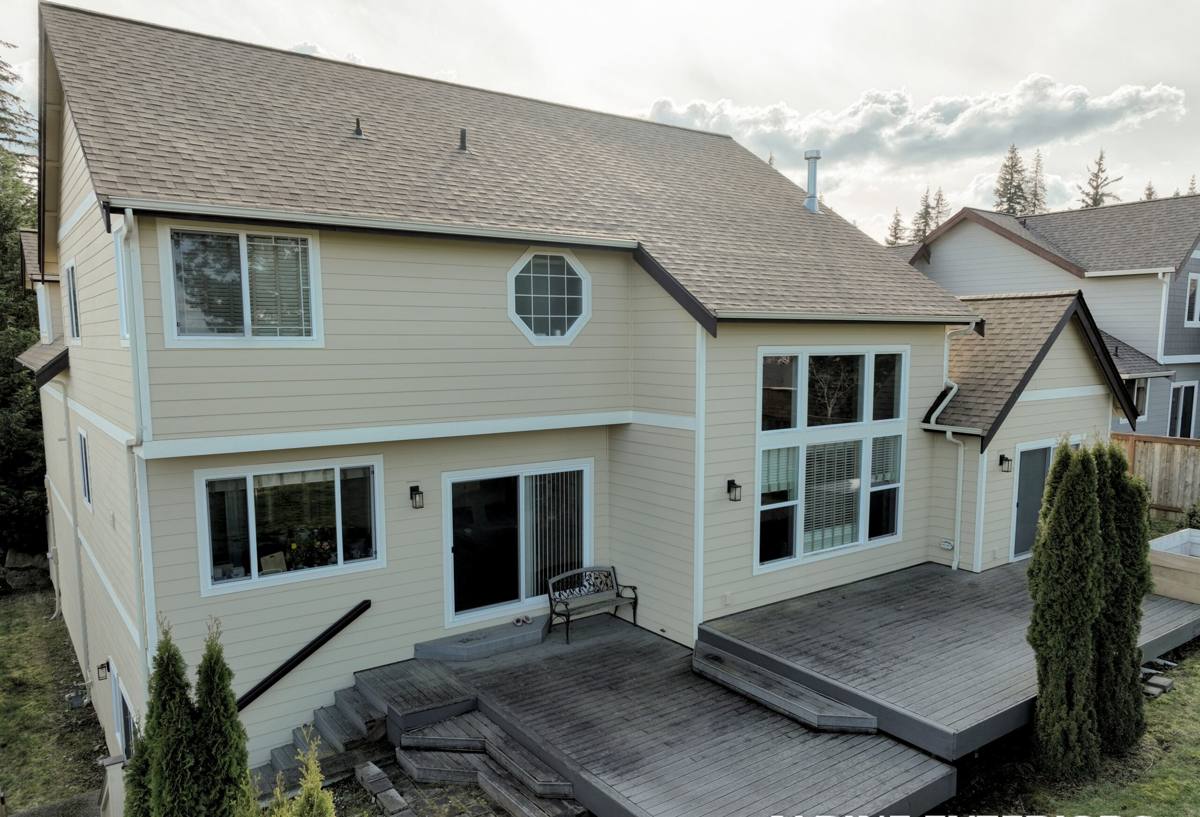
 Decking in Blaine Has to Work Harder Than It Does Most Places
Blaine sits right on the water at the northern edge of Whatcom County, and that location comes with a specific set of decking problems most inland contractors don't think about daily. Salt-laden air off the Strait of Georgia and Semiahmoo Bay accelerates corrosion on fasteners and hardware. Driving rain off the water pushes moisture sideways under railings and into end grain, not just straight down. And the region's long, damp shoulder seasons mean moss and algae get a genuine head start on any deck surface that doesn't shed water and dry out quickly. A deck built without those three things in mind will look fine for a year or two and then start showing problems that are expensive to reverse.
Composite decking, installed correctly, handles all three better than wood — but "installed correctly" is doing a lot of work in that sentence. A lot of the composite deck failures we get called out to inspect in this area aren't material failures. They're installation shortcuts that a coastal climate exposes faster than it would in a drier part of the state.
What Blaine's Climate Actually Does to a Deck
Salt Air and Metal Hardware
Standard deck screws, joist hangers, and structural connectors corrode faster this close to salt water. Galvanized coatings that hold up fine forty miles inland can start showing rust streaks on a Blaine deck within a couple seasons if the coating isn't rated for the exposure. Those rust streaks aren't just cosmetic — they mean the fastener itself is weakening, and on a deck, fastener integrity is structural, not decorative.
Driving Rain and Wind-Driven Moisture
Wind off the water doesn't let rain fall straight down. It drives moisture under rail caps, into fascia joints, and behind picture-frame trim boards — all places a deck design has to account for with proper flashing and drainage gaps, not just caulk. Composite boards themselves don't absorb water the way wood does, but the substructure underneath them (ledger boards, joists, framing connections) is still almost always wood, and that's where wind-driven rain does its damage if it's not detailed correctly.
Moss and Algae in a Long Damp Season
Whatcom County's mild, wet stretch from fall through spring gives moss and algae a long runway. Any deck surface that stays damp — because of poor airflow underneath, boards laid too tight, or a low spot that doesn't drain — will green up faster here than it would somewhere with a shorter wet season. Composite surfaces resist staining better than wood, but they're not immune, and a deck with bad drainage will still grow moss on top of composite boards.
Why We Recommend Composite for Blaine Specifically
We install both wood and composite decking, and for most Blaine homes we recommend composite for a straightforward reason: it removes the annual maintenance cycle that this climate makes especially punishing. Wood decking here needs yearly cleaning, sealing, and moss treatment just to keep pace with the moisture and salt exposure — skip a season and you're often behind on repairs, not just cosmetics. Composite doesn't need sealing or staining, resists moisture absorption in the boards themselves, and holds its color and surface texture much longer under this level of exposure.
That's a maintenance-burden and moisture-behavior tradeoff, not a claim that wood decking is a bad product. Some homeowners still prefer real wood for the look and are willing to keep up the maintenance — that's a legitimate choice. We just find that most people who've lived with a deck through a few Blaine winters end up wanting the lower-maintenance option for the replacement.
Composite vs. Wood in Blaine's Climate
| Factor | Composite Decking | Wood Decking |
|---|---|---|
| Annual maintenance | Occasional wash; no sealing/staining | Cleaning, sealing/staining most years |
| Moisture absorption | Minimal in the board itself | Absorbs and releases moisture seasonally |
| Moss/algae resistance | Better, but still needs airflow and drainage | More prone without regular treatment |
| Fastener/hardware exposure | Same coastal corrosion risk — hardware choice matters either way | Same coastal corrosion risk — hardware choice matters either way |
| Upfront cost | Higher material cost | Lower material cost |
| Long-term cost | Lower over 15-20 years with less upkeep | Ongoing maintenance cost adds up |
What a Correct Composite Deck Install Looks Like Here
The composite boards get most of the attention, but on a Blaine property the substructure and hardware decisions matter just as much for how the deck holds up.
Framing and Fasteners
We use fasteners and structural hardware rated for coastal/marine-adjacent exposure — not because code requires it everywhere, but because standard-grade hardware corrodes faster this close to the water and a corroded connector is a hidden problem until it isn't. Joist hangers, ledger bolts, and structural screws all get the same consideration.
Ledger Attachment and Flashing
Where the deck attaches to the house is the single most common point of moisture failure on any deck, anywhere. In a driving-rain environment like Blaine, proper ledger flashing that directs water away from the house band board isn't optional — it's the difference between a deck that lasts decades and one that causes hidden rot behind the siding.
Board Spacing and Airflow
Composite boards need consistent gapping for drainage and expansion, and the framing underneath needs enough airflow to let the underside dry out between rain events. Tight spacing or blocked airflow is exactly what lets moss and mildew get a foothold on an otherwise good composite surface.
Railing and Post Connections
Rail posts are a common leak point because they're a penetration through the deck surface. Correct blocking and flashing at each post location keeps water from tracking down into the framing.
Our Process for a Blaine Composite Deck Project
- On-site assessment — we look at the existing structure (if replacing a deck), house attachment point, drainage, and sun/wind exposure specific to your lot.
- Design and material selection — board style, color, and railing options, sized to your framing needs and budget.
- Permitting — decks over a certain height or attached to the home typically require permitting through the applicable jurisdiction; we handle that paperwork.
- Framing and structural work — coastal-rated hardware, proper ledger flashing, correct joist spacing for the composite product being installed.
- Composite installation — board layout, fastening system, and gapping done to manufacturer spec so the warranty stays intact.
- Railing, stairs, and trim — final structural elements, flashed and fastened correctly.
- Final walkthrough — we go over the finished deck and basic care with you before we consider the job done.
What to Ask Before You Hire Anyone for This Job
A composite deck is a significant investment, and the quality gap between a correctly installed one and a rushed one usually doesn't show up until year two or three — right when it's most expensive to fix. Before hiring a crew, it's worth asking a few direct questions.
- Do you use marine or coastal-rated fasteners and hardware, or standard-grade?
- How do you flash the ledger board where the deck meets the house?
- What board spacing and airflow allowance do you follow under the deck?
- Will the installation meet the manufacturer's requirements to keep the product warranty valid?
- Are you pulling the required permit, or expecting the homeowner to?
- Can you walk me through how you'll handle rail post penetrations and drainage?
If a contractor can't answer these clearly, that's worth noting before you sign anything.
Why Local Experience Matters for This Job
Whatcom County covers a lot of climate variation — Bellingham proper, the county's rural interior, and a waterfront community like Blaine don't all need the exact same detailing. A crew that regularly works Blaine properties already knows to spec coastal-rated hardware without being asked, already accounts for wind-driven rain in the flashing plan, and already understands how fast moss establishes on a poorly drained surface in this specific stretch of coastline. That's not something you get from a general decking crew working from a one-size-fits-all spec sheet — it comes from having repaired and replaced enough decks in this exact area to know where they typically fail first.
Get a Straight Answer on Your Blaine Deck Project
If you're planning a new composite deck or replacing one that's showing its age, we're glad to come take a look and give you a straightforward assessment — what your site needs, what it'll take to do it right, and a real cost range, with no pressure to sign anything on the spot. Reach out through the form below for a free estimate.