 Bellingham Siding
 Why Cordata Homes Take a Different Kind of Beating
Cordata sits on Bellingham's north side, close enough to the water and the Whatcom County weather patterns that come off it to make siding choice a real decision, not an afterthought. Homes here deal with three things year-round: salt-laden air rolling in off Bellingham Bay and the greater Salish Sea, long stretches of driving, wind-blown rain that doesn't just fall straight down but drives sideways into wall assemblies, and a moss and algae season that can run most of the year on shaded north- and east-facing walls. Any one of those is manageable. All three, hitting the same siding day after day for decades, is what separates a wall system that holds up from one that starts failing quietly behind a surface that still looks fine.
This page is about one thing specifically: installing James Hardie fiber cement siding on a Cordata home, the right way, for this exact climate. Not a generic pitch — the actual product engineering, the installation details that matter here, and why the crew doing the work matters as much as the material itself.
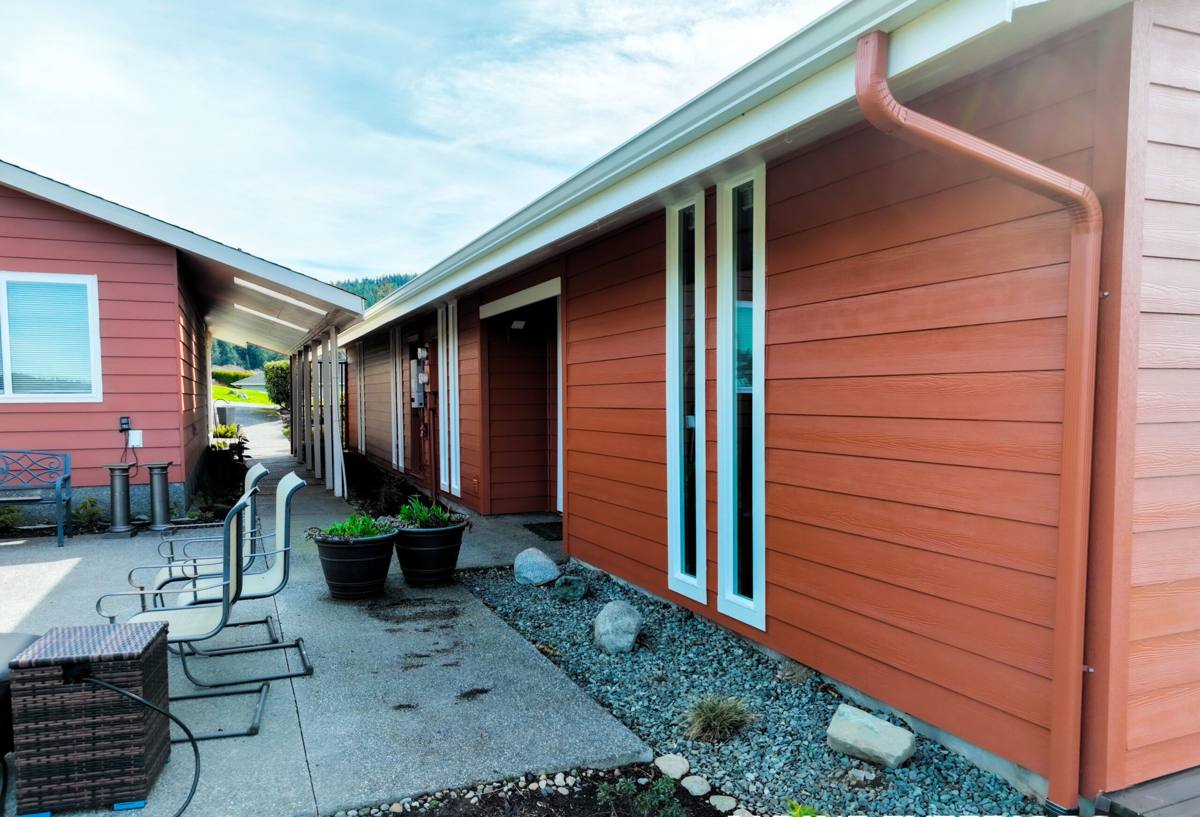
What James Hardie Actually Brings to This Climate
James Hardie fiber cement is a mix of cement, sand, and cellulose fiber, cured into a rigid board that doesn't behave like wood, vinyl, or engineered wood siding. It doesn't rot. It's non-combustible. It doesn't expand and contract with humidity swings the way wood-based products do. For a Whatcom County home dealing with the specific one-two punch of salt air and constant moisture exposure, those aren't marketing points — they're the actual reasons the material holds a factory finish and a straight profile for decades instead of one or two.
Built for the Pacific Northwest Specifically
James Hardie engineers its siding by climate zone under what it calls its HZ5 product line for regions like ours — formulated for cold, wet, high-moisture-cycling conditions rather than a one-size-fits-all national product. That matters in a place like Cordata where a wall can go from soaked to damp to soaked again for weeks at a stretch without ever fully drying between rain events.
ColorPlus Finish vs. Field-Painted Siding
Most Hardie siding we install carries the ColorPlus factory finish — a baked-on, multi-coat finish applied under controlled conditions rather than painted on-site after installation. In a salt-air environment, that finish resists fading and chalking better than a field-applied paint job, and it comes with its own finish warranty separate from the substrate warranty. It also means touch-up, when it's ever needed, uses matched ColorPlus touch-up product rather than a guessed-at paint match years later.
What a Correct Installation Actually Involves
Fiber cement siding is only as good as the wall assembly underneath it. James Hardie's own installation manual is specific and detailed for a reason — most siding failures we get called to look at aren't material failures, they're installation shortcuts. In a climate like Whatcom County's, those shortcuts show up faster.
Moisture Management Behind the Siding
Correct installation starts with a properly lapped weather-resistive barrier, a drainage plane (often a rain screen gap) so bulk water that gets past the siding can actually drain and dry rather than sit against the sheathing, and flashing at every window, door, deck ledger, and roof-to-wall transition. Driving rain off the bay finds every gap in a wall assembly that isn't detailed correctly — the siding itself is almost never the weak point when a wall leaks.
Fastening, Clearance, and Joint Treatment
James Hardie specifies fastener type, spacing, and embedment depth for a reason — under- or over-driven fasteners both create failure points. Siding needs a minimum clearance from grade, roof lines, and decks so it isn't sitting in standing water or snow load. Butt joints need the gap and treatment Hardie specifies, not a tight caulked seam that traps moisture. None of this is visible once the job is finished, which is exactly why it has to be done right the first time.
Comparing Siding Materials for a Cordata Wall
Homeowners planning a re-side often ask how the options actually stack up in this specific climate, not in general. Here's an honest comparison based on how these materials behave under salt air, sustained moisture, and a long moss season — the conditions that actually matter here.
| Material | Moisture & Moss Behavior | Salt Air Durability | Maintenance Burden | Fire Rating |
|---|---|---|---|---|
| Vinyl | Doesn't rot, but seams and J-channels trap moisture; can warp under heat/cold cycling | Can fade and chalk faster in coastal exposure | Low, but color is baked-in and can't be refreshed | Combustible, melts at low heat |
| Cedar / primed spruce | Absorbs moisture, feeds moss and algae growth, prone to cupping and checking | Salt accelerates weathering of the wood grain | High — refinishing every few years | Combustible |
| OSB-based engineered wood (e.g. LP SmartSide) | Resin-treated but still wood-based; edge swelling risk if moisture reaches cut ends or joints | Moderate, installation-sensitive | Moderate — depends heavily on install detailing | Combustible |
| James Hardie fiber cement | Doesn't absorb moisture into a wood substrate; moss/algae can still grow on the surface but doesn't compromise the board | Engineered finish holds up well; substrate is inert to salt | Low — occasional cleaning, no refinishing cycle | Non-combustible |
Every one of these materials has a legitimate place somewhere. Our position is simply that for the moisture load and salt exposure a Cordata home actually sees, fiber cement is the one we're willing to put our name on — which is why it's the only siding system we install.
Our Process on a Cordata Job
The work is the same discipline whether it's one wall or a full re-side, but the sequence matters:
- Assessment: We look at the existing wall assembly, check for hidden moisture damage or rot behind the current siding, and evaluate flashing at windows, roof lines, and penetrations before quoting anything.
- Planning: We spec the right Hardie profile and ColorPlus color for the home, confirm HZ5 product availability, and plan clearances, drainage, and trim details specific to that structure.
- Prep and moisture barrier: Old siding comes off, damaged sheathing gets addressed (not covered up), and the weather-resistive barrier and drainage plane go in correctly and get inspected before any siding goes up.
- Installation: Fastening, clearances, joint treatment, and flashing all follow James Hardie's published installation instructions — not shortcuts that only show up as problems years later.
- Final walkthrough: We check caulking, trim, touch-up, and clearances before calling the job done.
Installation Checklist We Hold Ourselves To
- Weather-resistive barrier lapped shingle-style, no gaps or reverse laps
- Drainage plane in place behind the siding for bulk water to escape
- Flashing at every window, door, deck ledger, and roof-to-wall intersection
- Minimum clearance maintained from grade, decks, and roof surfaces
- Fasteners at manufacturer-specified type, spacing, and depth — not over-driven
- Butt joints gapped and treated per James Hardie specification
- ColorPlus touch-up used only where specified, matched to the factory finish
Living With It: Maintenance in a Moss-Prone, Salt-Air Environment
Fiber cement doesn't eliminate moss and algae from the equation entirely — nothing that sits outside in Whatcom County year-round does. Shaded, damp walls can still develop surface growth over a long moss season. The difference is what that growth does to the material underneath. On wood-based siding, sustained moisture and organic growth can work into the substrate itself. On correctly installed Hardie siding, it stays a surface condition — an occasional gentle wash (low-pressure, not a power washer aimed point-blank) keeps it looking right without threatening the board. Salt air mostly shows up as gradual finish weathering rather than material breakdown, which is where the ColorPlus finish and its own warranty coverage earn their keep over the life of the siding.
Why a Crew That Already Works Cordata Matters
Siding installation is detail work, and the details that matter change with the site. A crew that already works this side of Bellingham knows which wall orientations in Cordata tend to hold moisture longest, how far driving rain off the bay actually travels inland on a bad storm day, and what a Whatcom County building department expects to see on a re-side permit. That's not something you get from a national installer passing through — it's what comes from doing this work, on homes like this one, in this specific climate, repeatedly. It also means someone local is answerable if a question comes up five or ten years down the road, not a phone number that changes hands.
What This Costs to Get Right
Every Cordata home is a different scope — square footage, number of stories, trim complexity, whether there's damaged sheathing to address, and how much of the existing wall assembly can be reused versus needs to be rebuilt. Rather than quote a number that doesn't mean anything without seeing the house, we walk the property, check the wall assembly, and give a written estimate based on what your home actually needs — not a generic per-square-foot guess.
If you're weighing a re-side in Cordata or anywhere else in Bellingham, we're happy to take a look and walk you through what your home specifically needs, with no pressure to sign anything on the spot. Reach out below for a free estimate.