 Bellingham Siding
 Decks in Puget Face a Different Set of Conditions Than Decks Inland
Puget sits close enough to the water that a deck here deals with a different combination of stresses than one built out toward the eastern part of Whatcom County. You get salt-laden air working on every metal fastener and connector, driving rain that comes in sideways during fall and winter storms, and a moss and algae season that can run eight months or longer on a shaded, north-facing deck. None of that means a deck can't last decades here — it means the details that don't matter much in a dry climate matter a great deal in this one.
Most deck problems we get called out to look at in this area aren't design failures. They're moisture and corrosion problems that started small — a missed flashing detail, an untreated cut end, a fastener that wasn't rated for coastal exposure — and got worse every wet season until they showed up as soft framing, rusted hardware, or a slick, moss-covered surface that's actually a fall hazard.
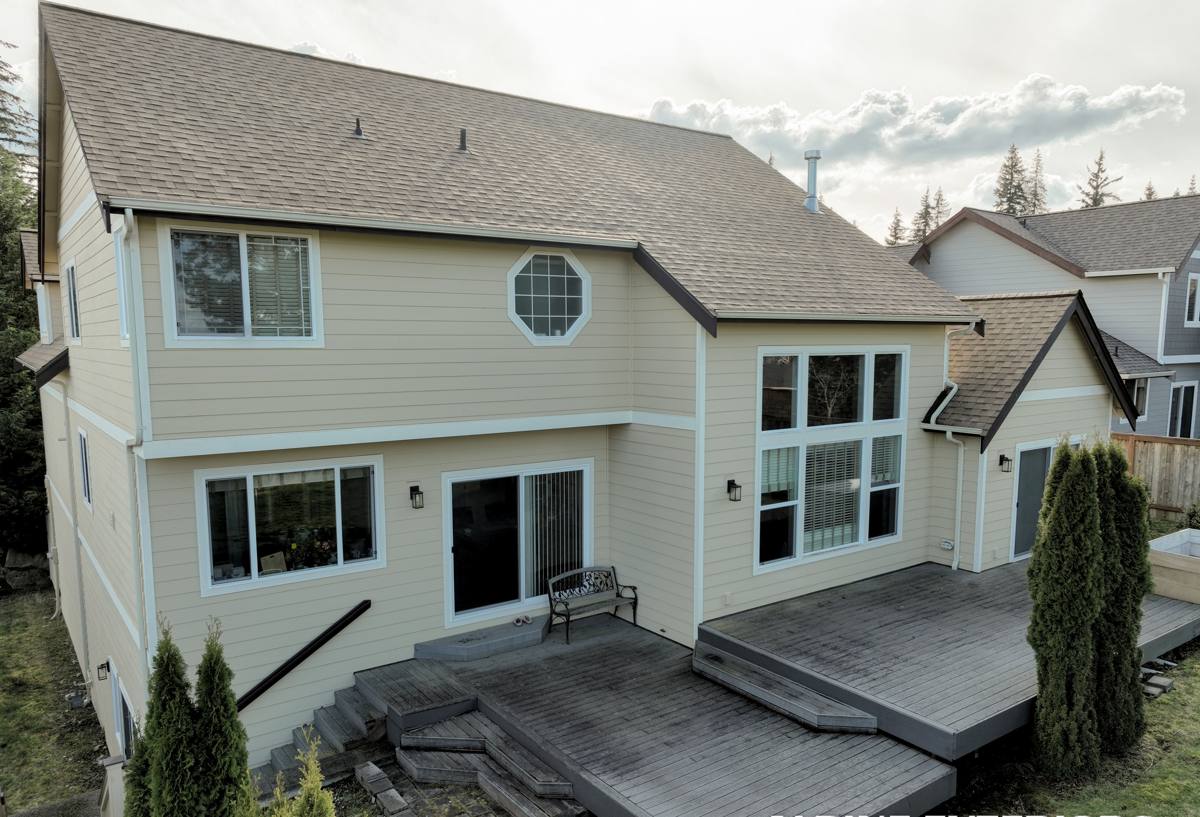
The Ledger Connection Is Where Most Rain Damage Starts
The ledger board — the piece that attaches the deck to the house — is the single most important flashing detail on the entire structure. It's also the one most commonly built wrong, because a poorly flashed ledger can look fine for years while water works its way behind the siding and into the rim joist.
Given how much driving rain this area sees, we treat ledger flashing as non-negotiable: proper step flashing or a continuous flashing membrane integrated behind the siding, a drainage gap or flashing tape between the ledger and the house, and stainless or hot-dip galvanized structural screws rated for the load and the exposure. Skipping any one of these doesn't cause a visible problem right away. It causes a hidden one that's expensive to fix once the siding and sheathing have to come off to get at it.
Signs an Existing Deck Has a Ledger Problem
- Staining or a dark line on the siding directly above where the deck attaches
- Soft or spongy decking near the house-side edge
- Visible gaps where the ledger meets the siding, with no flashing visible
- Rust streaks running down from ledger bolts or hangers
- A slight bounce or give where the deck meets the house that isn't present further out
Salt Air Shortens the Life of the Wrong Hardware
Every fastener, joist hanger, post base, and structural screw on a deck is a potential weak point, and salt-laden air accelerates corrosion on anything not rated for it. Standard galvanized hardware that would hold up fine further inland can start showing rust within a few years this close to the water, especially on a deck that also catches wind-driven spray.
We spec stainless steel or heavy-duty coated hardware rated for coastal and treated-lumber exposure on every connection point — hangers, post bases, ledger bolts, and the fasteners holding the decking itself. The same logic applies to metal railing components and any exposed structural steel: mismatched or under-rated hardware is usually the first thing to fail, and it fails quietly, underneath a deck surface that can still look fine on top.
It costs more up front than grabbing whatever's on the shelf at a hardware store. It also means the connections are still doing their job fifteen years from now, instead of needing to be torn into because a hanger rusted through behind decking that hasn't even needed replacing yet.
Moss, Algae, and a Long, Slick Season
Whatcom County's moss season isn't a minor seasonal nuisance on a deck — it's a real slip hazard and a real material concern. Shaded decks, north-facing decks, and anything tucked under trees or overhangs can stay damp for days at a time through fall and winter, which is exactly what moss and algae need to take hold.
Board Spacing and Drainage Matter More Than People Expect
Proper gapping between boards and a decking surface that actually drains — rather than holding a film of standing water — makes a real difference in how fast moss establishes. So does keeping the space under the deck ventilated instead of sealed and damp. We build in drainage and airflow from the start rather than relying on you to power-wash the problem away every spring.
Surface Choice Affects How Bad It Gets
Some surfaces resist algae growth better than others, and texture matters too — a heavily wood-grained composite can actually hold more moisture in its texture than a smoother board. We'll walk through the tradeoffs for your specific site — sun exposure, tree cover, which direction the deck faces — rather than assuming one material is automatically the right call for every lot.
What Regular Upkeep Actually Looks Like
A yearly cleaning with the right approach — not a pressure washer set too aggressively, which can chew up softwood decking — keeps most decks ahead of the problem. We'll tell you honestly what your specific material and site conditions need, rather than upselling maintenance you don't need or downplaying upkeep you do.
Choosing a Decking Material for This Climate
There's no single right answer for every deck in Puget — the right material depends on budget, how much shade the deck gets, and how much upkeep you're willing to take on. Here's how the common options actually perform in this climate:
| Material | Moisture & Moss Behavior | Maintenance | Typical Lifespan Here |
|---|---|---|---|
| Pressure-treated lumber | Absorbs water, needs sealing to shed rain well; moss takes hold if not maintained | Annual cleaning, periodic sealing/staining | 15-20 years with upkeep |
| Cedar | Naturally resists rot better than untreated wood; still needs finish to resist moss and graying | Regular sealing, cleaning | 20-25 years with upkeep |
| Composite decking | Doesn't absorb water like wood, but texture and shaded areas can still grow algae | Periodic washing, no sealing or staining | 25-30+ years |
| PVC decking | Sheds water well, very low moisture absorption | Occasional washing | 25-30+ years |
Whatever material you choose, the framing underneath and the fasteners holding it together matter more to long-term performance than the decking surface itself. A premium composite deck built on undersized, poorly flashed framing will fail before a well-built pressure-treated deck does.
Framing, Footings, and Ground Conditions
What's underneath the decking is what actually determines how long a deck lasts and how safe it stays. Post bases need to hold the post above grade so it isn't sitting in standing water after a heavy rain — a common shortcut we see on older decks is a post set directly into or too close to wet soil, which rots the post base from the inside out long before the visible wood shows any damage.
Footings need to be sized and set to local frost depth and soil conditions, not just poured to whatever looked deep enough at the time. That's part of what the permit and inspection process checks, which is one more reason to pull permits rather than skip them.
Sloped and Uneven Lots
A lot of lots in and around Bellingham aren't flat, and a deck on a sloped or uneven lot needs taller posts, more bracing, and sometimes a different footing approach than a deck built at grade. Taller decks also trigger different guardrail requirements. We plan for the actual grade of your lot rather than treating every deck like it's going on level ground.
Permits and Code Requirements
Most decks above a certain height, or attached to the house in a way that affects the structure, require a permit through the City of Bellingham or the county, along with an inspection of the framing and footings before decking goes down. Guardrails, baluster spacing, and stair rise-and-run all have code minimums that aren't optional once a deck crosses certain height and size thresholds.
We pull permits and schedule inspections as a normal part of the job rather than treating it as extra paperwork. It protects you if you ever sell the house, and it means a third party is checking the framing and footings before they're covered up by decking.
- Deck height above grade — determines whether guardrails are required
- Attachment to the house — determines ledger and structural review
- Total square footage — can affect permit type and setback requirements
- Stairs — rise, run, and handrail requirements apply once a certain number of steps is reached
- Guardrail baluster spacing — a fixed code maximum, not a design preference
How We Build a Deck in Puget
We start with a site visit to look at drainage, sun and shade exposure, tree cover, slope, and how the deck will attach to the house — specific to your lot, not a generic plan pulled off a shelf. From there we handle design, material selection, and permitting before any framing starts.
Construction follows the order that protects the structure: footings and posts set correctly for the soil and grade, framing with hardware rated for coastal exposure, ledger flashing done properly the first time, then decking and railings. We schedule required inspections at the right points instead of working around them. When the deck is done, we walk it with you — how to clean it, what to expect from moss and algae through the wet months, and what maintenance the material you chose actually needs.
Why a Crew That Already Works This Neighborhood Matters
A contractor who builds decks all over Western Washington knows decks in general. A crew that regularly works Puget and the rest of Bellingham knows what a shaded, north-facing lot near the water does to a deck by year three, which hardware actually holds up against salt air instead of just being rated for it on paper, and which framing shortcuts show up as callbacks two winters later.
That local pattern-recognition is the difference between a deck that needs real attention at year eight and one that's still solid at year twenty-five. It's also why we'd rather walk your specific lot and tell you honestly what it needs than quote a deck sight unseen.
If you're planning a new deck or replacing one that's showing its age, we're happy to take a look and give you a straightforward assessment — no pressure, no inflated scope. Use the form below to request a free estimate.