 Bellingham Siding
 Why Ferndale Decks Wear Out Faster Than the Manual Says
Every deck manufacturer publishes a maintenance schedule written for an average climate. Ferndale doesn't have an average climate. Sitting close to the water in Whatcom County, homes here take on a steady mix of salt-laden air, long stretches of driving rain off the Strait, and a moss season that can run from early fall through late spring. That combination is hard on wood, hard on fasteners, and hard on the connections that hold a deck together — often years before a homeowner notices anything wrong from the surface.
We repair decks in Ferndale regularly, and the failures we find are rarely random. They follow a pattern tied directly to the local conditions: moisture trapped where boards meet framing, corrosion on fasteners that weren't rated for coastal exposure, and rot that started underneath a healthy-looking board because the ledger flashing was never installed correctly in the first place. Understanding that pattern is the first step to fixing it right instead of just patching what's visible.
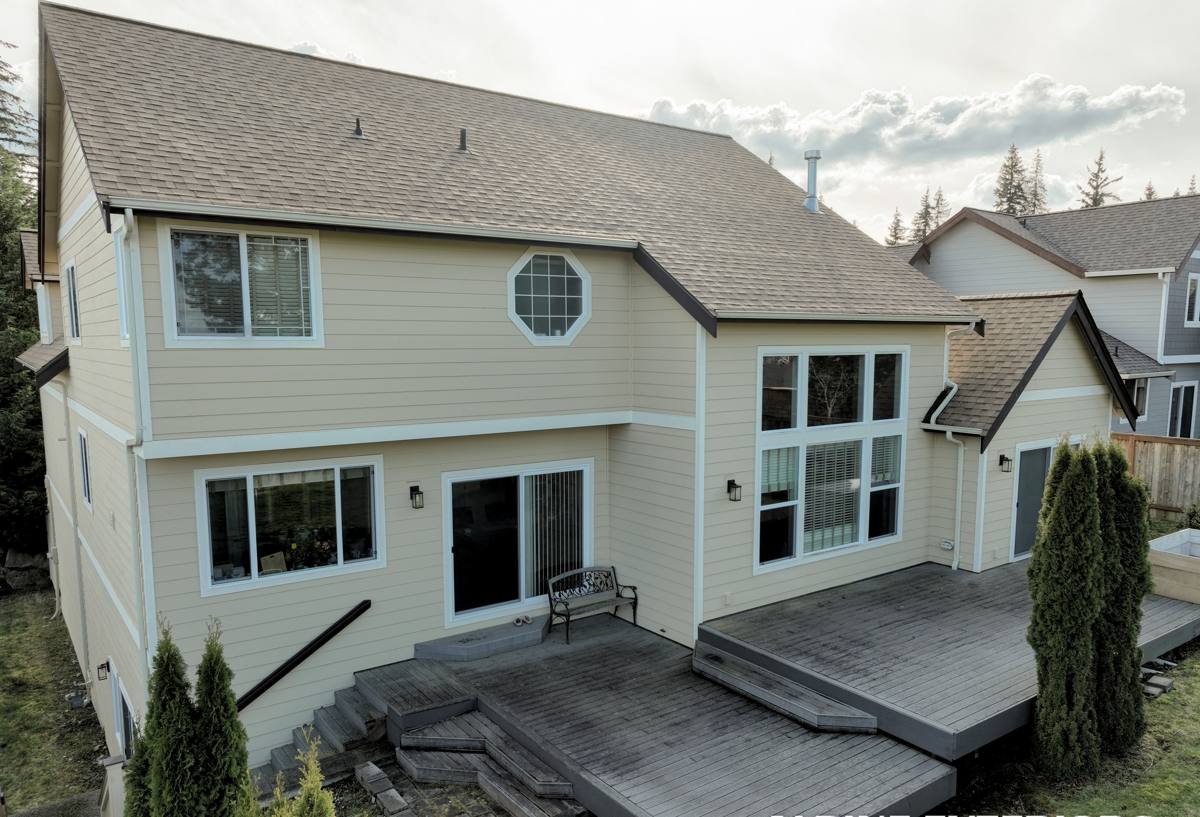
How Salt Air, Rain, and Moss Actually Damage a Deck
Salt Air and Metal Fatigue
Airborne salt accelerates corrosion on anything metal — joist hangers, structural screws, bolts, and flashing. Once a fastener starts to rust, it loses holding strength long before it looks obviously bad. A joist hanger that's rusted through on the inside can still look intact from a quick glance underneath the deck, which is exactly why we pull and inspect hardware rather than eyeball it.
Driving Rain and Water Intrusion
Wind-driven rain doesn't just fall straight down — it gets pushed sideways into gaps, under ledger boards, and behind rim joists. Over time, water finds every seam that wasn't properly flashed or sealed. The result is rot that develops from the inside out, often at the ledger board (where the deck attaches to the house) and at the tops of support posts where end grain soaks up moisture like a sponge.
Moss, Algae, and Trapped Moisture
A long moss season means extended periods where deck surfaces stay damp instead of drying out between rain events. Moss and algae hold moisture directly against wood fibers, which speeds up decay and makes boards more slippery — a real safety issue on stairs and ramps. Left alone, moss growth is more than cosmetic; it's a sign the deck isn't shedding water the way it should.
Signs Your Deck Needs Repair — And What They Usually Mean
- Soft or spongy boards — usually localized rot; often repairable by replacing individual boards if framing underneath is sound.
- Rust streaks below fastener heads — a sign hardware is corroding and losing grip strength, even if the board above still looks fine.
- Deck feels bouncy or springy underfoot — often points to a weakened or undersized joist, or a joist that's partially rotted.
- Gaps or movement where the deck meets the house — a serious warning sign; this connection (the ledger) carries a large share of the deck's load.
- Persistent moss or dark staining that returns after cleaning — indicates a drainage or airflow problem, not just a cleaning problem.
- Wobbly or leaning railings and posts — often a fastener or post-base failure, and a safety priority regardless of how the rest of the deck looks.
What a Correct Deck Repair Actually Involves
A repair that only replaces what's visible from the top often misses the cause. Our approach starts from the structure down, because that's where Ferndale's climate does the most damage.
1. Full Structural Inspection
We check the ledger board connection, joists, beams, posts, and footings — not just the decking boards. This includes probing wood with an awl to find soft spots that aren't visible from the surface, and checking fastener condition at connection points.
2. Ledger Flashing and Attachment
If the ledger board isn't properly flashed to shed water away from the house, no amount of surface repair will stop the underlying rot from coming back. Correcting ledger flashing is often the single most important step in a lasting repair.
3. Joist and Beam Repair or Sistering
Where a joist has partial rot but the rest of the structure is sound, sistering (attaching a new joist alongside the damaged one) can restore strength without a full rebuild. Where damage is extensive, replacement is the honest answer — we'll tell you which situation you're in.
4. Fastener and Hardware Upgrades
We replace corroded hardware with fasteners and connectors rated for coastal, high-moisture exposure, not the standard-grade hardware that's adequate inland but undersized for a site like Ferndale.
5. Decking, Railing, and Surface Work
Only after the structure is sound do we address boards, railings, and stairs — replacing what's damaged and matching the rest as closely as practical.
Repair vs. Replace: How We Help You Decide
Not every deck problem calls for a full rebuild, and not every deck is worth repairing indefinitely. Here's the honest breakdown we use when advising Ferndale homeowners:
| Condition | Usually Repairable | Usually Needs Replacement |
|---|---|---|
| Decking boards | Isolated soft or damaged boards, framing sound | Widespread rot across most of the surface |
| Ledger board | Localized rot caught early, house band board sound | Extensive rot into the house's rim joist |
| Joists/beams | One or two damaged joists, can be sistered | Multiple joists compromised or undersized to begin with |
| Posts/footings | Surface deterioration, footing still stable | Footing has shifted or heaved, post base rotted through |
| Railings/stairs | Loose connections, minor rot at posts | Structural railing failure or code-noncompliant original build |
In many cases a deck is a mix of both columns — solid framing with a failing surface, or the reverse. That's why we inspect before quoting rather than pricing off a phone description.
Materials We Use and Why
We choose materials based on how they'll actually perform in this climate, not just how they look on day one.
| Material | Strengths in Ferndale's Climate | Trade-offs to Know |
|---|---|---|
| Pressure-treated lumber | Cost-effective, widely available, good repair-matching for existing PT decks | Requires periodic sealing to resist moisture and moss |
| Cedar | Naturally rot-resistant, ages well, common on older Ferndale decks | Softer wood, needs more attentive maintenance near the coast |
| Composite decking | Resists rot and moss buildup on the surface, low maintenance | Higher upfront cost; framing underneath still needs wood-grade protection |
| Stainless or coated coastal-grade fasteners | Resists corrosion from salt air far longer than standard hardware | Costs more than standard fasteners, which is why lesser-grade hardware fails first |
Our standard is to spec hardware and flashing for coastal exposure by default on Ferndale jobs — not as an upgrade option, but as the baseline. Using standard-grade fasteners here just moves the corrosion timeline up, and we'd rather do the job once.
Our Repair Process, Start to Finish
- On-site inspection — we look at the deck from the structure up, including underneath, and explain what we find in plain terms.
- Written scope and pricing — a clear breakdown of what's being repaired and why, before any work starts.
- Structural repairs first — ledger, framing, and hardware corrected so the fix holds.
- Surface repairs — decking, railings, and stairs addressed once the structure underneath is sound.
- Final walkthrough — we go over the repair with you, including any maintenance you should keep up with going forward.
Maintenance That Actually Helps in This Climate
A repaired deck stays repaired longer with a few habits suited to Whatcom County's weather pattern:
- Clean moss and algae off deck surfaces and stairs before they build up a thick layer — a stiff brush and deck-safe cleaner, done early in the wet season, is far easier than scraping a season's growth later.
- Keep gutters and downspouts clear so roof runoff isn't dumping extra water directly onto or under the deck.
- Check that furniture, planters, and rugs aren't trapping moisture against the boards for long stretches.
- Look underneath the deck once or twice a year for rust streaks, soft wood, or gaps at the ledger connection.
- Re-seal wood decking on the schedule appropriate for the product — coastal exposure often shortens the interval compared to inland recommendations.
- Address small issues (a loose board, a rust spot) as they appear rather than waiting for them to become structural.
Why a Crew That Already Works Ferndale Makes a Difference
Deck repair advice that works for a dry inland climate can actively steer you wrong here. A crew unfamiliar with coastal Whatcom County conditions might replace boards without upgrading the fasteners underneath, or miss ledger flashing problems because they're not used to looking for them. We work on decks throughout the Bellingham and Ferndale area regularly, so we're diagnosing the same salt air, driving rain, and moss patterns job after job — not guessing at what's causing the damage.
That familiarity also means straight answers. If a deck genuinely needs a full rebuild, we'll say so. If a targeted repair will hold up for years, we won't talk you into more than that. Either way, the goal is a deck that's actually safe and actually lasts in the conditions it sits in — not just one that looks fixed for a season.
Get a No-Pressure Estimate
If your deck has soft spots, rust streaks, persistent moss, or just doesn't feel as solid as it used to, it's worth a proper look before the next wet season sets in. We'll inspect it, tell you honestly what's going on, and lay out your options — no pressure, no upsell. Use the form below to request a free estimate.