 Bellingham Siding
 Storm Damage Roof Repair Built for Ferndale's Weather
Ferndale sits in the open, low-lying part of Whatcom County, closer to the Salish Sea than the hills that shelter parts of Bellingham. That exposure matters. Winter storms roll in off the water with driving rain and sustained wind, and there's less tree cover and terrain to slow them down before they hit a roof. Add in the region's long, damp moss season, and Ferndale roofs take on a specific kind of punishment: wind-lifted shingles, wind-driven rain forced under flashing, and moss and moisture working into weak spots year-round. Storm damage repair here isn't just about fixing what broke in one bad night — it's about understanding how the last several years of salt air, rain, and moss growth already softened the roof before the storm ever hit.
We work on roofs across Whatcom County, and Ferndale jobs tend to share a pattern: aging shingle or composition roofs, moss buildup in shaded valleys and north-facing slopes, and flashing that was fine when it was installed but has since loosened from years of freeze-thaw and wind. When a storm hits a roof already in that condition, damage shows up faster and spreads further than it would on a well-maintained roof in a more sheltered spot.
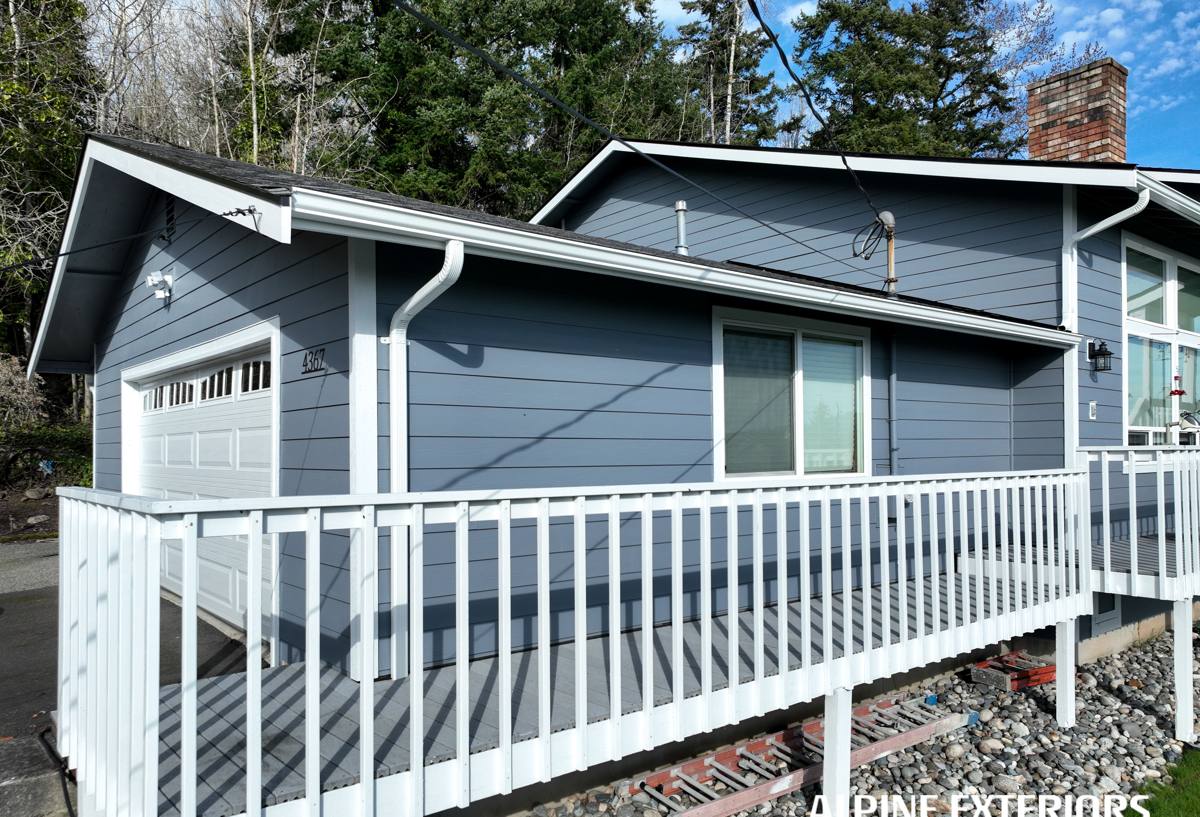
What Whatcom County Storms Actually Do to a Roof
Wind
Sustained wind off the water doesn't just rattle shingles — it gets underneath the tab line and works it loose, especially on roofs where the sealant strip has already weakened from age or heat cycling. Once a few tabs lift, the next storm has an easier time lifting more. Wind also drives rain sideways, which pushes water into laps and seams that are only designed to shed water moving straight down.
Driving rain
A roof can handle straight-down rain for decades. Wind-driven rain is different — it gets pushed uphill under shingle edges, around vent boots, and into flashing laps that were never meant to see water from that angle. This is where most storm-related leaks actually start: not a dramatic hole, but water finding a path it was never supposed to have.
Moss and prolonged moisture
Whatcom County's moss season runs long, and Ferndale's mix of shade, moisture, and mild temperatures is close to ideal for it. Moss holds water against the shingle surface far longer than open air ever would, which accelerates granule loss and softens the mat underneath. A shingle that's been sitting under a moss mat for a couple of seasons is simply weaker than a clean one nearby — so it's often the first place storm damage shows up.
Signs Your Ferndale Roof May Have Storm Damage
- Missing, cracked, or curled shingles, especially on the side of the roof that faces prevailing wind
- Granules collecting in gutters or downspouts after a storm
- New or worsening moss growth in valleys, along ridges, or on north-facing slopes
- Bent, lifted, or missing flashing around chimneys, vents, and skylights
- Water stains on interior ceilings or in the attic, particularly near exterior walls
- Sagging or soft spots when walked on (do not attempt to check this yourself from the roof)
- Debris — branches, needles, gravel from shingle surfaces — collected in valleys or against the roof edge
- Gutters pulling away from the fascia or showing new dents from wind-blown debris
Some of these are obvious right after a storm. Others — like early moss regrowth or a slow leak that only shows up during the next hard rain — take longer to notice. That's part of why a post-storm inspection matters even when nothing looks obviously wrong from the ground.
What a Correct Storm Damage Repair Actually Involves
Storm damage repair done right is not the same as slapping a patch over the spot that's visibly leaking. A patch addresses the symptom; a proper repair addresses the reason water got in and confirms nothing else nearby is compromised.
Full-roof inspection, not just the trouble spot
Wind and rain damage rarely stay in one tidy area. We check the whole roof plane — not just the section over the leak — because a storm that lifted shingles in one spot often stressed the surrounding field too, even if it hasn't failed yet.
Underlayment and decking check
If water has been getting in for any length of time, the underlayment beneath the shingles and the roof decking itself need to be checked for softness or rot. Replacing shingles over compromised decking just hides the problem until it fails again, usually at a worse time.
Flashing repair or replacement
Flashing around chimneys, vents, skylights, and roof-to-wall transitions is where most leaks actually originate, storm or no storm. Proper repair means re-securing or replacing flashing and re-sealing it correctly — not just caulking over a gap.
Matching materials and proper tie-in
New shingles need to tie into the existing roof correctly — right nailing pattern, right exposure, right sealant activation — so the repaired section performs as one system with the rest of the roof rather than as a patch that stands out and fails at its own edges.
Moss and debris clearing
Given how much moss contributes to roof wear in this area, a storm repair on a Ferndale roof usually isn't complete without addressing moss growth nearby — clearing it and treating it so it doesn't undermine the repair within a season or two.
Our Process, Start to Finish
- Contact and initial questions. We ask what you're seeing — active leak, missing shingles, storm date — so we show up prepared.
- On-site inspection. We walk the roof (weather permitting) and check the attic or ceiling from inside where relevant, looking for both the obvious damage and anything the storm stressed but didn't fully break.
- Written assessment. You get a clear explanation of what's damaged, what's at risk, and what we recommend — repair, partial re-roof of the affected slope, or full replacement if the roof is past the point where repair makes sense.
- Straightforward estimate. No pressure, no inflated urgency. If it can wait, we'll tell you that too.
- Repair work. We remove and replace only what's damaged and compromised, matching materials and tying the work into the existing roof correctly.
- Final walkthrough. We show you what was done and what to watch for going forward, including moss maintenance if that's a factor on your roof.
Repair or Replace? What Actually Drives That Decision
| Factor | Leans toward repair | Leans toward replacement |
|---|---|---|
| Roof age | Under 12-15 years, otherwise sound | Nearing or past expected lifespan |
| Extent of damage | Isolated to one section or slope | Spread across multiple areas or slopes |
| Decking condition | Solid, no rot found | Soft spots or rot in multiple areas |
| Shingle condition elsewhere | Rest of roof still has good granule coverage | Widespread granule loss or brittleness |
| Moss history | Minimal or well-maintained | Heavy, longstanding moss damage |
| Prior repairs | First real repair needed | Multiple past patches already in place |
Most storm calls in Ferndale turn out to be genuine repairs — a roof that's fundamentally sound but took real damage in one area. But we'll tell you plainly if what we find suggests the smarter long-term move is replacement, and explain exactly why, with the specific conditions we found as the reason.
Insurance Claims and Storm Damage Documentation
If your damage is storm-related, your homeowner's insurance may cover part or all of the repair. We can document what we find with photos and a written description of the damage and its likely cause, which you can provide to your insurer. We don't handle the claim itself or negotiate with your insurance company on your behalf, but having a clear, honest assessment from a contractor who actually inspected the roof tends to make that conversation easier. We'll always tell you what we genuinely found — not what makes the largest claim.
Materials and Approach for Whatcom County Conditions
Given the salt air, sustained rain, and moss pressure common around Ferndale, we pay particular attention to a few things during repairs:
- Using fasteners and flashing rated for coastal, high-moisture exposure rather than the minimum spec
- Confirming proper ventilation isn't trapping moisture in the attic, which accelerates decking rot from underneath
- Sealing and re-securing flashing with materials that hold up to repeated wet-dry cycling rather than one-time caulk fixes
- Addressing moss at the source — clearing it and treating affected areas — rather than repairing around it and letting it keep working on the roof
None of this is exotic. It's just what a roof in this specific climate needs to actually hold up, rather than a repair that looks fine for a season and fails again at the next storm.
Why a Crew That Already Works in Ferndale Matters
A roofer who works Whatcom County regularly already knows what this climate does to a roof over time — which slopes hold moss longest, how wind off the water tends to hit certain roof orientations harder, and what flashing details tend to fail first in this kind of weather. That's not something you can fully substitute with general roofing experience from a drier or more sheltered region. It also means a crew that's realistic about scheduling around this area's weather windows and can get to storm damage promptly, before a temporary problem becomes a bigger one from repeated exposure.
What to Do Right After a Storm
- Check your attic or top-floor ceilings for new stains, damp spots, or drips
- Look at the ground and gutters for shingle pieces or unusual amounts of granules
- Note the date and general conditions of the storm for insurance purposes
- Avoid climbing onto the roof yourself, especially on wet or steep sections
- Cover any active interior leak to limit damage to ceilings, insulation, or belongings
- Call for an inspection sooner rather than later — minor storm damage left through another rain cycle tends to get worse, not stay the same
If a recent storm left you with missing shingles, a new leak, or you're just not sure whether your roof took damage, we're happy to take a look. Fill out the form below for a free, no-pressure estimate — we'll give you an honest read on what we find and what it actually needs.