 Bellingham Siding
 Siding Built for the Barkley Climate, Not Just Any Climate
Barkley sits close enough to Bellingham Bay that homes here take on a specific mix of weather stress: salt-laden marine air, wind-driven rain that hits siding at an angle instead of straight down, and a long stretch of the year where shaded north and east walls barely dry out between storms. Add Whatcom County's moss season, which can run from early fall well into spring, and you have an exterior environment that punishes any siding material with weak points at the seams, the fasteners, or the finish.
We install James Hardie fiber cement siding exclusively, and the reason ties directly back to this local climate. Fiber cement doesn't absorb moisture the way wood-based products do, it doesn't corrode like some metal trims, and it holds a factory-baked finish instead of a field-applied paint job that has to fight the same rain and salt air every year. That's the baseline. The real work is in how the siding is detailed and installed for a specific house in a specific microclimate — which is where a lot of jobs go wrong even with good material.
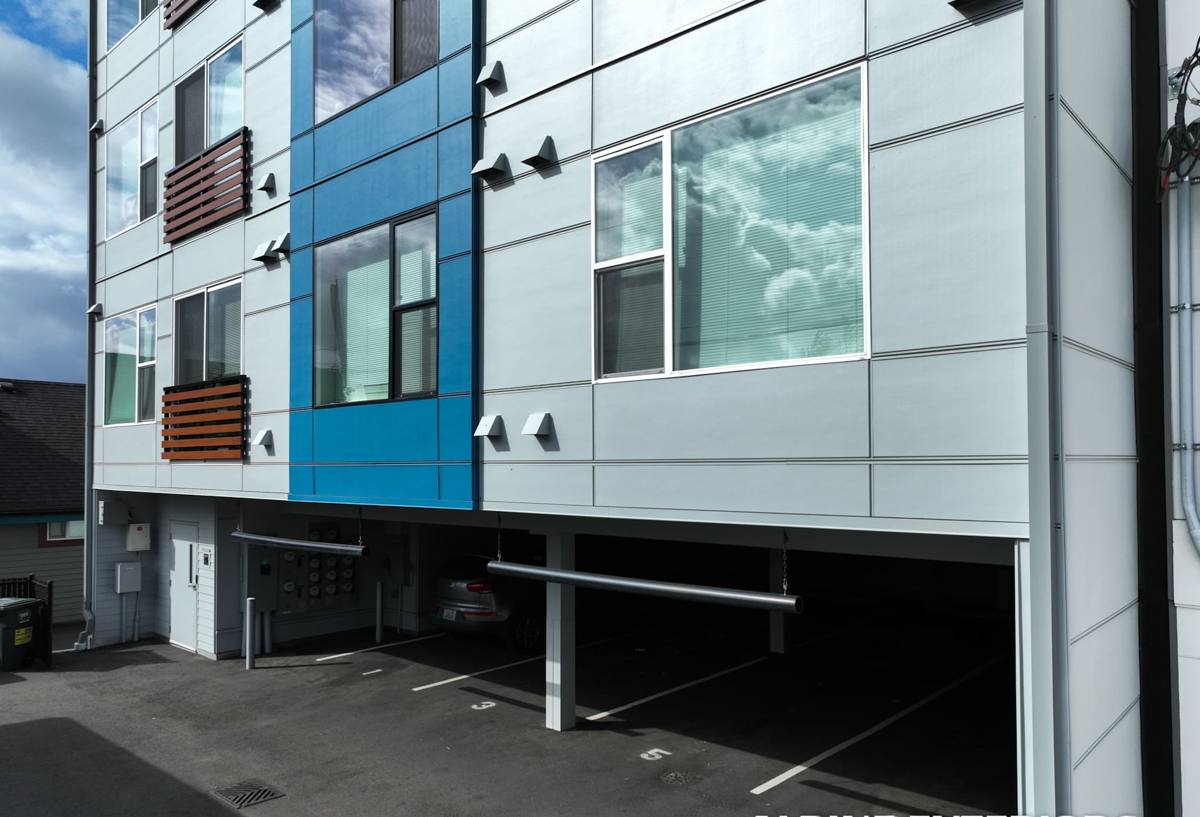
What Barkley Homes Are Actually Fighting
Salt Air and Metal Fatigue
Proximity to the bay means airborne salt settles on exterior surfaces and accelerates corrosion on unprotected fasteners, flashing, and trim. Siding systems that rely on exposed metal components or fasteners that aren't rated for coastal exposure will show rust streaks and premature wear years before an inland install would.
Driving Rain and Wall Assembly Moisture
Wind off the water pushes rain sideways into wall assemblies, not just down the face of the siding. Any gap in flashing, any caulk joint doing the job a proper drainage plane should be doing, becomes a path for water to get behind the cladding. Once moisture is behind the siding instead of in front of it, the problem stops being cosmetic.
Moss, Algae, and Shade
Tree cover and cooler, damp shoulder seasons mean moss and algae growth on north-facing and shaded walls is a near-guarantee over time, regardless of material. The question isn't whether organic growth will appear — it's whether the siding and finish can be cleaned without damage, and whether the substrate underneath is sealed well enough that moss roots and moisture don't work their way into the material itself.
Why Fiber Cement Specifically Answers These Problems
James Hardie's HZ5 product line is engineered for wetter, harsher climates like ours, with a formulation intended to resist moisture-related damage better than the standard HZ10 line used in milder regions. That distinction matters more in Barkley than it would twenty miles inland. The ColorPlus factory finish is baked on and cured under controlled conditions, which gives it far better adhesion and UV/moisture resistance than a field-applied coat — and it means the finish isn't relying on caulking bay-air humidity to keep it stable.
Fiber cement is also non-combustible, which is a separate but real consideration for homes near dry brush or with wood decks and fences nearby. It won't rot, it won't feed pests the way untreated wood-based siding can, and it holds paint or factory finish far longer than wood siding exposed to this much moisture cycling.
What a Correct Installation Involves
The material only performs as designed if the installation matches James Hardie's engineering. This is the part that separates a siding job that lasts twenty-plus years from one that fails at the seams in five. On every Barkley job we run through the same non-negotiables:
- A drainage plane and rainscreen gap behind the siding so any moisture that does get past the cladding has somewhere to go instead of sitting against the wall sheathing
- Correct fastener spacing, type, and embedment depth per Hardie's installation specs — not shortcuts based on what's fastest
- Proper flashing at every window, door, and roofline intersection, installed to shed water outward rather than relying on sealant alone
- Manufacturer-specified clearances from grade, roof lines, and decks so splash-back and standing moisture don't sit against the bottom course
- Butt joints and seams treated correctly so they don't become the first failure point in driving rain
- Corrosion-resistant fasteners and trim components suited to coastal-adjacent exposure
Skipping any one of these doesn't show up on day one. It shows up in year three or four as a stain, a soft spot, or a seam that's started to separate — usually on the wall that takes the worst of the weather, which in Barkley is often the west or southwest-facing side that catches storms rolling in off the water.
How the Process Works
1. On-Site Assessment
We look at the whole wall assembly, not just the visible siding — existing moisture damage, current flashing condition, window and door detailing, and which elevations are taking the worst exposure. Barkley homes with mature tree cover get an added look at moss and algae patterns on shaded walls.
2. Scope and Product Selection
We spec the right Hardie profile (lap, shingle-style panel, or board-and-batten depending on the home) and confirm HZ5 climate-engineered product where the exposure calls for it, along with a ColorPlus finish selection that fits the home and holds up to marine UV and salt exposure.
3. Tear-Off and Wall Prep
Old siding comes off, the sheathing gets inspected for hidden moisture damage before anything new goes on, and the drainage plane and rainscreen system go in correctly the first time. This step is where most corners get cut on lower-quality jobs, and it's the step that determines whether the siding lasts.
4. Installation to Spec
Fastening, flashing, clearances, and joint treatment all follow James Hardie's published installation guidelines, not a generalized approach borrowed from other siding types.
5. Final Walkthrough
We walk the finished job with the homeowner, covering what correct maintenance looks like for this specific climate and what to watch for over the first few seasons.
Comparing Siding Materials for a Barkley Exterior
| Factor | James Hardie Fiber Cement | Vinyl | Wood / Cedar |
|---|---|---|---|
| Salt air / coastal exposure | Engineered HZ5 option for wetter climates | Can become brittle and discolored over time | Vulnerable to accelerated weathering |
| Driving rain resistance | Strong when installed with proper rainscreen and flashing | Prone to gaps and warping at seams over time | Absorbs moisture without heavy maintenance |
| Moss / algae on shaded walls | Cleanable factory finish, sealed substrate | Can trap moisture behind panels | Susceptible to rot if moss roots into grain |
| Finish longevity | Factory-baked ColorPlus finish | Color molded in, but fades and chalks with UV/salt | Requires repainting/staining on a recurring cycle |
| Fire resistance | Non-combustible | Can soften or melt under heat exposure | Combustible |
Maintenance in a Whatcom County Climate
Fiber cement is low-maintenance, not no-maintenance. In Barkley's climate, that means an annual rinse-down on shaded or moss-prone walls, keeping gutters and downspouts clear so runoff isn't dumping directly onto siding, and keeping vegetation trimmed back from exterior walls so airflow can help walls dry between rain events. A correctly installed system with proper clearances makes all of this easier — siding sitting too close to grade, decking, or roof lines will hold moisture and grow moss faster no matter how good the material is.
Caulking and paint touch-ups, where needed, should use products compatible with the ColorPlus finish. This is a case where using the wrong sealant or an incompatible touch-up paint can actually undermine a finish that would otherwise last decades.
Why a Crew That Already Works Barkley Matters
Installation quality is what determines whether fiber cement siding delivers on its twenty-to-thirty-year performance expectations or fails early. A crew that already works homes in and around Barkley knows which elevations catch the worst of the wind-driven rain off the bay, how moss behaves on the shaded lots common in this part of Bellingham, and where salt exposure tends to concentrate corrosion on fasteners and trim. That's knowledge that shows up in the small decisions — flashing details, fastener choice, clearance heights — that a generic install crew working from a national spec sheet alone might miss.
We stand behind our work with installation practices that match James Hardie's requirements, which keeps the manufacturer's warranty intact and gives homeowners a siding system actually built for what this specific location throws at it.
If you're planning a siding project in Barkley or elsewhere in Bellingham, we're happy to take a look at your home and walk you through what correct fiber cement installation looks like for your specific exposure. Use the form below for a free, no-pressure estimate.