 Bellingham Siding
 Why Decks in Happy Valley Wear Out Faster Than Homeowners Expect
Happy Valley is one of Bellingham's older, tree-shaded residential neighborhoods, and that mature tree canopy is part of what makes it a nice place to live — but it's also part of what shortens the life of an exposed wood deck. Overhead branches drop needles, leaves, and pollen into deck boards where they trap moisture against the wood. Combine that with Whatcom County's long, wet fall-through-spring season and the salt-tinged air drifting in off Bellingham Bay, and you have a near-constant cycle of dampness, drying, and re-dampness that most decking materials were never built to handle indefinitely.
Moss is usually the first visible symptom. It doesn't just make a deck slippery — it holds water directly against the board surface for weeks at a time, which is exactly the condition that accelerates rot in wood and coating failure on composite caps. By the time a homeowner notices soft spots, gaps opening between boards, or rust streaks from old fasteners, the underlying structure has often been quietly degrading for a couple of seasons already.
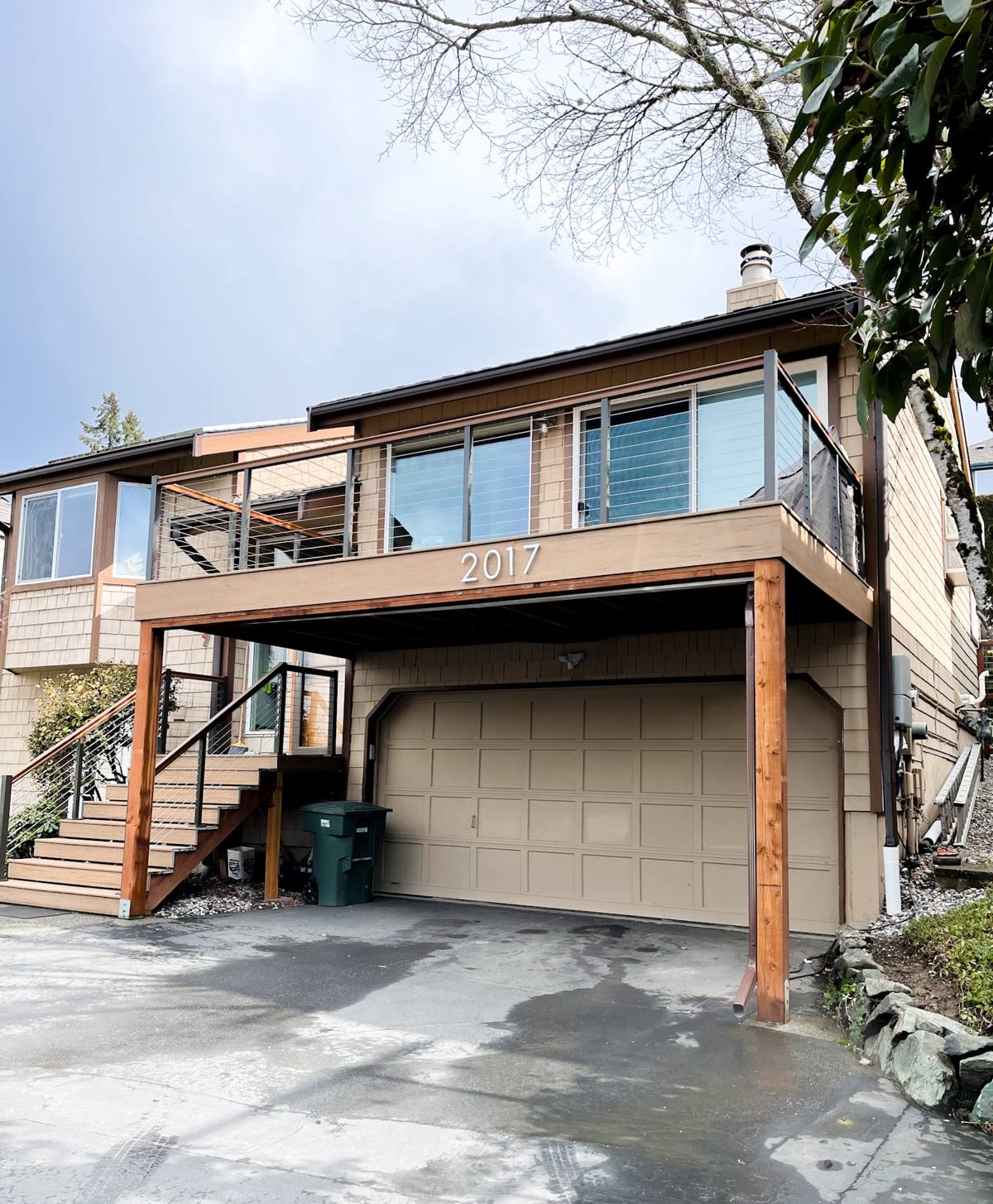
Repair or Replace? Signs Your Deck Has Reached the End
Not every deck problem means a full replacement. A few loose boards, surface graying, or a railing that's come loose from its posts can often be fixed. Replacement becomes the honest recommendation when the issues are structural rather than cosmetic.
Warning signs worth taking seriously
- A screwdriver sinks into the ledger board, joists, or posts with light pressure — a sign of interior rot
- Boards feel spongy or bounce noticeably underfoot, especially near the house
- Gaps between the deck and the house siding, or staining on the siding above the ledger board
- Persistent moss or algae that regrows within weeks of cleaning, even after treatment
- Fasteners that are rusted, backing out, or leaving black stains around the screw heads
- Railings or stair stringers that flex or feel less solid than they did a couple of years ago
If more than one of these shows up at the same time, it's usually a sign the deck's structural life, not just its surface, is running out — and patching individual boards just delays a full rebuild while masking the bigger issue.
What a Correct Deck Replacement Actually Involves
A deck that looks good in photos but was assembled without attention to moisture management will fail early in this climate, regardless of how nice the decking boards are. The parts that matter most are the ones you don't see once the project is finished.
The ledger board and flashing
The ledger board — where the deck attaches to the house — is the single most common failure point on Pacific Northwest decks, because it's the one piece of the structure that's bolted directly to your home's framing and sits at the exact spot where water runs off the deck surface. Proper flashing (metal flashing plus a self-adhering waterproof membrane behind it) keeps water from tracking behind the siding and into the house framing. This is not an optional upgrade; it's the difference between a deck that lasts and one that quietly rots your wall sheathing from the inside.
Framing and structural spacing
Joists sized and spaced correctly for the decking material you choose, proper joist tape or flashing on top of each joist, and adequate airflow underneath the deck all matter more in a wet climate than in a dry one. Undersized or overspanned framing is a common shortcut on older decks and one of the reasons a "replacement" sometimes needs to include new footings, not just new boards.
Fasteners and hardware
Coastal air with salt content will corrode standard fasteners faster than inland areas. Hot-dip galvanized or stainless steel hardware, structural connectors rated for exterior use, and fasteners matched to whatever decking material is chosen all reduce the rust staining and hardware failure that's common on older Bellingham-area decks.
Decking Material Options for Happy Valley's Climate
There's no single "best" decking material — there's a best material for your budget, your shade level, and how much upkeep you're realistically going to do. Given Happy Valley's tree cover and the region's moss-friendly dampness, low-maintenance shouldn't be treated as a luxury upgrade; it's a practical response to the site conditions.
| Material | Moss & Moisture Behavior | Maintenance | Typical Lifespan |
|---|---|---|---|
| Pressure-treated wood | Absorbs moisture readily; needs sealing to resist rot and moss growth | Annual cleaning and re-sealing recommended | 10–15 years with upkeep |
| Cedar | Naturally rot-resistant but still needs sealing in shaded, damp spots | Periodic cleaning and refinishing | 15–20 years with upkeep |
| Capped composite (e.g. Trex, TimberTech) | Won't rot or absorb water into the core; surface can still grow moss if never cleaned | Occasional washing, no sealing or staining | 25–30 year manufacturer warranties common |
| PVC decking | Fully synthetic, most resistant to moisture and moss buildup | Lowest maintenance of the options | Similar to or longer than composite |
We install both quality wood and low-maintenance composite/PVC systems and will talk through the honest trade-offs for your specific yard — how much sun the deck gets, whether it sits under trees, and how much time you want to spend cleaning it every year — rather than pushing one product line by default.
Our Deck Replacement Process
1. On-site assessment
We start by getting under the deck and testing the framing, ledger connection, and posts directly, rather than just looking at the surface boards. This tells us honestly whether you need a full tear-out or whether the structure underneath is salvageable.
2. Permitting
Deck replacement in the City of Bellingham and unincorporated Whatcom County generally requires a building permit once you're rebuilding the structure, not just swapping boards on an existing frame. We handle that paperwork so you're not the one chasing it down.
3. Demolition and disposal
Full removal of the old decking, railings, and any compromised framing, with debris hauled off — you're not left with a pile of old lumber in the yard.
4. Ledger flashing and framing
New or reinforced ledger board with proper flashing and membrane, correctly spaced and sized joists, and code-compliant footings and post connections.
5. Decking, railing, and stairs
Installation of your chosen decking material with proper fastener spacing and gapping to allow for seasonal wood movement and drainage, followed by railings and stairs built to current code.
6. Final walkthrough
We walk the finished deck with you, point out anything you should know about maintenance for the material you chose, and make sure you're comfortable with the result before we consider the job done.
Why a Crew That Already Works Happy Valley Makes a Difference
Happy Valley's lots often combine mature trees, sloped yards, and older homes built before current flashing standards were common practice. A crew that's already worked in the neighborhood has a feel for the site conditions before the first board comes up — how the drainage tends to behave on the hillier lots, how much shade a given yard actually gets through the year, and what kind of ledger and flashing problems tend to show up on homes of a certain age in this area.
There's also a practical logistics side to it: knowing the local permitting process at Whatcom County and City of Bellingham offices, having a track record with local inspectors, and being close enough to actually show up promptly if something needs a follow-up visit after the job is done. A crew that treats a Happy Valley deck the same as a job three counties away doesn't have that local context, and it shows in the details.
What Affects the Cost of a Deck Replacement
| Factor | How It Affects Cost |
|---|---|
| Deck size and shape | Larger decks and multi-level or angled designs require more material and labor |
| Decking material | Pressure-treated wood costs less upfront; composite and PVC cost more initially but less over time |
| Structural condition | Rotted framing, footings, or ledger connections add cost beyond simple board replacement |
| Railing and stair complexity | Custom railings, multiple stair runs, or code-required guard heights add labor |
| Site access | Sloped yards, tree removal for clearance, or tight side-yard access can add time |
| Permitting requirements | Full rebuilds requiring permits and inspections add time to the schedule, not just cost |
We give a written, itemized estimate after the on-site assessment so you know what you're paying for and why — not a single number with no explanation behind it.
Keeping a New Deck in Good Shape Through Whatcom County Winters
Even a well-built deck benefits from a little seasonal attention, especially in a climate where moss has months to establish itself before summer sun dries things back out.
- Sweep leaves and debris off the deck regularly in fall, especially between boards where they collect
- Wash the surface at least once a year to prevent moss and algae from taking hold
- Trim back overhanging branches to improve airflow and sun exposure where practical
- Check railings and stair connections annually for looseness
- For wood decks, re-seal on the manufacturer's recommended schedule rather than waiting until it looks dry
- Keep gutters and downspouts near the deck clear so runoff isn't draining directly onto or under it
If you're in Happy Valley and your deck is showing its age, we're happy to take a look and give you a straight answer about whether it needs a full replacement or just targeted repairs. Reach out for a free, no-pressure estimate using the form below.